July 14, 2026
How to Improve Your Online Presence and Turn Visibility Into Business Growth
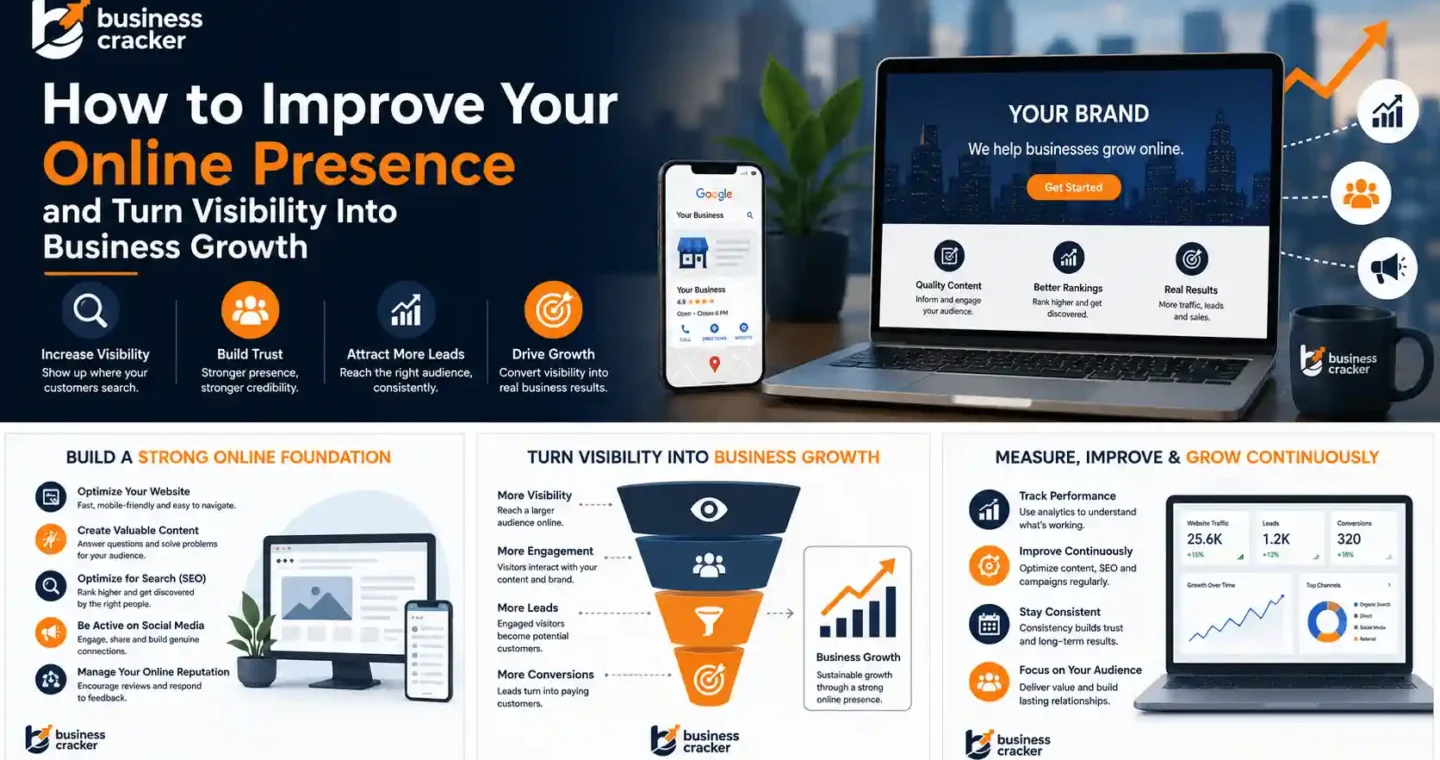
Your business may already have a website, several social media accounts, a Google Business Profile, and a few directory listings.
That does not necessarily mean you have a strong online presence.
A business has a strong online presence when the right people can find it, understand what it offers, trust its credibility, and take a meaningful next step. That next step might be calling your team, requesting a proposal, booking an appointment, subscribing to your email list, or purchasing a product.
The challenge is that many businesses focus only on the first part of that journey: getting seen.
They publish content without a conversion path. They run ads without fixing weak landing pages. They collect website traffic without measuring lead quality. They create social profiles but fail to connect those profiles to a larger customer acquisition strategy.
At Business Cracker, we approach online presence as a connected business growth system. Your website, SEO, content, backlinks, reviews, social media, paid campaigns, and brand reputation should work together instead of operating as separate marketing activities.
This guide explains how to improve your online presence, diagnose what is holding your business back, prioritize the right channels, and turn digital visibility into measurable business results.
What Is an Online Presence?
Your online presence is the complete picture people see when they search for, research, compare, or interact with your business online.
It includes more than your website.
A complete online presence may include:
- Your website and landing pages
- Organic search results
- Google Business Profile
- Social media profiles
- Online reviews
- Business directory listings
- News and media mentions
- Backlinks from other websites
- Videos and podcasts
- Email communications
- Paid search and social advertisements
- Customer discussions on forums and communities
- Brand mentions in AI-generated search results
A strong online presence should help a prospective customer answer five questions:
- Is this business relevant to my problem?
- Does it appear credible?
- Can it provide the service or product I need?
- Is it a better choice than the alternatives?
- What should I do next?
If your digital channels do not answer those questions clearly, more traffic may not solve the problem.
Why a Strong Online Presence Matters in 2026
The size of the online audience is only part of the story.
The Digital 2025 Global Overview Report reported that 5.56 billion people were using the internet at the start of 2025, representing 67.9 percent of the global population.
However, customers do not discover businesses through one channel.
The same report found that the typical adult internet user discovers brands and products through an average of 5.8 different sources. Search engines were the leading individual source, but they were cited by only 32.8 percent of respondents. No single channel reached more than one-third of users.
This means your business cannot rely entirely on one source of visibility.
SEO may introduce someone to your company. Reviews may determine whether they trust you. Social media may provide evidence that your business is active. Your website may answer their questions. A case study may reduce risk. An email may bring them back when they are ready to buy.
The businesses that perform well online create consistency across the entire journey.
Diagnose Your Online Presence Problem Before Choosing a Strategy
Before investing in another website redesign, SEO campaign, social media plan, or advertising channel, identify what is actually broken.
Different symptoms require different solutions.
Your Business Gets Little or No Website Traffic
Likely causes
Your website may have:
- Weak keyword targeting
- Limited search visibility
- Technical SEO issues
- Thin or outdated content
- Poor local search optimization
- Few authoritative backlinks
- Pages that search engines cannot crawl or index
- No content distribution strategy
What to fix first
Start with an SEO and website audit.
Review:
- Google Search Console performance
- Indexed and excluded pages
- Technical errors
- Keyword rankings
- Competitor rankings
- Existing content quality
- Service-page structure
- Internal links
- Backlink quality
- Google Business Profile visibility
A structured SEO service can help you identify whether the primary issue involves technical SEO, content, search intent, local SEO, or off-page authority.
Your Website Gets Traffic but Generates Few Leads
Likely causes
The problem may not be visibility. It may be conversion.
Common causes include:
- An unclear value proposition
- Generic service descriptions
- Weak calls to action
- Poor mobile usability
- Missing trust signals
- Complicated forms
- Slow page loading
- A mismatch between search intent and page content
- No pricing or process guidance
- Poor conversion tracking
What to fix first
Review what happens after a visitor reaches the website.
Ask:
- Can visitors understand what we do within five seconds?
- Is the service relevant to the keyword or advertisement that brought them here?
- Is the next step obvious?
- Is there enough proof to reduce risk?
- Does the form work properly?
- Are calls, forms, bookings, and purchases being tracked?
Our guide to website design for SEO and conversions explains why traffic, design, trust, and conversion paths must work together.
Your Website Ranks, but the Leads Are Poor Quality
Likely causes
You may be targeting keywords that generate traffic without strong commercial relevance.
For example, a software development company may rank for broad educational searches while failing to appear for searches related to custom software development, application modernization, SaaS development, or dedicated engineering teams.
What to fix first
Map keywords to customer intent.
Separate your target queries into:
- Informational intent
- Commercial research
- Comparison intent
- Transactional intent
- Local intent
- Branded intent
Then create a suitable page for each important intent.
A blog post can answer a broad question. A service page should explain a commercial solution. A comparison page should help buyers evaluate options. A landing page should support a specific campaign or offer.
Do not expect one page to satisfy every stage of the buying journey.
Customers Find You but Do Not Trust You
Likely causes
Your business may have:
- Too few reviews
- Old or unanswered reviews
- Inconsistent business information
- Weak case studies
- No visible team or author information
- An outdated website
- Inactive social profiles
- No transparent process
- Poor branded search results
- Missing policies or contact information
What to fix first
Audit every trust point a customer may check before contacting you.
This includes:
- Your website
- Google reviews
- Social media
- Business directories
- Industry-specific review platforms
- Branded Google searches
- Founder or leadership profiles
- Customer testimonials
- Case studies
- Contact details
- Privacy, refund, or service policies
A structured online reputation management strategy can help connect review management, brand monitoring, social trust, and website credibility.
12 Ways to Improve Your Online Presence
The following strategies are designed to work together. You do not need to implement all of them at once. Choose the actions that address your most important business constraint.
1. Define Your Audience, Offer, and Market Position
A business cannot build a clear online presence without clear positioning.
Before choosing keywords, redesigning pages, or creating content, answer these questions:
- Who is the ideal customer?
- What problem are they trying to solve?
- What triggers them to search for help?
- What alternatives are they comparing?
- What outcome are they willing to pay for?
- Why should they choose your company?
- What proof would reduce their perceived risk?
- What action should they take next?
Avoid descriptions such as:
We provide innovative, high-quality solutions for businesses of all sizes.
That statement could describe thousands of companies.
A stronger message is specific:
We help B2B software companies improve organic visibility and build relevant backlinks to service pages that need stronger authority.
The second version identifies the customer, service, problem, and business outcome.
Clear positioning improves your website copy, SEO keyword selection, advertisements, outreach, sales conversations, and content strategy.
2. Build a Website That Supports Discovery and Conversion
Your website is the part of your online presence that you control most directly.
Social platforms can change their algorithms. Advertising costs can increase. Review platforms can update their policies. Your website remains your primary owned digital asset.
A professional website should:
- Explain what your business does
- Identify who the service is for
- Show which problems you solve
- Present separate pages for important services
- Establish credibility
- Work well on mobile devices
- Load quickly
- Make contacting the business easy
- Support search engine crawling
- Track meaningful actions
Build dedicated service pages
Do not place every service on one short, generic page.
A digital marketing company may need separate pages for:
- SEO
- Link building
- Performance marketing
- Web design
- Social media optimization
- Online reputation management
Dedicated pages give you more space to explain the service, answer customer questions, target relevant searches, present proof, and use a focused call to action.
Improve conversion paths
Each important page should have a clear next step.
Possible calls to action include:
- Request a consultation
- Ask for a website audit
- Book a product demonstration
- Get a project estimate
- Download a checklist
- Compare service options
- View a case study
- Talk to a specialist
Match the CTA to the visitor’s stage.
A person reading an educational guide may not be ready to request a proposal. A checklist, related guide, or newsletter may be more appropriate. A person visiting a high-intent service page may be ready to contact your team.
Professional web design services should connect appearance with usability, SEO readiness, trust, and lead generation.
3. Strengthen Your Technical SEO Foundation
A useful website cannot generate organic visibility if search engines cannot access, interpret, or index it correctly.
Technical SEO covers the behind-the-scenes elements that support search performance.
Review:
- Crawlability
- Indexability
- XML sitemaps
- Robots directives
- Canonical tags
- Redirects
- Mobile rendering
- HTTPS
- Page speed
- Core Web Vitals
- Structured data
- Broken links
- Duplicate content
- JavaScript rendering
- URL structure
- Internal linking
- Server errors
Google’s SEO Starter Guide explains that SEO helps search engines understand your content while helping users find your pages and decide whether to visit them. It also notes that Google frequently discovers new pages through links.
Use tools such as:
- Google Search Console
- PageSpeed Insights
- Google Lighthouse
- Screaming Frog
- Ahrefs
- Semrush
Our guide to technical SEO for business websites provides a more detailed explanation of crawlability, indexing, speed, redirects, canonicals, and structured data.
4. Create Content Around Customer Problems and Search Intent
Content should not exist only because your competitors publish blogs.
Every page should have a purpose.
Useful business content can:
- Attract qualified search traffic
- Explain a complex problem
- Help buyers compare options
- Reduce objections
- Demonstrate experience
- Support sales conversations
- Earn backlinks
- Generate email subscribers
- Strengthen topical authority
- Give AI search systems clear, useful source material
Google recommends creating helpful, reliable, people-first content instead of producing pages primarily to attract search engine visits. Google specifically warns against summarizing what others have already published without adding meaningful value.
Create content for different buying stages
Awareness content
Help readers understand the problem.
Examples:
- Why is my website not generating leads?
- What causes organic traffic to decline?
- Why are software projects delayed?
- What makes a backlink valuable?
Consideration content
Help readers explore possible solutions.
Examples:
- SEO versus paid advertising
- Custom software versus off-the-shelf software
- In-house marketing versus agency support
- Guest posting versus digital PR
Decision content
Help readers choose a provider or service.
Examples:
- How to choose an SEO agency
- How much does custom software development cost?
- What should a link-building proposal include?
- Questions to ask before redesigning a website
Retention content
Help existing customers get more value.
Examples:
- Product tutorials
- Implementation guides
- Maintenance checklists
- Reporting explanations
- Best-practice resources
Add information competitors do not provide
Premium content should contain something that could not have been created by copying the first page of Google.
Add:
- Firsthand observations
- Original frameworks
- Practical examples
- Screenshots
- Templates
- Calculators
- Decision trees
- Industry benchmarks
- Expert commentary
- Case studies
- Common failure patterns
- Step-by-step implementation guidance
Do not write to reach an arbitrary word count. Write until the reader has enough information to understand the problem and make a better decision.
5. Build Authority With Relevant Backlinks and Digital PR
Good content creates value on your website. Link building helps other websites discover, validate, and reference that value.
Google states that links are a crucial resource for discovering pages and connecting users with corroborating information.
However, link building is not about collecting the largest possible number of backlinks.
A useful backlink should be evaluated based on:
- Topical relevance
- Editorial quality
- Website credibility
- Page quality
- Organic visibility
- Placement context
- Anchor-text naturalness
- Destination-page relevance
- Referral potential
- Long-term risk
A link from a relevant industry publication to a strong service page or research asset can be more valuable than dozens of unrelated directory or guest-post links.
Effective link acquisition methods may include:
- Digital PR
- Expert commentary
- Original research
- Guest contributions
- Resource-page outreach
- Broken-link outreach
- Unlinked brand-mention reclamation
- Strategic partnerships
- Supplier or association links
- Podcast appearances
- Data-led content
- Linkable tools and templates
Business Cracker’s link-building services focus on relevance, editorial quality, strategic outreach, and long-term SEO value.
You can also review:
- What is link building in SEO?
- How to get high-quality backlinks
- Digital PR link building
- Custom link-building services, cost, and ROI
The goal is not to make your backlink report look busy. The goal is to strengthen the authority of pages that support important business searches.
6. Improve Your Local Search Presence
Local businesses need to be visible when nearby customers search for a service, location, product, or provider.
A strong local presence begins with a complete Google Business Profile.
Keep the following information accurate:
- Business name
- Address
- Phone number
- Website
- Opening hours
- Service areas
- Business category
- Products or services
- Appointment or booking links
- Photos
- Business description
You should also build consistent listings across relevant directories, maps, chambers of commerce, professional associations, and industry platforms.
Create useful location pages
A location page should provide more than a city name inserted into generic content.
Include:
- Services available in the location
- Areas served
- Local contact details
- Relevant customer examples
- Location-specific FAQs
- Directions or service boundaries
- Local proof
- Unique information about how you serve that market
Avoid creating dozens of nearly identical city pages solely to capture search traffic.
Connect local visibility with reputation
Local ranking is only one part of the decision.
After finding your profile, customers may examine your reviews, photos, website, recent posts, operating hours, and responses to complaints.
Local SEO and reputation management should support each other.
7. Build and Protect Your Online Reputation
Online reviews influence whether a customer feels safe choosing your business.
BrightLocal’s 2026 Local Consumer Review Survey found that Google remained the most-used individual review source, used by 71 percent of respondents. It also found that consumers were consulting an average of six review sites and that the use of AI tools for local recommendations had increased to 45 percent.
This means reputation is becoming more distributed.
Customers may examine:
- Trustpilot
- Yelp
- Better Business Bureau
- Industry review websites
- YouTube
- TikTok
- AI recommendation tools
- Your own website
Create a review management process
Your process should include:
- Asking real customers for honest feedback
- Providing a direct review link
- Monitoring new reviews
- Responding professionally
- Moving sensitive discussions to private channels
- Reporting only reviews that violate platform rules
- Tracking repeated service problems
- Using feedback to improve operations
Never purchase reviews or offer incentives that depend on positive sentiment.
The Federal Trade Commission’s rule on consumer reviews and testimonials addresses fake reviews, purchased reviews, undisclosed insider reviews, and incentives conditioned on review sentiment. The rule took effect on October 21, 2024.
Google also prohibits fake engagement, incentivized reviews, selective positive-review solicitation, and reviews that do not reflect genuine experiences.
For a complete operational process, read our ORM guide for small businesses.
8. Use Social Media as a Discovery and Trust Channel
Social media should not be treated as a daily posting requirement with no connection to business goals.
Use social media to:
- Help people discover the brand
- Demonstrate expertise
- Show recent work
- Distribute website content
- Answer customer questions
- Present customer proof
- Build professional relationships
- Drive traffic to owned assets
- Support recruitment
- Monitor customer sentiment
- Generate remarketing audiences
DataReportal reported 5.24 billion active social media user identities at the start of 2025. It also found that 50 percent of adult social media users visit social platforms to learn more about brands and view the content those brands publish.
Choose platforms based on audience behavior
Do not assume your company must be equally active everywhere.
For example:
- LinkedIn may suit B2B services, software companies, consultants, and professional audiences.
- Instagram may suit visually driven brands, hospitality, lifestyle services, retail, and design.
- YouTube may suit demonstrations, education, product comparisons, and complex services.
- Facebook may support local communities, established consumer audiences, and remarketing.
- TikTok may work for short-form education, entertainment, product discovery, and younger audiences.
Turn one idea into multiple formats
A strong article can become:
- A LinkedIn post
- A carousel
- A short video
- An email
- A sales resource
- A webinar topic
- A checklist
- Several short social posts
This creates consistency without forcing your team to develop every post from scratch.
Business Cracker’s social media optimization services focus on profile clarity, content direction, audience engagement, consistency, and brand visibility.
9. Build an Email Audience You Own
Search traffic and social followers are valuable, but your access to them depends on another company’s platform.
An email list is an owned audience.
Use email to:
- Nurture leads
- Share useful content
- Announce new products or services
- Educate prospects
- Re-engage inactive customers
- Request feedback
- Promote webinars
- Send product updates
- Support customer retention
- Drive repeat purchases
Offer a useful reason to subscribe
Generic newsletter invitations rarely perform well.
A more useful offer may include:
- An industry checklist
- A cost calculator
- A planning template
- A technical audit worksheet
- A buyer’s guide
- A case-study collection
- A benchmarking report
- A mini-course
- An implementation roadmap
Your email sequence should continue solving the problem that led the person to subscribe.
Do not add people to promotional lists without appropriate consent, and provide a clear unsubscribe process.
10. Use Paid Advertising for Speed, Testing, and Retargeting
SEO and content build compounding visibility, but they usually require time.
Paid campaigns can create faster exposure when your business has:
- A defined audience
- A clear offer
- A suitable landing page
- Reliable conversion tracking
- A realistic budget
- A follow-up process
Paid advertising can help you:
- Test demand
- Test messaging
- Promote a time-sensitive offer
- Reach high-intent searches
- Enter a new market
- Retarget previous visitors
- Promote a new product
- Support an event or launch
Paid traffic will not repair a weak offer or confusing website.
Before increasing advertising spend, verify:
- The advertisement matches the landing page
- The page loads quickly
- The offer is clear
- The CTA is specific
- Trust signals are visible
- Forms work
- Calls and submissions are tracked
- The sales team follows up promptly
- Lead quality is measured
Business Cracker’s performance marketing services connect campaign planning, audience targeting, remarketing, conversion tracking, and landing-page performance.
Our comparison of SEO versus paid advertising can help you decide when each channel makes sense.
11. Prepare Your Website for AI-Powered Search
Online presence now extends beyond traditional search-result pages.
Customers increasingly use AI-powered tools to research products, compare providers, understand complex topics, and find recommendations.
Google’s official guide to optimizing for generative AI search states that foundational SEO practices remain relevant for AI Overviews and AI Mode because these features are connected to Google’s core search ranking and quality systems. Google recommends creating original, non-commodity content, maintaining a clear technical structure, and publishing information that provides real value beyond common summaries.
To improve your chances of being understood and referenced:
- Publish original, expert-led content
- Keep business information accurate
- Use clear headings and page structure
- Explain products and services precisely
- Add firsthand examples
- Include authorship information
- Cite reliable sources
- Maintain crawlable pages
- Use useful structured data
- Publish clear comparison and FAQ content
- Earn legitimate external mentions
- Strengthen reviews and public discussions
- Update outdated information
Do not chase every new AI optimization hack.
Google says website owners do not need special AI files, tiny content chunks, or content rewritten solely for generative systems.
The strongest long-term approach is still to create accurate, distinctive, useful content that customers would value even if search engines did not exist.
Read our guide on how to optimize for AI-powered search for a more detailed AEO, GEO, and AI SEO framework.
12. Measure Business Outcomes, Not Marketing Activity
A business can increase impressions, followers, sessions, and backlinks without increasing revenue.
Measurement should connect marketing actions to customer behavior.
Visibility metrics
Track:
- Search impressions
- Keyword visibility
- Local search views
- Branded searches
- Referring domains
- Social reach
- Media mentions
- AI search visibility where measurable
Engagement metrics
Track:
- Engaged sessions
- Returning visitors
- Pages viewed
- Scroll depth
- Video engagement
- Email subscriptions
- Resource downloads
- Social interactions
Conversion metrics
Track:
- Qualified form submissions
- Phone calls
- Booked consultations
- Product purchases
- Demonstration requests
- Trial registrations
- Quote requests
- Newsletter signups
Commercial metrics
Track:
- Lead-to-customer rate
- Customer acquisition cost
- Cost per qualified lead
- Revenue by source
- Average order or contract value
- Return on advertising spend
- Sales cycle length
- Customer lifetime value
- Marketing-influenced pipeline
A useful report should explain:
- What changed?
- Why did it change?
- Did the change affect qualified demand?
- Which pages and channels contributed?
- What should the business do next?
Do not report ten new backlinks as a success unless those links support relevant pages, authority, rankings, referral traffic, or business visibility.
Do not report higher traffic as a success if the additional visitors have no connection to your target market.
Which Online Presence Channel Should You Prioritize First?
Your priorities depend on your current business stage.
| Business situation | First priorities |
| New business with limited digital presence | Positioning, website, essential service pages, analytics, Google Business Profile |
| Website receives little organic traffic | Technical SEO, keyword mapping, content improvement, internal links, link building |
| Website receives traffic but few leads | Messaging, conversion paths, trust signals, landing pages, tracking |
| Local business needs more calls | Google Business Profile, local SEO, reviews, local pages, citations |
| Business depends too heavily on ads | SEO, content, email, authority building, organic landing pages |
| Paid campaigns are underperforming | Offer review, targeting, landing pages, conversion tracking, lead quality |
| Established brand wants more authority | Digital PR, expert content, original research, strategic link building |
| Business has reputation problems | Review audit, response system, listing cleanup, ORM, service recovery |
| Business wants AI search visibility | Strong SEO foundation, original content, accurate entity information, public authority signals |
The most common mistake is choosing a channel based on popularity instead of the business constraint.
A company with broken website forms does not need more traffic first.
A company with a strong website but no visibility may need SEO and distribution.
A company with good rankings but weak trust may need reviews, case studies, and reputation management.
A 90-Day Plan to Improve Your Online Presence
You do not need to rebuild your entire digital presence in one month.
Use the following sequence to address the foundation first.
Days 1 to 30: Diagnose and Repair the Foundation
Week 1: Establish the baseline
- Review website traffic
- Review Search Console data
- Check rankings
- Audit lead sources
- Review paid campaign performance
- Search for the brand name
- Review social profiles
- Review online ratings
- Compare key competitors
Week 2: Fix tracking
Set up or verify tracking for:
- Forms
- Calls
- Email clicks
- WhatsApp clicks
- Purchases
- Bookings
- Downloads
- Newsletter subscriptions
- Paid campaign conversions
Week 3: Improve priority pages
Start with:
- Homepage
- Main service pages
- Highest-traffic landing pages
- Contact page
- Important local pages
- Pages receiving paid traffic
Improve messaging, CTAs, proof, headings, internal links, mobile layout, and page speed.
Week 4: Correct technical and profile issues
- Fix indexing problems
- Repair broken links
- Update redirects
- Submit or review the sitemap
- Correct business information
- Complete social profiles
- Improve Google Business Profile
- Respond to important reviews
Days 31 to 60: Build Visibility and Trust
Focus on:
- Search-intent keyword mapping
- Updating underperforming content
- Publishing high-value content
- Improving internal links
- Adding case studies
- Collecting genuine customer reviews
- Sharing content through relevant social channels
- Building email capture points
- Beginning outreach to relevant publications and websites
Choose quality over publishing volume.
One detailed, original guide supported by outreach can create more value than ten short articles that repeat common advice.
Days 61 to 90: Expand Authority and Conversion
Focus on:
- Strategic link acquisition
- Digital PR
- Expert contributions
- Landing-page testing
- Remarketing
- Email nurturing
- Content repurposing
- Competitor-gap analysis
- Conversion-rate improvements
- Lead-quality reviews
- Budget reallocation
At the end of 90 days, compare performance with your original baseline.
Identify:
- Which channels generated qualified leads?
- Which pages improved?
- Which pages still underperform?
- Which content attracted links or engagement?
- Which campaigns wasted budget?
- Which customer objections remain unresolved?
Use those answers to create the next 90-day plan.
Common Online Presence Mistakes to Avoid
Trying to Be Active on Every Platform
You do not need to publish daily on six social networks.
Choose the channels where your customers research, compare, and communicate.
Publishing Generic AI Content at Scale
AI can support research, organization, editing, and ideation. It should not replace expertise, firsthand knowledge, fact-checking, or editorial judgment.
Content that merely restates existing articles gives readers little reason to trust, share, or reference it.
Focusing Only on Traffic
Traffic is useful only when it contributes to awareness, qualified demand, customer relationships, or revenue.
Buying Low-Quality Backlinks
Irrelevant or manipulated links may create risk without improving meaningful visibility.
Build links for relevance, authority, referral potential, and page support.
Redesigning Without Protecting SEO
Changing URLs, navigation, internal links, page titles, or content without an SEO migration plan can damage existing visibility.
Treating Reviews as a One-Time Campaign
Review collection and response management should be part of regular operations.
Running Ads Before Fixing the Landing Page
More paid traffic will often make a conversion problem more expensive.
Ignoring Follow-Up
A marketing campaign may generate leads, but slow or inconsistent sales follow-up can prevent those leads from becoming customers.
Online presence does not end when the form is submitted.
Online Presence Audit Checklist
Use this checklist to evaluate your current position.
Website
- Is the value proposition clear?
- Does every important service have a dedicated page?
- Is the website easy to use on mobile?
- Are CTAs specific and visible?
- Are forms working?
- Are trust signals present?
- Does the website load quickly?
- Is contact information easy to find?
SEO
- Can search engines crawl and index important pages?
- Are keywords mapped to appropriate pages?
- Does content match search intent?
- Are titles and headings descriptive?
- Are internal links supporting priority pages?
- Is the sitemap accurate?
- Are technical errors being monitored?
Content
- Does the content answer real customer questions?
- Does it provide original value?
- Is outdated content being improved?
- Are content assets connected to services?
- Is there content for awareness, consideration, and decision stages?
Authority
- Is the website earning relevant backlinks?
- Are important commercial pages supported?
- Are brand mentions being monitored?
- Is outreach focused on relevant websites?
- Does the business have linkable assets?
Local presence
- Is the Google Business Profile complete?
- Is business information consistent?
- Are local pages useful and unique?
- Are reviews recent?
- Are local citations accurate?
Reputation
- Are reviews monitored and answered?
- Are recurring complaints tracked?
- Are genuine customers asked for feedback?
- Are social comments and mentions monitored?
- Do branded search results support trust?
Measurement
- Are leads and sales tracked?
- Is lead quality reviewed?
- Can revenue be connected to marketing sources?
- Are reports focused on decisions?
- Does the team know which channel to improve next?
How Business Cracker Helps Businesses Build a Stronger Online Presence
At Business Cracker, we do not treat online presence as a collection of unrelated activities.
A business may need better SEO, but SEO cannot perform at its best if the website is weak.
A business may need link building, but links will have limited value if the target pages do not match search intent.
A business may need paid advertising, but advertising will waste budget if tracking and landing pages are poor.
A business may need reputation management, but reviews alone cannot compensate for a confusing offer or inconsistent customer experience.
Our digital marketing services connect:
- SEO
- Link building
- Social media optimization
- Performance marketing
- Website design
- Online reputation management
The right strategy depends on your growth stage, target customers, competition, website condition, sales process, and available resources.
If you are unsure where your online growth is getting stuck, contact Business Cracker for a practical review of your website, search visibility, authority, paid campaigns, and digital trust.
Final Thoughts
Improving your online presence is not about creating more accounts, publishing more often, or chasing every new marketing tactic.
It is about building a connected system that helps the right customer:
- Discover your business
- Understand your solution
- Trust your expertise
- Compare you favorably
- Take action
- Become a customer
- Return or recommend you
Start by diagnosing the biggest constraint.
If customers cannot find you, improve visibility.
If they find you but do not understand you, improve positioning and website clarity.
If they understand you but do not trust you, improve reviews, proof, and reputation.
If they trust you but do not convert, improve the offer, CTA, landing page, and follow-up process.
The goal is not simply to become more visible online. The goal is to build a digital presence that supports qualified leads, stronger customer relationships, and sustainable business growth.
Frequently Asked Questions
What is the best way to improve an online presence?
The best starting point depends on what is currently limiting growth. Businesses with low visibility should prioritize SEO, content, local search, and authority. Businesses with traffic but few leads should prioritize website messaging, conversion paths, trust signals, and tracking.
How long does it take to build a strong online presence?
Some improvements, such as correcting business information, improving CTAs, or launching paid campaigns, can create results quickly. SEO, content authority, link building, reputation growth, and email audience development usually require consistent work over several months.
Does a small business need a website to build an online presence?
A business can appear on social platforms or maps without a website, but a professional website provides greater control over branding, service information, content, lead generation, analytics, and customer journeys. It also acts as the central owned asset connecting other digital channels.
How does SEO improve online presence?
SEO helps search engines crawl, understand, and rank website pages for relevant searches. A complete SEO strategy may include technical SEO, keyword research, content optimization, local SEO, internal linking, and backlink development.
Are social media followers important for online presence?
Follower count alone is not a reliable measure of business impact. Audience relevance, profile credibility, engagement quality, website traffic, leads, customer conversations, and content distribution are more useful measures.