
May 25, 2026
ORM Guide for Small Businesses
Small businesses often think that online reputation becomes important only after a bad review appears. That is the wrong time to start thinking about it.
For a small business, reputation is not only what people say after buying. It is what potential customers see before they call, visit, book, or fill out a form. Google reviews, social media comments, business directory listings, Reddit discussions, review sites, local search results, and even old unanswered complaints can influence the decision.
That is why ORM for Small Business matters. ORM, or online reputation management, is the process of monitoring, improving, and protecting how a business appears online. It includes review management, negative review management, customer response systems, brand mention tracking, local profile cleanup, social reputation, and trust-building content.
Small businesses do not need complicated reputation theory. They need a working system that helps them spot problems early, respond properly, collect genuine reviews, and protect trust across platforms.
The Problem This Article Solves
Many small businesses are visible online, but not fully in control of their reputation.
A customer may leave a poor review on Google. A competitor may post suspicious negative reviews. A frustrated buyer may complain publicly on Facebook or Instagram. A directory may show old business details. A business may have good service in real life, but weak star ratings online. In some cases, a single negative review can appear on the first screen of branded search results and influence new customers before the business gets a chance to explain.
Recent small business and Google Business Profile discussions show practical concerns. Business owners are asking how to remove false Google reviews, what to do when reviews look fake, and how to respond without sounding defensive. One business owner described a review as false and harmful, while others advised that even negative reviews can become an opportunity to show how the business handles issues publicly.
That is the real ORM problem for small businesses. It is not just about removing bad reviews. It is about building enough credibility that one bad review does not define the brand.
Desired Reader Outcome
After reading this guide, you should be able to:
- Understand what online reputation management means for a small business
- Know which reputation signals affect customer trust
- Build a basic review management process
- Handle negative reviews without making the situation worse
- Identify when a review may be eligible for removal
- Connect ORM with SEO, social media, and business visibility
- Decide when professional ORM services are needed
Why ORM Matters for Small Businesses in 2026
Reviews are no longer a small trust signal. Many local and service-based businesses, they are part of the buying process.
BrightLocal’s 2026 Local Consumer Review Survey found that 47 percent of consumers will not use a business with fewer than 20 reviews, 74 percent only care about reviews written in the last three months, and 31 percent will only use a business with a 4.5-star rating or higher. It also found that 85 percent of people are more likely to use a business after reading positive reviews, while negative reviews deter 77 percent of consumers.
For a small business, this creates a direct commercial risk. If the review profile is weak, outdated, or full of unanswered complaints, customers may choose a competitor before they ever speak with you.
This is why online reputation management for small businesses should not be treated as a damage-control activity. It should be part of regular business operations.
What Is ORM for Small Business?
ORM for Small Business is the process of managing how a small business appears across search engines, review platforms, social media, directories, and public web results.
It usually includes:
- Review monitoring
- Review response management
- Negative review management
- Fake review reporting
- Google Business Profile review management
- Social media comment monitoring
- Brand mention tracking
- Directory listing cleanup
- Reputation risk checks
- Customer feedback systems
- Trust-building content
- Public response planning
Good ORM does not mean hiding every negative comment. That approach is unrealistic and often harmful. Good ORM means showing that the business is active, accountable, responsive, and trustworthy.
ORM Is Not Only Review Removal
Many small businesses search for ORM services only when they want a negative review removed. That is understandable, but limited.
Some reviews can be reported. Some cannot. Google says businesses can report reviews that violate policy, but it also says not to report a review only because the business disagrees with it or dislikes it. Reviews that comply with policy may remain live even if the business believes the customer is being unfair.
This is why a proper ORM strategy includes both sides:
- Removal attempts for reviews that violate platform policies
- Professional response handling for reviews that stay live
A business that only tries to remove negative reviews may look defensive. A business that responds calmly, explains the situation, and shows accountability can often reduce the impact.
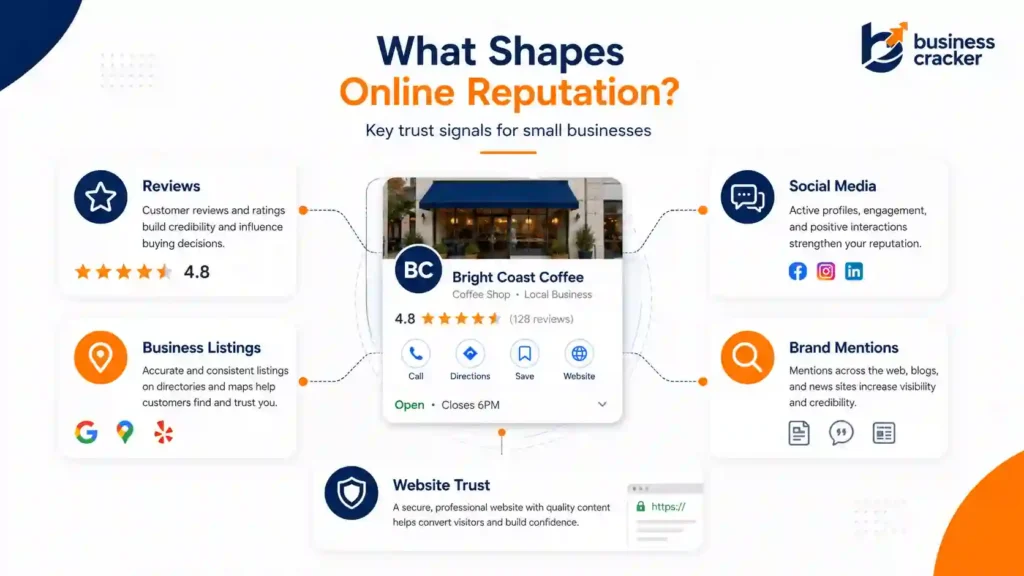
What Counts as Online Reputation?
Small businesses often think reputation means Google reviews only. That is too narrow.
Online reputation includes:
- Google Business Profile reviews
- Facebook recommendations
- Yelp reviews where relevant
- Trustpilot or industry review platforms
- Social media comments
- Branded search results
- Business directory listings
- Local citations
- Customer photos
- Reddit or forum mentions
- YouTube comments
- News mentions
- Blog mentions
- Employee reviews on relevant platforms
- Founder or owner visibility
- Case studies and testimonials
- Website trust signals
A small business reputation problem may start on one platform but influence another. For example, a customer may read Google reviews, check Instagram comments, visit the website, and then search the brand name again before calling.
That journey is not linear. ORM has to cover the full trust path.
The Main Reputation Problems Small Businesses Face
1. Negative Reviews That Stay Unanswered
An unanswered negative review can create more damage than the review itself.
When a business does not respond, users may assume the complaint is accurate or that the business does not care. A calm response shows that the business is paying attention.
A good response should:
- Acknowledge the concern
- Avoid public arguments
- Avoid sharing private customer details
- Explain the next step
- Invite the customer to continue privately
- Stay professional even if the review is unfair
Weak response:
“This is fake. You were rude and wrong.”
Better response:
“Thank you for sharing your concern. We take service feedback seriously and would like to review this properly. Please contact our team with your booking details so we can check the case and respond with the right context.”
The second response protects the business without escalating the issue.
2. Fake or Suspicious Reviews
Fake reviews are a serious issue for small businesses because one low rating can affect the average rating, local trust, and customer decisions.
Google’s review policy says contributions should reflect a genuine experience. It does not allow fake engagement, paid reviews, multiple-account manipulation, incentives in exchange for reviews, or competitor reviews intended to damage another business.
If a review appears suspicious, document the issue before reporting it.
Check:
- Is the reviewer in your customer records?
- Does the review mention a real service?
- Was there a booking, call, invoice, or email?
- Are multiple negative reviews appearing at once?
- Do the accounts look new or inactive?
- Are the claims vague or copied?
- Is there personal abuse, hate speech, spam, or conflict of interest?
- Is there evidence of extortion?
Google also provides a process for reporting inappropriate reviews and a Reviews Management Tool to check review status or submit an appeal when eligible.
Do not report every negative review as fake. The report only reviews those that appear to violate policy. For genuine negative feedback, respond professionally and improve the root issue.
3. Low Review Volume
A business with a 5-star rating but only three reviews may not look trustworthy enough. Customers now want both quality and volume.
BrightLocal’s 2026 data says 47 percent of consumers will not use a business with fewer than 20 reviews. This means small businesses need continuous review collection, not occasional review requests.
A small business should request reviews regularly from real customers after successful service delivery.
Good review request moments include:
- After a completed service
- After product delivery
- After a positive customer support interaction
- After repeat purchase
- After project completion
- After an in-person visit
- After a customer sends positive feedback privately
Keep the request simple. Do not pressure the customer. Do not offer incentives for positive reviews.
4. Old Reviews That No Longer Reflect the Business
A business may have improved its service, staff, process, or delivery quality, but old negative reviews may still influence users.
Review recency matters. BrightLocal found that 74 percent of consumers only care about reviews written in the last three months.
This is important for small businesses that have changed ownership, improved operations, hired better staff, changed vendors, or fixed past service problems.
The solution is not to hide old reviews. The solution is to build a consistent flow of recent, genuine reviews that reflect the current business experience.
5. Inconsistent Business Information
Reputation is not only about reviews. Incorrect business details can also reduce trust.
Check whether your business details are consistent across:
- Google Business Profile
- Website
- Yelp or industry directories
- Local business directories
- Maps listings
- Appointment platforms
- Review platforms
Review:
- Business name
- Address
- Phone number
- Website URL
- Opening hours
- Service areas
- Category
- Description
- Photos
- Booking links
Incorrect information creates friction and can make the business look poorly managed.
6. Poor Social Media Response Behavior
Customers often use social media to ask questions, complain, or check whether a business is active. Social channels have become part of reputation management.
Sprout Social’s 2025 Index surveyed more than 4,000 consumers, 900 social practitioners, and 322 marketing leaders across the US, UK, Canada, and Australia. The report focuses on how brands can create memorable social experiences and build stronger cases for social resources.
This matters for ORM because social reputation can influence trust before a customer visits your website. If comments are ignored, complaints are public, and the business rarely responds, the brand may look unreliable.
That is where SMO services and ORM connect. SMO improves profile clarity and social media visibility. ORM protects trust, reviews, and public perception.
7. No Ownership of Reputation Monitoring
In many small businesses, no one owns reputation management.
The owner assumes the marketing person is checking reviews. The marketing person assumes the operations team is responding. The operations team assumes the customer support person is handling it. As a result, reviews go unanswered, customer complaints spread, and reputation risks are discovered late.
A simple ownership model helps.
Assign:
- One person to check reviews daily or weekly
- One person to draft responses
- One person to approve sensitive responses
- One person to report fake or policy-violating reviews
- One person to track recurring complaints
- One person to update business listings
For a small business, this can be simple. It does not need a large system, but it does need clear ownership.
How to Build an ORM System for a Small Business
Step 1: Audit Your Current Reputation
Start with a full reputation audit.
Search:
- Business name
- Business name plus reviews
- Business name plus complaints
- Business name plus location
- Business name plus service
- Owner name is closely tied to the business
- Brand name on Google, Facebook, Instagram, LinkedIn, Reddit, and review sites
Review:
- Average rating
- Number of reviews
- Recent reviews
- Negative review themes
- Review response rate
- Unanswered complaints
- Search result sentiment
- Incorrect listings
- Social media comments
- Customer photos
- Competitor ratings
This is the foundation of brand reputation management.
Step 2: Categorize Reputation Issues
Not all reputation problems are the same.
Sort issues into categories:
- Genuine customer complaint
- Fake or suspicious review
- Spam review
- Competitor attack
- Service delay complaint
- Staff behavior complaint
- Product quality complaint
- Pricing complaint
- Refund or cancellation complaint
- Communication gap
- Old review
- Platform error
- Wrong business listing
This helps you respond properly.
A genuine complaint needs service recovery. A fake review needs evidence and reporting. A recurring complaint needs operational correction. A listing error needs profile cleanup.
Step 3: Create a Review Response Framework
Small businesses should not reply emotionally.
Create a basic response framework for:
- Positive reviews
- Neutral reviews
- Genuine negative reviews
- Fake or suspicious reviews
- Reviews mentioning staff
- Reviews with incorrect claims
- Reviews involving refunds
- Reviews involving legal or safety concerns
Positive review response:
“Thank you for your feedback. We appreciate you choosing us and are glad the experience met your expectations.”
Genuine negative review response:
“Thank you for sharing this. We are sorry the experience did not meet expectations. We would like to review the details and understand what happened. Please contact our team so we can look into this properly.”
Suspicious review response:
“We are unable to match this review with our customer records based on the details provided. We take feedback seriously and welcome you to contact us directly with more information so we can investigate.”
Keep responses short, professional, and specific enough to show care without revealing private information.
Step 4: Build a Review Collection Process
Review management should be regular.
A simple review request process can include:
- Ask after a successful service
- Send a direct review link
- Keep the message short
- Do not ask only happy customers
- Do not offer incentives
- Do not write the review for the customer
- Do not pressure customers to mention specific staff members or keywords
- Follow platform guidelines
The FTC’s final rule on consumer reviews and testimonials prohibits fake reviews, buying positive or negative reviews, and incentives tied to a particular review sentiment. It also addresses insider reviews, review suppression, and fake social media indicators.
This is important because aggressive review tactics can create legal and platform risk. Small businesses should focus on genuine, voluntary reviews from real customers.
Step 5: Improve the Customer Experience Behind the Reviews
ORM cannot fix a broken service experience forever.
If many reviews complain about the same issue, the business should treat it as operational data.
Common patterns include:
- Slow response time
- Poor communication
- Missed appointments
- Unexpected charges
- Delayed delivery
- Weak after-sales support
- Staff behavior issues
- Product mismatch
- Refund delays
- Poor complaint handling
Track negative review themes monthly. Then fix the source.
A good ORM system protects reputation, but a good business operation earns it.
Step 6: Use Social Media to Build Trust
Social media can support online reputation management when used properly.
Use social profiles to show:
- Real work
- Customer education
- Service process
- Team credibility
- Reviews and testimonials
- FAQs
- Case studies
- Behind-the-scenes proof
- Business updates
- Response activity
This is where social media optimization services support ORM. A clean, active, and credible social presence can reduce doubt when users check the business before contacting it.
For example, a customer who sees a negative review may still trust the business if the social profile shows recent work, helpful posts, real customer interactions, and professional responses.
Step 7: Strengthen Website Trust Signals
Your website is also part of reputation management.
Add trust signals such as:
- Real business information
- Clear service pages
- Testimonials
- Case studies
- Reviews
- Contact details
- Business address where relevant
- Team or founder information
- Policies
- FAQs
- Portfolio
- Certifications if applicable
- Clear pricing guidance where appropriate
- Recent content
If a customer reads reviews and then checks your website, the website should support trust.
Business Cracker’s broader digital marketing services connect ORM with SEO, SMO, web design, performance marketing, and other growth channels because reputation is rarely isolated from the rest of the digital presence.
Step 8: Monitor Brand Mentions
Small businesses should monitor more than Google reviews.
Track mentions on:
- Google Search
- Google Business Profile
- YouTube
- Industry forums
- Local directories
- Review sites
- News mentions
- Customer communities
Simple tools can help:
- Google Alerts
- Native platform notifications
- Review platform alerts
- Social listening tools
- Manual monthly searches
- CRM notes from customer complaints
For small businesses, manual monitoring is often enough at the beginning. The main point is consistency.
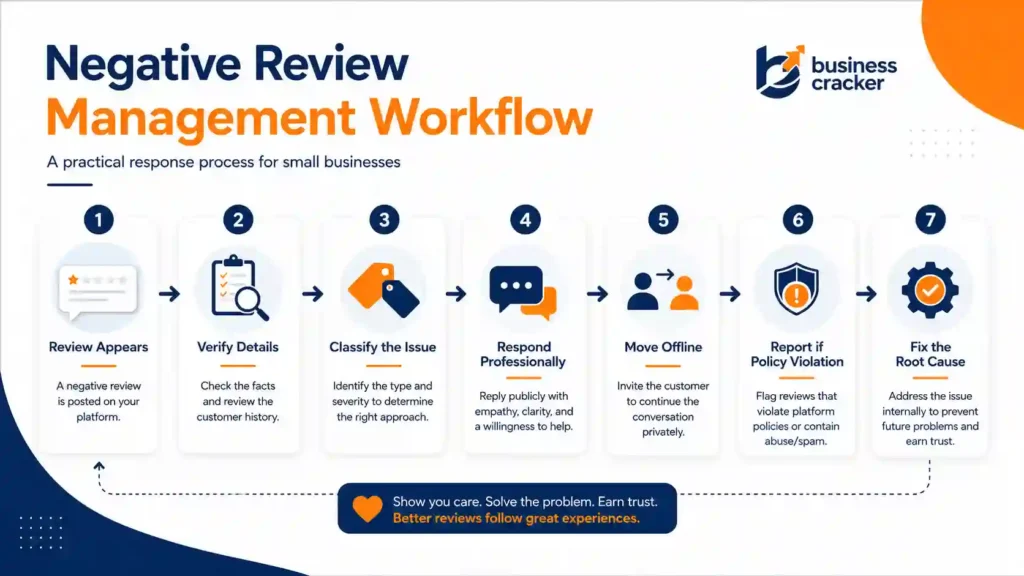
Step 9: Handle Negative Reviews Properly
Negative review management should follow a clear process.
First, verify the review
Check customer records, booking details, order history, emails, call logs, and staff notes.
Second, classify it
Decide whether it is genuine, unclear, fake, spam, abusive, or policy-violating.
Third, respond professionally
Avoid arguments. Avoid blame. Avoid sarcasm. Avoid long explanations.
Fourth, move details offline
Invite the customer to contact the business directly.
Fifth, fix the root issue
If the complaint is valid, correct the process.
Sixth, report only if there is a policy issue
If the review violates platform rules, report it with evidence.
Seventh, document the case
Save screenshots, dates, customer records, review links, and response details.
This process protects the business and reduces emotional decision-making.
What Not to Do With Negative Reviews
Avoid these mistakes:
- Do not insult the reviewer
- Do not reveal private customer details
- Do not threaten legal action publicly unless advised by counsel
- Do not ask employees to attack the reviewer
- Do not buy fake positive reviews to bury the issue
- Do not offer discounts in exchange for removing a review
- Do not copy-paste the same response everywhere
- Do not ignore serious complaints
- Do not report every negative review as fake
- Do not suppress genuine feedback
Google’s policies prohibit incentives in exchange for reviews or for the revision or removal of negative reviews. They also prohibit discouraging or selectively soliciting negative reviews.
For small businesses, the safest approach is to request honest feedback from real customers and respond professionally when criticism appears.
When Can a Review Be Removed?
A review may be eligible for removal when it violates platform policies.
Possible examples include:
- Spam
- Fake engagement
- Conflict of interest
- Impersonation
- Offensive content
- Personal information
- Hate speech
- Harassment
- Irrelevant content
- Competitor manipulation
- Incentivized review activity
- Extortion or threats
Google says flagged reviews that violate its content policies are removed, but reviews are not removed simply because a business disagrees with them. It also provides a one-time appeal option if a flagged review is not removed and the business believes the decision is wrong.
This is why documentation matters. If you report a review, provide the strongest available evidence.
When Should a Small Business Use ORM Services?
A business should consider professional reputation management services when:
- Negative reviews are affecting inquiries
- Fake reviews are appearing repeatedly
- The business has no review response process
- Review ratings are below competitors
- Reviews are outdated
- Social complaints are being ignored
- Search results show poor brand sentiment
- Business listings are inconsistent
- The owner or team lacks time to monitor the reputation
- Review requests are irregular
- There is a reputation issue after a service failure
- The business is entering a competitive local market
- Paid campaigns are underperforming because trust signals are weak
Professional ORM services can help with reputation audits, review response systems, review generation planning, negative review handling, platform reporting, and brand trust improvement.
How ORM Supports SEO and Social Media
ORM, SEO, and SMO work together.
A customer may search for your service, find your website, check your reviews, visit your social profile, compare competitors, and then decide whether to contact you. If any of these trust points are weak, conversion can drop.
ORM supports SEO by improving trust signals around branded search and local discovery.
ORM supports SMO by making social profiles more credible and responsive.
ORM supports paid marketing because users who click ads often check reviews before converting.
ORM supports web design because trust signals on the website can reinforce a positive reputation.
This is why ORM should not be handled as an isolated service. It should be connected with digital marketing services, especially when a business depends on search visibility, social proof, and online inquiries.
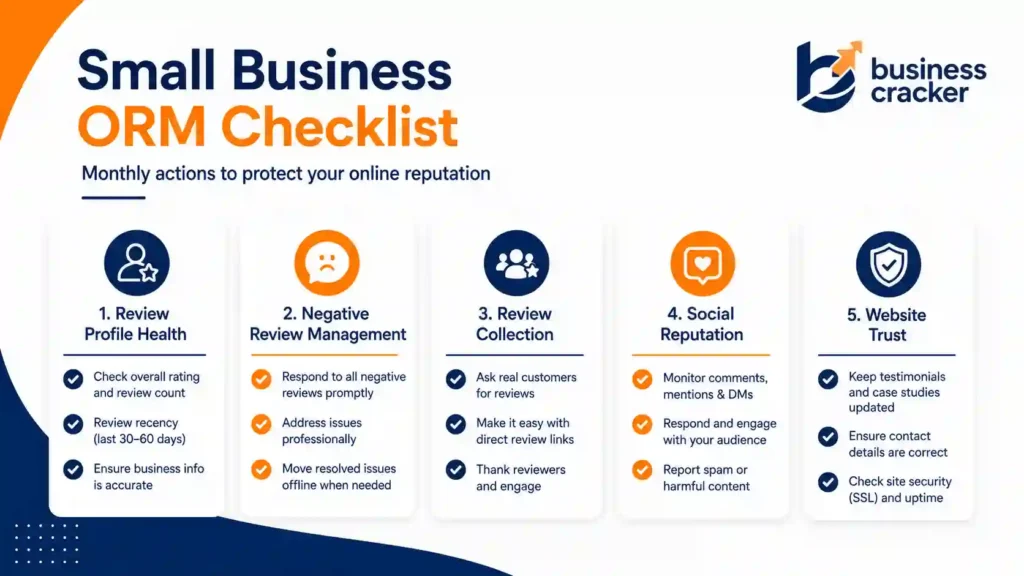
A Practical ORM Checklist for Small Businesses
Use this checklist monthly.
Review Profile Health
- Check Google Business Profile rating
- Check number of reviews
- Check review recency
- Check review response rate
- Check review themes
- Check competitor ratings
- Check industry-specific review platforms
Negative Review Management
- Identify new negative reviews
- Verify customer records
- Categorize complaint type
- Respond professionally
- Move details offline
- Report policy-violating reviews
- Document evidence
- Track recurring issues
Review Collection
- Ask real customers for reviews
- Use direct review links
- Avoid incentives
- Avoid pressure
- Do not request specific wording
- Request reviews consistently
- Track review volume monthly
Brand Reputation Management
- Search business name
- Search business name plus reviews
- Search the business name plus complaints
- Check social comments
- Check local directories
- Check outdated business information
- Check the owner or founder mentions if relevant
Social Reputation
- Respond to comments
- Monitor DMs
- Review tagged posts
- Clean spam comments
- Answer public questions
- Share trust-building content
- Keep profiles active and clear
Website Trust
- Add testimonials
- Add case studies
- Add clear contact details
- Add service explanations
- Add FAQs
- Keep policies clear
- Keep business information consistent
How Business Cracker Approaches ORM
Business Cracker treats ORM as part of a wider business visibility and trust system.
The goal is not only to respond to reviews. The goal is to help the business look credible across search, social, review platforms, and its own website.
That may include:
- Reputation audit
- Review management
- Negative review response planning
- Google Business Profile review support
- Social trust improvement
- Brand mention checks
- Listing consistency review
- Customer feedback process improvement
- Connection with SMO and SEO work
For small businesses, this matters because reputation affects more than public image. It affects clicks, calls, form submissions, local visibility, paid campaign trust, and customer confidence.
Final Thoughts
ORM for Small Business is not about hiding criticism. It is about managing trust properly.
Small businesses should monitor reviews, respond professionally, collect genuine feedback, fix recurring service issues, and build enough positive reputation that one negative review does not control the customer’s decision.
If your business has weak reviews, unanswered complaints, suspicious negative reviews, inconsistent listings, or poor social reputation signals, now is the right time to build a structured ORM process.
For a practical review of your current online reputation, review profile, and trust signals, contact Business Cracker and discuss how ORM can support your business growth.
