July 24, 2026
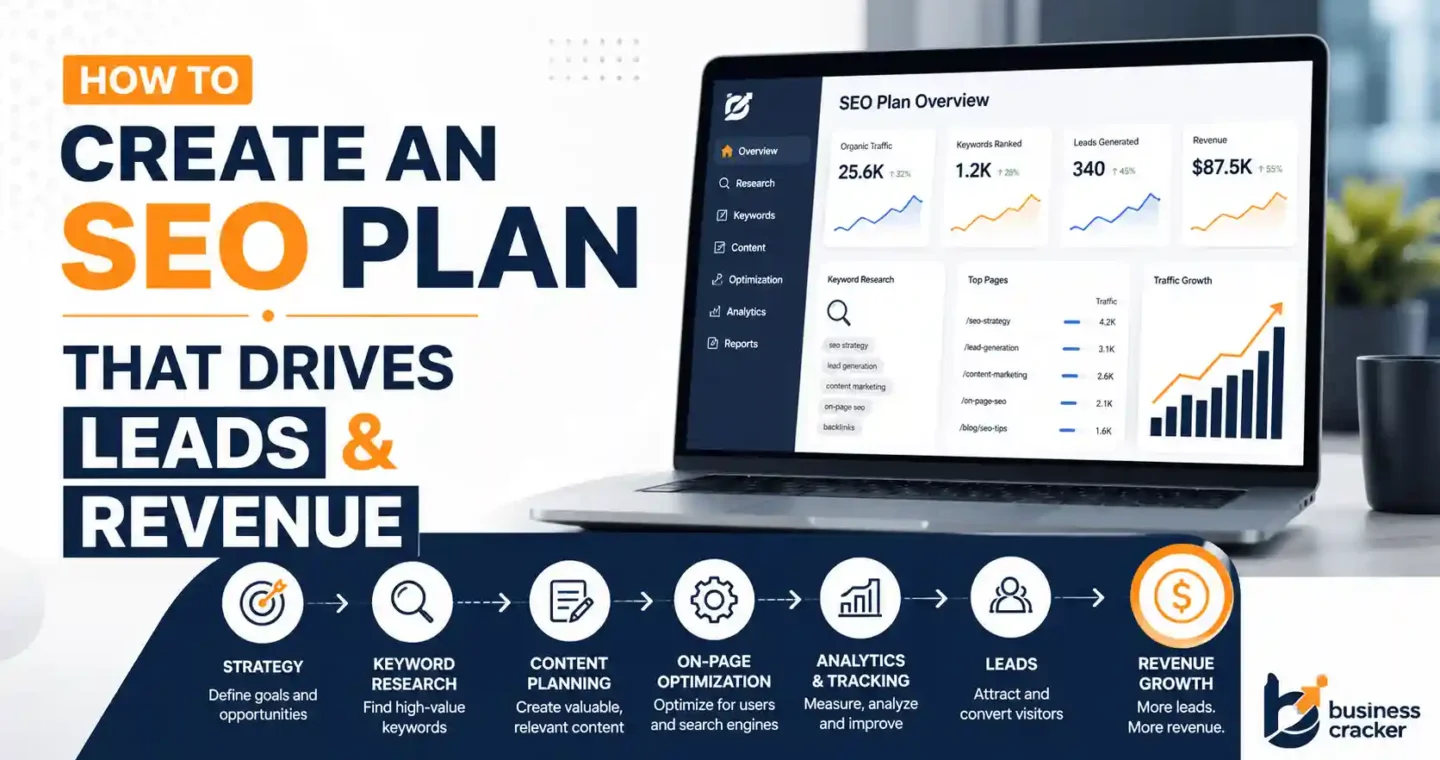
How to Create an SEO Plan That Drives Leads and Revenue
Most SEO plans look productive on paper.
They include keyword research, blog posts, technical audits, title-tag updates, competitor reports, and a monthly backlink target. The marketing team stays busy, rankings move occasionally, and traffic may even increase.
Then someone asks the question that matters:
How much business did SEO generate?
That is where many SEO strategies fall apart.
An effective SEO plan should not stop at rankings or organic traffic. It should identify which search opportunities support the business, determine why the website is not capturing those opportunities, assign the right work to the right people, and measure whether that work produces qualified leads, sales, or another meaningful outcome.
This guide explains how to create an SEO plan that connects technical SEO, content, internal links, backlinks, user experience, and conversion tracking to real business growth.
Quick Answer: How Do You Create an SEO Plan?
To create an effective SEO plan:
- Define the business result SEO must support.
- Measure your current search and conversion performance.
- Audit the website’s technical, content, authority, and conversion problems.
- Research customers, competitors, search intent, and keyword opportunities.
- Map target keywords to the correct pages.
- Prioritize opportunities by business value, feasibility, and effort.
- Fix critical technical SEO issues.
- Improve existing pages before creating unnecessary new content.
- Build relevant internal links and backlinks.
- Connect organic landing pages to appropriate conversion actions.
- Assign owners, timelines, and deliverables.
- Track qualified leads, revenue, visibility, and efficiency.
- Review the data and refine the plan continuously.
The objective is not to complete the longest SEO checklist. It is to complete the work most likely to create useful business impact.
What Is an SEO Plan?
An SEO plan is a documented set of actions designed to improve a website’s visibility in organic search and turn that visibility into measurable business results.
It normally covers:
- Technical SEO
- Keyword research
- Search intent
- Website architecture
- Content creation and improvement
- On-page optimization
- Internal linking
- Link building
- Conversion tracking
- Reporting
- Ongoing optimization
Google describes SEO as helping search engines understand your content and helping users decide whether they should visit your website through a search result. A strong plan has to serve both sides of that equation. It must make the site understandable to search engines and valuable to the people who find it. Review Google’s SEO Starter Guide and Search Essentials for its foundational guidance.
SEO Strategy vs. SEO Plan vs. SEO Roadmap
These terms are often used interchangeably, but they serve different purposes.
| Term | What it means | Example |
| SEO strategy | The choices that determine how SEO will support the business | Focus on high-value B2B service searches rather than broad marketing traffic |
| SEO plan | The actions required to execute the strategy | Improve service pages, publish comparison content, fix indexation, and earn industry links |
| SEO roadmap | The order, ownership, and timing of those actions | Technical fixes in month one, content improvements in month two, and outreach beginning in month three |
A strategy without a plan remains theoretical. A plan without a roadmap usually becomes a disconnected task list.
Why Businesses Need a Revenue-Focused SEO Plan
The first organic result does not receive all available clicks, but it usually earns a much larger share than lower-ranking pages.
A Backlinko analysis of approximately four million Google search results found that the first organic result had an average click-through rate of 27.6%. The same study found that only 0.63% of searchers clicked a result on the second page. Results vary by query and search-results layout, but the data illustrates why moving a commercially important page from an invisible position to a competitive first-page position can matter. Read the complete organic CTR study.
Rankings alone, however, do not guarantee business growth.
A website can rank for hundreds of informational keywords and still generate very few qualified enquiries. This usually happens when:
- The keywords have little connection to the company’s offer.
- The content attracts the wrong audience.
- Commercial pages are weak.
- Calls to action do not match search intent.
- Conversion tracking is incomplete.
- Sales and marketing teams define a qualified lead differently.
- Backlinks are directed to pages with no commercial potential.
A revenue-focused SEO plan solves this by connecting every major initiative to a business objective.
Why Most SEO Plans Fail
They Begin With Keywords Instead of Business Priorities
Keyword research is important, but it should not be the first business decision.
Before opening a keyword tool, determine:
- Which services or products are most profitable?
- Which markets are strategic priorities?
- What does a qualified lead look like?
- Which customer problems can the business solve better than competitors?
- How long is the buying cycle?
- Which pages already produce enquiries or sales?
- What marketing resources are available?
Without this context, a company may spend six months ranking for keywords that generate activity but no meaningful demand.
They Treat Every SEO Issue as Equally Important
An audit may find hundreds or thousands of warnings.
Not all of them deserve immediate action.
An important service page blocked by a noindex directive is a critical business problem. A missing image title attribute on an old blog post may not be.
A professional SEO plan separates findings into:
- Critical blockers
- High-impact growth opportunities
- Medium-priority improvements
- Low-priority enhancements
- Issues that do not require action
They Publish New Content Before Reviewing Existing Pages
Creating content feels productive, but a new article is not always the best use of resources.
An existing page ranking between positions 6 and 20 may need only:
- Better alignment with search intent
- More useful information
- Stronger internal links
- A clearer title
- Updated examples
- Relevant backlinks
- A more effective conversion path
Improving an established URL can produce results faster than creating another page from zero.
They Measure Delivery Instead of Performance
A weak report says:
- Four articles published
- Ten backlinks delivered
- Twenty titles updated
- One audit completed
A useful report says:
- Which priority pages improved
- Which queries gained or lost visibility
- Which pages generated qualified leads
- Which technical problems were resolved
- Which backlinks supported priority URLs
- What the team learned
- What should happen next
Completion is not the same as impact.
They Separate SEO From Website Conversion
SEO teams often stop at the click.
That creates a serious gap. Organic traffic has limited value when visitors cannot understand the offer, trust the company, find the right service, or complete the desired action.
An SEO plan should therefore include landing-page quality, user experience, conversion tracking, and lead attribution.
The Business Cracker SEO Growth Framework
At Business Cracker, we approach digital growth through four connected phases:
- Discover
- Plan
- Execute
- Optimize
This framework connects SEO services, content, website improvements, and link building services to the condition and objectives of the business rather than applying the same package to every website.
Discover
Understand the company, its customers, its market, its website, and the reason organic growth is currently limited.
Plan
Choose the right opportunities, determine the order of work, assign responsibilities, and define success.
Execute
Fix the technical foundation, improve content, strengthen internal links, earn relevant authority, and improve conversion paths.
Optimize
Review performance, diagnose gaps, preserve what works, and adjust priorities based on reliable data.
The following steps turn this framework into a practical SEO action plan.
Step 1: Define the Business Result SEO Must Support
Do not begin with a goal such as “increase organic traffic.”
It is too broad to guide decisions.
A useful goal defines:
- The business outcome
- The target audience
- The relevant products or services
- The measurement method
- The deadline
- The commercial value
For example:
Generate 25 qualified organic-search enquiries per month for custom software development services within nine months.
That goal is more useful because it tells the SEO team which services, landing pages, customers, and conversion events matter.
Connect Business Goals to SEO Metrics
Use a measurement chain that connects early search signals to final business outcomes.
| Business objective | SEO objective | Leading indicators | Commercial indicators |
| Generate B2B leads | Improve visibility for high-intent service queries | Rankings, impressions, clicks, engaged visits | Qualified forms, calls, meetings, pipeline |
| Increase ecommerce sales | Improve category and product discovery | Indexed products, category rankings, organic sessions | Transactions, revenue, average order value |
| Expand into a new city | Build local search visibility | Local rankings, profile views, location-page traffic | Calls, bookings, direction requests |
| Reduce paid-media dependence | Grow non-branded organic acquisition | Non-branded clicks and landing-page traffic | Organic cost per lead and revenue contribution |
| Build category authority | Earn visibility across a topic cluster | Ranking coverage, mentions, referring domains | Branded demand, assisted conversions, sales influence |
Define a Qualified Conversion
A form submission is not automatically a qualified lead.
Before measuring SEO, agree on what the company considers valuable.
A qualified lead may require:
- The correct service need
- A minimum project size
- A target location
- A realistic timeline
- Decision-making authority
- A valid business email
- A genuine sales conversation
This prevents the SEO report from celebrating low-quality conversions that the sales team cannot use.
Step 2: Establish a Reliable SEO Baseline
A baseline shows where the website stands before major changes are made.
Without it, the team cannot prove improvement or identify the cause of a decline.
Measure Search Visibility
Use Google Search Console to measure:
- Clicks
- Impressions
- Average click-through rate
- Average position
- Search queries
- Landing pages
- Countries
- Devices
- Search appearances
Google explains that Search Console’s Performance report shows traffic from Google Search and lets website owners break performance down by queries, pages, countries, and other dimensions.
Separate the data into:
- Branded and non-branded searches
- Informational and commercial pages
- New and returning content
- Priority and non-priority markets
- Desktop and mobile
- Leads and non-converting traffic
A rise in branded clicks may indicate stronger brand demand, but it does not necessarily prove that non-branded SEO visibility improved.
Measure Website Behavior and Conversions
Use Google Analytics or another analytics platform to review:
- Organic sessions
- Engaged sessions
- Landing-page engagement
- Key events
- Form submissions
- Calls
- Purchases
- Demo requests
- Assisted conversions
Google Analytics allows important user actions from organic search and other channels to be measured as conversions. Review Google’s conversion documentation when setting up measurement.
Measure Current Authority
Create a baseline for:
- Referring domains
- Backlinks to priority pages
- Branded anchors
- Commercial anchors
- Lost links
- Broken backlinks
- Links to redirected URLs
- Competitor authority gaps
- Unlinked brand mentions
Do not treat Domain Authority, Domain Rating, or another third-party metric as a Google score. These metrics can help with comparative research, but they do not reveal Google’s internal evaluation of a site.
Record Current Commercial Performance
For each priority organic landing page, record:
- Organic visits
- Conversion rate
- Number of qualified leads
- Pipeline contribution
- Revenue
- Assisted conversions
- Cost of maintaining the page
This reveals whether the problem is visibility, conversion, or both.
Step 3: Audit the Website Before Prescribing Work
An SEO audit should answer a business question:
What is preventing this website from earning and converting relevant organic visibility?
A useful audit covers five areas.
Technical SEO Audit
Review whether search engines can discover, crawl, render, understand, and index the correct pages.
Check:
- Robots.txt rules
- noindex directives
- Canonical tags
- XML sitemaps
- Redirects
- Status codes
- Duplicate URLs
- JavaScript rendering
- Mobile usability
- Core Web Vitals
- Structured data
- Internal-link crawlability
- HTTPS
- Server reliability
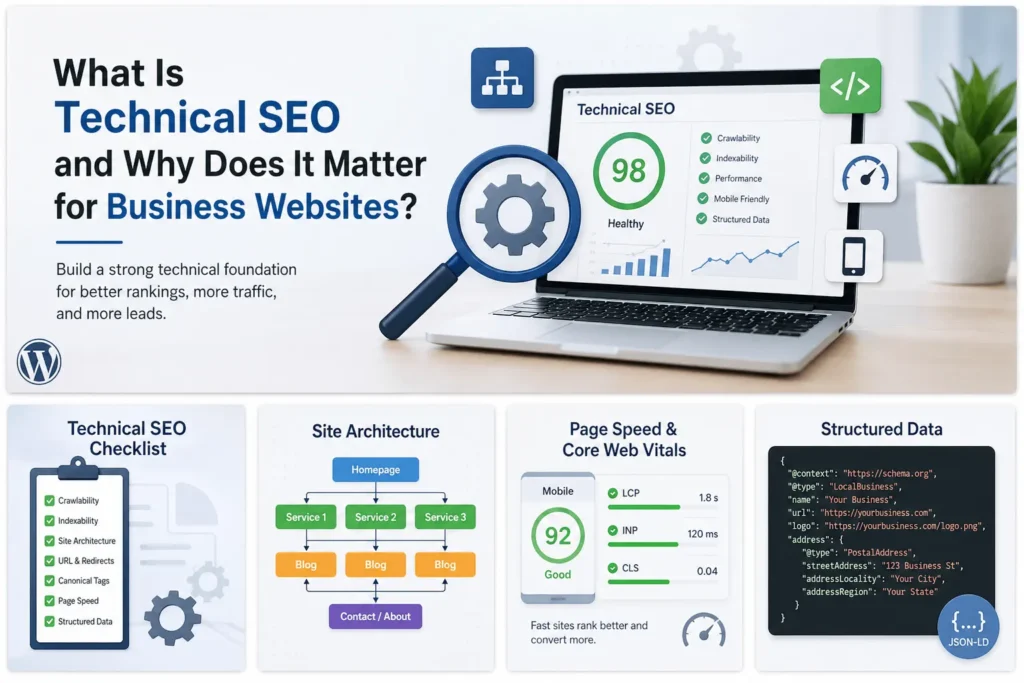
Our guide to technical SEO for business websites explains how crawlability, indexing, canonicals, performance, and website structure affect search visibility.
Separate Technical Findings by Business Impact
| Priority | Example | Response |
| Critical | Revenue-generating service page is not indexable | Fix immediately |
| High | Important pages are orphaned or buried deeply | Add crawlable internal links |
| Medium | Several redirect chains waste crawl activity | Consolidate redirects |
| Low | Minor schema enhancement on a low-value archive | Schedule after higher-impact work |
| No action | Tool warning has no practical effect | Document and ignore |
An audit should reduce uncertainty, not create an endless list of technical tasks.
Content Audit
Review every important page and assign one action:
- Keep
- Improve
- Expand
- Reposition
- Merge
- Redirect
- Remove
- Create
Evaluate:
- Search intent
- Accuracy
- Originality
- Topic coverage
- Readability
- Evidence
- Internal links
- Organic performance
- Conversion potential
- Cannibalization
- Business relevance
A page should not remain live only because someone spent time creating it.
Backlink and Authority Audit
Review:
- Which pages attract links
- Which pages need links
- Whether competitors have stronger page-level authority
- Whether anchors look natural
- Whether links come from relevant pages
- Whether old backlinks point to broken URLs
- Whether previous campaigns created risky patterns
- Whether the brand appears in relevant third-party conversations
Our guide explaining what link building is and why it matters provides a practical way to separate useful backlinks from weak or risky placements.
Conversion Audit
Check whether organic visitors can take an appropriate next step.
Review:
- Value proposition
- Page headline
- Service clarity
- Proof
- Calls to action
- Form length
- Mobile usability
- Contact details
- Trust indicators
- Case studies
- Pricing information
- Comparison information
- Response expectations
A page may not have an SEO problem. It may have an offer or conversion problem.
For more guidance, read our article on website design for lead generation and review Business Cracker’s web design services when website structure or user experience is limiting performance.
Analytics Audit
Confirm that:
- Forms are tracked correctly.
- Calls are measured where practical.
- Duplicate events are removed.
- Internal traffic is filtered appropriately.
- Organic and paid conversions can be separated.
- Thank-you pages do not inflate results.
- Cross-domain tracking works.
- CRM outcomes can be connected to acquisition sources.
Bad tracking creates bad decisions.
Step 4: Research Customers, Competitors, and Search Demand
Keyword research should begin with customer problems, not a list of high-volume phrases.
Map the Customer Journey
For each important service or product, document:
- The customer’s problem
- What the customer already knows
- What questions they ask
- What alternatives they consider
- What objections delay a decision
- What proof they need
- What action they should take next
Then map searches to buying stages.
| Buying stage | Example search | Best content type | Appropriate action |
| Problem awareness | why is my website not generating leads | Educational guide | Read related guide or request an audit |
| Solution research | ways to improve website lead generation | How-to article or checklist | Download resource or view service |
| Commercial investigation | SEO agency vs in-house SEO | Comparison article | Review capabilities or case study |
| Provider evaluation | SEO services for SaaS companies | Service page | Book consultation |
| Decision | Business Cracker SEO services | Branded service or contact page | Request proposal |
Perform Keyword Research
For every keyword, review:
- Search intent
- Relevance
- Search demand
- Ranking difficulty
- SERP features
- Current competitors
- Buyer stage
- Geographic relevance
- Commercial value
- Existing page fit
Do not reject a keyword simply because its search volume is low.
A phrase searched 30 times per month by qualified enterprise buyers may be more valuable than a phrase searched 10,000 times by students or casual readers.
Analyze the Search Results
Search intent is not determined by the keyword alone.
Review the pages Google currently surfaces and ask:
- Are they service pages, category pages, tools, videos, or articles?
- Are the ranking pages beginner-friendly or technical?
- Do they focus on steps, templates, examples, costs, or comparisons?
- Are results local, national, or international?
- Are the domains publishers, vendors, marketplaces, or government sites?
- What useful information is missing?
- What would make your page substantially better?
Do not copy headings from the top results and call that research. Find the unanswered questions and unresolved business problems.
Build a Keyword-to-Page Map
A keyword map connects related queries to the page best positioned to satisfy them.
Include:
| Field | Purpose |
| Primary keyword | Main search concept |
| Supporting keywords | Related language and subtopics |
| Search intent | What the user needs |
| Buyer stage | Awareness, consideration, or decision |
| Existing URL | Current page, where applicable |
| Planned action | Keep, improve, merge, redirect, or create |
| Business value | Commercial importance |
| CTA | Most appropriate next step |
| Internal links | Pages that should support the URL |
| Status | Planned, in progress, published, or monitoring |
Keyword mapping prevents multiple pages from competing for the same intent and helps the team create a connected site architecture.
Step 5: Prioritize SEO Opportunities
A successful SEO roadmap does not try to fix everything simultaneously.
Use a simple opportunity-scoring system.
Business Cracker SEO Opportunity Score
Score each factor from 1 to 5.
| Factor | Question |
| Business value | Can this page generate meaningful leads or sales? |
| Intent fit | Does the search closely match the offer? |
| Ranking potential | Is the site reasonably capable of competing? |
| Conversion readiness | Can the page turn visitors into a useful next step? |
| Strategic value | Does the opportunity support an important market or service? |
| Effort | How much time, budget, and coordination are required? |
A practical formula is:
Priority score = Business value + intent fit + ranking potential + conversion readiness + strategic value, divided by effort
The score is not a ranking prediction. It is a decision-making tool.
Examples of High-Priority Opportunities
- A service page ranking in position 8 for a high-value term
- A category page with demand but poor internal linking
- A converting page blocked from indexing
- A strong article that competitors outrank mainly through links
- A local page with relevant impressions but weak conversion content
- An outdated comparison page that already earns qualified traffic
Examples of Low-Priority Distractions
- A high-volume keyword unrelated to the offer
- A technical warning on a page with no users or business value
- A backlink opportunity from an irrelevant website
- A new article that duplicates an existing page
- A cosmetic optimization with no effect on usability or search understanding
Step 6: Fix the Technical SEO Foundation
Technical SEO creates the conditions required for content, links, and user experience to work properly.
It does not replace good content or authority, but it can prevent both from producing results.
Prioritize Crawlability and Indexability
Important pages should:
- Return the correct status code
- Be accessible to search crawlers
- Be indexable
- Use consistent canonical signals
- Appear in the correct XML sitemap
- Receive internal links
- Avoid unnecessary duplication
- Render important content correctly
Google recommends standard, crawlable <a> links with descriptive anchor text so users and search engines can understand the destination. Review Google’s link best practices.
Improve Core Web Vitals
The current Core Web Vitals are:
- Largest Contentful Paint: Good at 2.5 seconds or less
- Interaction to Next Paint: Good at 200 milliseconds or less
- Cumulative Layout Shift: Good at 0.1 or less
These replaced the older set that included First Input Delay. Google evaluates the metrics using real-world user data, generally at the 75th percentile. Review the current Core Web Vitals thresholds and Google’s Search guidance.
Do not optimize only for a perfect test score. Prioritize the actual experience of high-value page templates, including:
- Service pages
- Product pages
- Category pages
- Lead-generation landing pages
- Blog posts
- Contact pages
Use Structured Data Accurately
Structured data can help search engines understand eligible content and display richer search features.
Use only markup that:
- Matches visible page content
- Represents the correct page type
- Follows Google’s guidelines
- Remains accurate after page updates
Do not add fake reviews, misleading FAQs, or unsupported claims.
Step 7: Build a Content Plan Around Business Problems
Content should help the customer make progress.
That may mean understanding a problem, evaluating a solution, comparing providers, reducing perceived risk, or taking action.
Improve Existing Content First
An existing page is often a better opportunity when it:
- Already ranks on pages one or two
- Earns impressions but has a low click-through rate
- Receives traffic but does not convert
- Has outdated examples or advice
- Misses important subtopics
- Has weak internal links
- Has backlinks but poor content
- Competes with another page on the same site
Before editing, record current:
- Rankings
- Clicks
- Impressions
- Leads
- Backlinks
- Conversion rate
This gives you a reliable before-and-after comparison.
Create New Content When There Is a Real Gap
Create a new URL when:
- No existing page satisfies the intent.
- The topic represents a distinct customer need.
- The business can provide original value.
- The page has a clear place in the site architecture.
- The content supports a product, service, or authority objective.
- The team can maintain it.
Avoid publishing near-duplicate articles for every minor keyword variation.
Use a Complete SEO Content Brief
Every content brief should include:
- Target audience
- Customer problem
- Search intent
- Primary keyword
- Supporting questions
- Buyer stage
- Recommended format
- Unique value
- First-hand expertise
- Evidence and sources
- Internal links
- Conversion action
- Writer
- Reviewer
- Deadline
- Success metric
Make the Content Distinctive
A premium article should offer more than a summary of existing search results.
Add:
- Original data
- Real examples
- Templates
- Calculators
- Decision frameworks
- Screenshots
- Subject-matter expert commentary
- Case studies
- Implementation instructions
- Common failure points
- Clear limitations
Content becomes more defensible when it reflects actual experience rather than generic information available everywhere.
Step 8: Optimize On-Page SEO and Internal Links
On-page SEO helps users and search engines understand the purpose and relevance of a page.
Optimize the Main Page Elements
Review:
- Title tag
- Meta description
- H1
- H2 and H3 structure
- Opening paragraph
- URL
- Image alt text
- Internal anchors
- Supporting terminology
- Calls to action
- Structured data
Use the main keyword naturally, but do not write for keyword density.
A page about creating an SEO plan should use related concepts such as SEO strategy, roadmap, audit, keyword mapping, content planning, technical SEO, link building, and reporting where they genuinely help explain the subject.
Build Internal Links Around User Journeys
Internal links should help readers move from one useful page to another.
For example:
- A technical audit article can link to an SEO service page.
- A link-building guide can link to backlink services.
- A comparison article can link to relevant commercial pages.
- A high-authority blog post can support an underlinked service page.
- A service page can link to proof, FAQs, and related resources.
Use descriptive anchor text rather than repeating generic phrases such as “click here.”
Internal links also help search engines discover pages and understand relationships between topics. Google specifically recommends making content easy to find through internal links, including for visibility in AI features.
Step 9: Create a Link Building and Authority Plan
Competitive pages often need external authority in addition to strong content and technical SEO.
Google states that its ranking systems use link analysis, including PageRank, to understand how pages relate to one another and which pages may be helpful. Links remain one part of a much larger ranking system.
The question is not whether to build the largest number of backlinks.
The question is:
Which pages need authority, and what links would make sense for those pages, audiences, and business objectives?
Decide Whether the Page Is Ready for Backlinks
Build Links Now When
- The page is indexable.
- Search intent is correct.
- The content is competitive.
- Internal links are in place.
- The page can convert visitors.
- Competing pages have stronger backlink profiles.
- Rankings have plateaued after on-site improvements.
- The link opportunity is relevant and defensible.
Fix the Page First When
- The page is blocked from indexing.
- The content is thin or unclear.
- The offer does not match the query.
- Conversion tracking is missing.
- The page loads poorly.
- The target keyword is unrealistic.
- Internal links are weak.
- Multiple pages compete for the same intent.
Backlinks cannot fully compensate for a weak destination page.
Choose the Right Link Building Methods
A balanced strategy may include:
- Manual outreach
- Digital PR
- Guest posting
- Relevant niche edits
- Resource-page outreach
- Broken-link building
- Expert commentary
- Partner links
- Integration pages
- Local citations
- Link reclamation
- Unlinked brand mentions
- Comparison-page outreach
- Original research
Business Cracker’s custom link building guide explains how campaign selection should depend on target pages, competition, content readiness, business value, and risk rather than a fixed backlink package.
Evaluate Backlink Quality Carefully
Review the linking:
- Website
- Page
- Topic
- Audience
- Editorial context
- Anchor text
- Organic visibility
- Outbound-link pattern
- Placement
- Business relevance
- Referral potential
Do not approve a website based only on DA or DR.
A 2026 BuzzStream analysis of approximately 500,000 websites in the commercial guest-post market found that 96.2% were classified as low quality under its methodology. It also found that 39.6% had no estimated monthly organic traffic, while only 1.37% qualified as high quality or top tier. Read the full guest-post marketplace study.
The study does not mean every guest post is harmful. It shows why manual review, relevance, editorial quality, and page-level analysis matter.
Business Cracker provides link building services that can include prospect research, outreach planning, guest posting, niche edits, broken-link outreach, digital PR support, and placement reporting. Our approach focuses on relevant authority and sustainable execution rather than inexpensive volume.
For a detailed comparison of two common methods, read guest posting vs. niche edits.
Follow Google’s Link Policies
Google defines link spam as creating links to or from a site primarily to manipulate search rankings. Its policies cover practices such as paid links that pass ranking credit, excessive exchanges, automated link creation, and low-quality links embedded in third-party content. Review Google’s spam policies and outbound-link qualification guidance.
A legitimate advertising or sponsorship relationship should be disclosed and qualified appropriately.
Step 10: Connect SEO Traffic to Conversion
SEO should not end when a visitor reaches the page.
The next action should match what the person is ready to do.
| Search intent | Visitor need | Appropriate CTA |
| Informational | Understand a problem | Read a related guide, use a checklist, or subscribe |
| Commercial research | Compare approaches | View a case study, service comparison, or consultation offer |
| Transactional | Purchase or hire | Request a proposal, buy, book, or start a trial |
| Local | Find a nearby provider | Call, request directions, or schedule an appointment |
| Branded | Evaluate the company | View services, proof, team information, or contact details |
Do not place the same aggressive sales CTA on every page.
A visitor reading a beginner’s guide may not be ready to request a proposal. A visitor searching for a specific service should not be forced to download a generic ebook before contacting the company.
Improve Commercial Landing Pages
A conversion-ready service page should answer:
- What does the company provide?
- Who is the service for?
- Which problems does it solve?
- What is included?
- How does the process work?
- What makes the approach credible?
- What outcomes can the client reasonably expect?
- What should the visitor do next?
Track Assisted Conversions
SEO often supports more than the final click.
A buyer may:
- Discover the company through a blog.
- Return through a branded search.
- Review a service page.
- Read a case study.
- Contact the company directly.
Review assisted journeys rather than giving all credit to the final channel.
Step 11: Build a 90-Day SEO Roadmap
SEO results rarely fit neatly into 90 days, but a 90-day roadmap is useful for creating momentum, accountability, and early evidence.
Days 1 to 30: Discover and Diagnose
Focus on:
- Business goals
- Customer and sales interviews
- Analytics validation
- Search Console baseline
- Technical audit
- Content inventory
- Backlink audit
- Competitor research
- Keyword research
- Conversion audit
- Opportunity scoring
Primary deliverables:
- Baseline report
- Prioritized audit
- Keyword-to-page map
- Conversion measurement plan
- Approved SEO roadmap
Days 31 to 60: Fix and Improve
Focus on:
- Critical crawling and indexation fixes
- High-potential content updates
- Service-page improvements
- Internal linking
- Metadata improvements
- Redirect and canonical cleanup
- Core Web Vitals priorities
- Content briefs
- Linkable-asset development
Primary deliverables:
- Resolved technical blockers
- Improved priority pages
- Internal-link map
- Approved content briefs
- Outreach-ready assets
Days 61 to 90: Publish, Promote, and Measure
Focus on:
- New priority content
- Content refreshes
- Digital PR and outreach
- Relevant backlinks
- Conversion improvements
- Search performance monitoring
- Lead-quality review
- Next-quarter planning
Primary deliverables:
- Published content
- Qualified link placements
- Conversion findings
- Performance report
- Updated quarterly roadmap
What to Expect During the First 90 Days
The team may see:
- Improved crawling and indexation
- Better keyword alignment
- Initial ranking movement
- Higher impressions
- More relevant landing-page traffic
- Early link acquisition
- Better conversion tracking
Major commercial growth may take longer, especially for new websites, competitive markets, migrations, or sites with limited authority.
Step 12: Assign Owners and Build SEO Workflows
SEO often depends on marketing, development, design, analytics, sales, and leadership.
Without ownership, important tasks remain open because everyone assumes another department will handle them.
| Activity | Primary owner | Supporting team | Deliverable |
| Technical audit | SEO specialist | Developer | Prioritized technical backlog |
| Keyword mapping | SEO strategist | Sales and product teams | Approved keyword-to-page map |
| Content brief | SEO or content lead | Subject expert | Production-ready brief |
| Content production | Writer | SEO and editor | Reviewed draft |
| Website implementation | Developer or CMS manager | SEO | Live optimized page |
| Link acquisition | Outreach specialist | Content and PR | Approved placements |
| Conversion tracking | Analytics specialist | Developer | Tested conversion events |
| Performance review | SEO lead | Sales and leadership | Decision-focused report |
Every task should have:
- One accountable owner
- A deadline
- A clear deliverable
- Acceptance criteria
- Dependencies
- A method of verification
Step 13: Measure SEO Results That Matter
SEO reporting should work at four levels.
Visibility Metrics
Track:
- Impressions
- Clicks
- Average position
- Ranking distribution
- Non-branded visibility
- SERP features
- AI-search visibility
- Indexed priority pages
Engagement Metrics
Track:
- Organic sessions
- Engaged sessions
- Landing-page engagement
- Internal CTA clicks
- Return visits
- Content paths
Commercial Metrics
Track:
- Qualified leads
- Calls
- Booked consultations
- Trials
- Purchases
- Organic conversion rate
- Pipeline
- Revenue
- Assisted conversions
Efficiency Metrics
Track:
- Cost per qualified organic lead
- Content cost
- Link acquisition cost
- Revenue per landing page
- Time to meaningful improvement
- Percentage of work completed
- Return from updated content
Use the Data to Diagnose Problems
| Performance pattern | Likely issue | Next investigation |
| Impressions rise but clicks do not | Weak position, title, snippet, or SERP fit | Review rankings, titles, intent, and SERP features |
| Clicks rise but leads do not | Conversion or audience-quality problem | Review CTA, offer, UX, and lead quality |
| Page is indexed but receives no impressions | Weak relevance or demand | Review keyword targeting, intent, and internal links |
| Rankings remain between 5 and 15 | Content, authority, or SERP competition | Compare coverage, links, intent, and page experience |
| One page declines | Page-level issue | Review competitors, content freshness, links, and intent |
| Entire site declines | Technical, algorithmic, seasonal, or demand shift | Segment by page, query, device, country, and date |
| Backlinks increase but rankings do not | Wrong links, wrong target, or weak page | Audit relevance, placement, target readiness, and competition |
Do not react to every daily change. Review meaningful trends against seasonality, implementation dates, competitor activity, and business conditions.
Step 14: Prepare the SEO Plan for AI Search
Search is expanding beyond traditional lists of links.
Businesses now need visibility across AI Overviews, AI Mode, answer engines, third-party publications, review platforms, communities, and other sources used during research.
This does not mean abandoning SEO fundamentals.
Google states that its established SEO best practices remain relevant to AI Overviews and AI Mode. A page must be indexed and eligible to appear in Google Search, and Google does not require a special AI file, AI schema, or separate technical system for inclusion. Review Google’s AI features guidance and its newer generative AI optimization guide.
AI Search Optimization Checklist
- Publish unique, useful information.
- Make important content available in clear text.
- Use descriptive headings.
- Answer specific questions directly.
- Support claims with evidence.
- Demonstrate real experience.
- Build a consistent brand position.
- Earn relevant third-party mentions.
- Keep business information accurate.
- Use high-quality images and videos where helpful.
- Ensure structured data matches visible content.
- Build clear internal links.
- Maintain crawlability and indexability.
- Monitor branded and non-branded mentions.
Google introduced dedicated generative AI performance reporting in Search Console in June 2026, providing views of impressions within features such as AI Overviews and AI Mode while retaining the data in overall Search performance reporting.
AI visibility should be monitored, but it should not be treated as a shortcut or replacement for useful content, technical accessibility, strong brand signals, and credible third-party references.
How an SEO Plan Changes by Business Type
Different companies should not use the same SEO roadmap.
| Business type | Main SEO priorities |
| New website | Indexability, core service pages, initial topical coverage, branded links, and trust |
| Established service company | Existing-page improvements, commercial keywords, lead tracking, and page-level backlinks |
| SaaS company | Product-led content, use cases, integrations, comparisons, reviews, and software publications |
| Local business | Google Business Profile, location pages, reviews, local links, and conversion actions |
| Ecommerce website | Category architecture, product indexing, filters, internal links, structured data, and commercial content |
| Enterprise website | Governance, crawl management, templates, cross-team workflows, migrations, and reporting |
| Business with declining traffic | Technical diagnosis, content decay, intent shifts, competitor changes, and demand analysis |
| Website with traffic but few leads | Audience quality, service alignment, CTA, proof, UX, and sales attribution |
Common SEO Plan Mistakes
Chasing Search Volume
High volume does not guarantee high business value.
Creating One Page for Every Keyword
Closely related keywords with the same intent usually belong on one comprehensive page.
Treating Backlinks as a Monthly Quota
A fixed number of links can encourage poor prospect selection and irrelevant placements.
Ignoring Existing Content
Pages already earning impressions or rankings may offer the fastest path to improvement.
Reporting Rankings Without Leads
Rankings are indicators, not final business outcomes.
Making Changes Without Recording a Baseline
Without a baseline, the team cannot measure the effect of its work.
Optimizing for Search Engines but Not Customers
A page can be technically optimized and still fail because it is generic, confusing, or unconvincing.
Following an Inflexible Annual Plan
SEO plans should provide direction without preventing the team from responding to data, market changes, algorithm updates, and new business priorities.
Complete SEO Plan Checklist
Business and Measurement
- Define the commercial objective.
- Agree on the qualified-conversion definition.
- Validate analytics and conversion tracking.
- Record the search-performance baseline.
- Connect SEO data to sales outcomes where possible.
Technical SEO
- Review crawlability.
- Review indexability.
- Validate canonical tags.
- Review XML sitemaps.
- Fix broken links and redirects.
- Check mobile usability.
- Review Core Web Vitals.
- Validate structured data.
- Review JavaScript rendering where relevant.
- Confirm HTTPS and security.
Keyword and Content Strategy
- Research customer pain points.
- Map the buying journey.
- Research relevant keywords.
- Analyze search intent.
- Review competitors.
- Build a keyword-to-page map.
- Identify content gaps.
- Prioritize existing-page improvements.
- Create content briefs.
- Define internal links and CTAs.
Authority and Link Building
- Audit existing backlinks.
- Review target-page distribution.
- Analyze competitor link gaps.
- Create linkable assets.
- Select appropriate outreach methods.
- Review prospect relevance and quality.
- Control anchor-text risk.
- Track placements and lost links.
- Measure impact beyond link count.
Conversion and User Experience
- Clarify the offer.
- Match CTAs to intent.
- Improve trust signals.
- Test forms and contact methods.
- Strengthen service pages.
- Improve mobile usability.
- Review lead quality.
- Track assisted journeys.
Operations
- Assign owners.
- Define deadlines.
- Record dependencies.
- Create acceptance criteria.
- Build monthly and quarterly reporting.
- Review priorities continuously.
Frequently Asked Questions
How Long Does an SEO Plan Take to Produce Results?
Some technical fixes can affect crawling or indexation relatively quickly. Content, ranking, authority, and revenue improvements usually take longer.
The timeline depends on:
Website condition
Competition
Existing authority
Content quality
Technical complexity
Implementation speed
Market demand
Link acquisition
Sales cycle
SEO should be treated as a long-term growth channel with short-term diagnostic and optimization milestones.
What Should Be Included in an SEO Plan?
An SEO plan should include goals, baseline data, technical findings, keyword research, search intent, page mapping, content actions, internal links, link building, conversion tracking, ownership, timelines, and reporting.
Should a New Website Focus on Content or Backlinks First?
A new website needs both, but the sequence matters.
Start with indexable, useful, well-structured pages. Establish internal links and a credible commercial foundation. Then earn relevant backlinks and mentions.
Building links to thin or incomplete pages is usually premature.
How Many Keywords Should an SEO Plan Target?
There is no universal number.
A small service business may focus on a limited group of high-value services and locations. An ecommerce or enterprise website may need thousands of mapped queries.
Target only as many opportunities as the team can support with strong pages, implementation, promotion, and measurement.
How Many Backlinks Does a Website Need?
There is no fixed backlink number.
The requirement depends on:
Keyword competition
Current authority
Competitor link profiles
Page quality
Search intent
Internal links
Brand strength
Industry
Focus on the authority gap and quality of opportunities rather than purchasing an arbitrary quantity.
Is SEO Still Important With AI Search?
Yes.
Google states that standard SEO practices remain relevant for AI Overviews and AI Mode because these experiences rely on Google’s search and quality systems. Strong content, indexability, internal links, page experience, structured information, and external credibility continue to matter.
Final Thoughts
A strong SEO plan is not a collection of disconnected marketing tasks.
It is a business-growth system.
It begins by identifying the outcomes that matter, diagnosing the reason those outcomes are not being achieved, and prioritizing the work most likely to change the situation.
That may include fixing technical barriers, improving an existing service page, consolidating duplicate content, creating a new resource, strengthening internal links, earning relevant backlinks, improving a form, or correcting incomplete tracking.
The right action depends on the problem.
Business Cracker provides practical SEO services and link building services for businesses that need a clearer path from organic visibility to authority, qualified traffic, and long-term growth.
Our work can include technical reviews, keyword and content planning, on-page improvements, link prospect research, manual outreach, guest posting, niche edits, digital PR support, and performance reporting.
To discuss your website, current rankings, backlink profile, or SEO roadmap, contact Business Cracker for a practical consultation.