July 15, 2026
Website Design for Lead Generation: How to Turn Traffic Into Qualified Leads
A business website can look professional, rank for keywords, and attract thousands of visitors without producing enough sales opportunities.
That is not always a traffic problem.
It may be a targeting problem, a messaging problem, a trust problem, a user experience problem, or a follow-up problem. In many cases, several of these issues exist at the same time.
Effective lead generation website design addresses the complete journey. It attracts the right visitors, helps them understand the offer, gives them reasons to trust the business, guides them toward an appropriate action, and sends useful information to the sales team.
At Business Cracker, we view a website as part of a larger revenue system. SEO, content, link building, paid advertising, website design, reputation, analytics, and sales follow-up must support the same business objective.
This guide explains how to build that system.
What Is Lead Generation Website Design?
Lead generation website design is the process of planning, writing, designing, developing, and optimizing a website to turn relevant visitors into potential customers.
The desired conversion may be:
- Requesting a quote
- Booking a consultation
- Scheduling a product demonstration
- Calling the business
- Completing an assessment
- Starting a free trial
- Downloading a decision-support resource
- Subscribing to a relevant email sequence
A lead generation website is different from a standard brochure website.
A brochure website primarily tells visitors that a company exists. A lead generation website helps visitors decide whether the company can solve their problem and gives them a clear way to continue the conversation.
That does not mean every page should aggressively demand a form submission. Someone reading an introductory guide is at a different stage from someone reviewing pricing, services, technical capabilities, or case studies.
The website must support both visitors.
Why Website Traffic Does Not Automatically Produce Leads
Businesses often assume that more traffic will solve weak lead generation. Sometimes it does. Frequently, it only increases the number of people encountering the same unresolved problem.
A website usually underperforms for one of the following reasons.
| Business symptom | Likely problem | Practical solution |
| Low traffic and few enquiries | Weak search visibility or promotion | Improve SEO, content distribution, paid acquisition, and authority |
| High traffic but few enquiries | Search intent or conversion mismatch | Review landing pages, messaging, offers, and calls to action |
| Many enquiries but poor lead quality | Weak targeting or qualification | Refine campaigns, keywords, page copy, and form fields |
| Strong leads but few sales | Slow or ineffective follow-up | Improve CRM routing, response times, sales qualification, and nurturing |
| High mobile abandonment | Poor mobile UX or page performance | Simplify layouts, shorten forms, improve speed, and test real devices |
| Strong rankings but low click-through rates | Weak titles or SERP positioning | Improve title tags, descriptions, topical relevance, and brand credibility |
| Visitors review several pages but do not contact | Unanswered questions or insufficient proof | Add case studies, process details, pricing context, and risk-reduction content |
This diagnosis should happen before a redesign begins.
Changing colors, typography, images, or button styles will not solve irrelevant traffic, an unclear offer, or a sales team that takes three days to respond.
Start With the Business Outcome
Before discussing page layouts or form fields, define what a successful lead means to the business.
A Conversion Is Not Always a Qualified Lead
A conversion is any tracked action. A qualified lead is a potential customer who reasonably matches the company’s commercial requirements.
For example, a form submission may not be useful when the visitor:
- Needs a service the company does not provide
- Operates outside the target market
- Has no realistic budget
- Is looking for employment
- Is selling a competing service
- Has no decision-making influence
- Needs an immediate result that cannot be delivered
- Submitted spam or automated content
Businesses should distinguish between:
- Website conversions
- Enquiries
- Marketing-qualified leads
- Sales-qualified leads
- Sales opportunities
- Closed customers
This prevents the marketing team from celebrating form volume while the sales team receives irrelevant contacts.
Define Lead Qualification Criteria
A practical lead definition may include:
- Industry
- Company size
- Location
- Required service
- Problem severity
- Budget range
- Purchase timeframe
- Existing solution
- Decision-making authority
- Expected contract value
Not every business needs to ask all these questions in the initial form. Some information can be inferred from behavior, enriched through a CRM, or collected during the first sales conversation.
The goal is to collect enough information to support the next step without making contact unnecessarily difficult.
Calculate the Economics of Website Lead Generation
A website should be evaluated through business value, not conversion rate alone.
A simple model is:
Expected revenue = Qualified leads × Opportunity rate × Close rate × Average customer value
Consider this example:
- 100 monthly enquiries
- 40 percent qualify
- 50 percent of qualified leads become opportunities
- 25 percent of opportunities close
- $20,000 average customer value
The expected result is:
- 40 qualified leads
- 20 opportunities
- 5 customers
- $100,000 in expected revenue
Now compare it with a website generating 150 enquiries, of which only 10 percent qualify. The second site has more conversions but produces fewer commercially useful leads.
This is why conversion benchmarks require context.
Unbounce’s Conversion Benchmark Report analyzed more than 41,000 landing pages, 464 million unique visitors, and 57 million conversions. It found a median landing-page conversion rate of 6.6 percent across the industries studied. Unbounce also notes that its benchmark measures conversion events, not the financial value of each event. A lower-converting page may still produce stronger business results when its leads are more valuable.
The Six-Part Lead Generation Website Framework
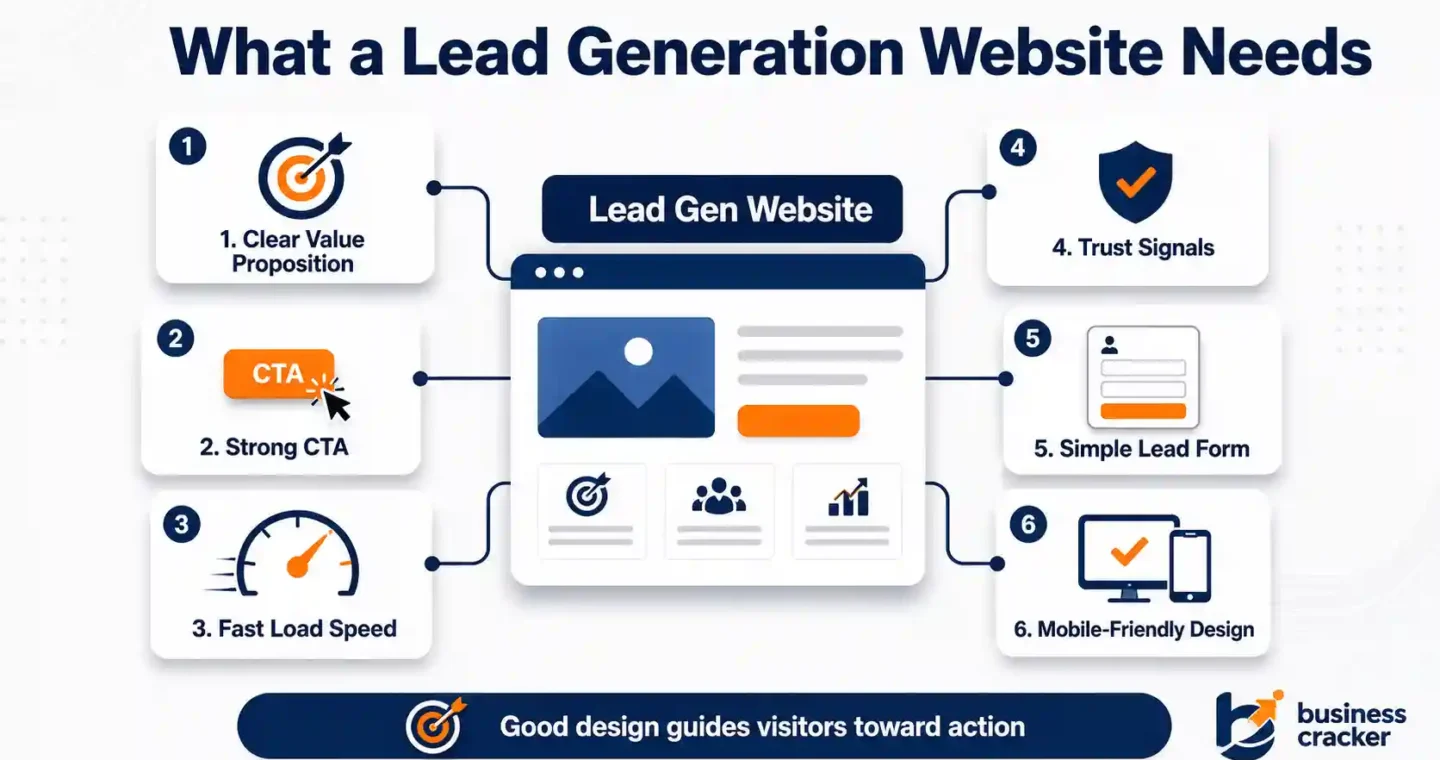
A reliable lead generation website must perform six connected functions.
1. Discoverability
The right audience must be able to find the website.
Discoverability may come from:
- Organic search
- Paid search
- Social media
- Referral websites
- Digital PR
- Industry directories
- Email campaigns
- Partnerships
- Review platforms
- AI-assisted search and answer engines
This requires more than publishing a few blog posts. A strong acquisition strategy combines useful content, technically sound pages, search-intent alignment, relevant authority, and thoughtful promotion.
Business Cracker’s SEO services focus on technical performance, on-page optimization, keyword strategy, content direction, and search-intent alignment. For websites competing in difficult search results, our link building services help strengthen authority through relevant outreach, guest posting, niche edits, and digital PR.
2. Relevance
The page must match the reason the visitor arrived.
A visitor who searches for “enterprise software development partner” expects different information from someone searching for “how much does custom software development cost?”
The first search may require a commercial service page. The second may require an educational cost guide that leads naturally to a consultation.
Relevance depends on alignment among:
- Search query
- Advertisement
- Page headline
- Offer
- Supporting copy
- Proof
- Call to action
A paid advertisement promising a free website audit should not send visitors to a general homepage. A link about technical SEO should not send readers to an unrelated social media service.
When the promise and destination do not match, visitors lose confidence.
3. Clarity
A visitor should quickly understand:
- What the company provides
- Who the service is for
- What problem it solves
- How the company approaches the work
- Why the solution is credible
- What the visitor should do next
Avoid vague headlines such as:
- Transforming Your Future
- Innovation Without Limits
- Experience Excellence
- Empowering Digital Possibilities
These phrases sound polished but communicate little.
A clearer headline would be:
Custom Software Development for Healthcare Companies That Need Secure, Scalable Patient Platforms
The second version identifies the service, audience, and important outcome.
4. Confidence
Visitors rarely convert because a company claims to be excellent. They convert when they find enough evidence to believe the claim.
Useful confidence signals include:
- Detailed case studies
- Specific customer outcomes
- Relevant testimonials
- Real team photographs
- Demonstrated expertise
- Certifications
- Security documentation
- Process transparency
- Client logos
- Independent reviews
- Industry memberships
- Clear privacy policies
- Real contact information
- Accessible terms and conditions
Proof should appear near the claim it supports.
If a page claims that a software team can handle regulated healthcare data, show relevant security practices, compliance experience, technical documentation, or a related case study in that section.
Do not place every testimonial, certification, logo, and award in one crowded block. Trust is stronger when evidence appears naturally throughout the decision journey.
For companies facing negative reviews, inconsistent brand information, or weak digital credibility, online reputation management can support review management, reputation recovery, monitoring, and stronger trust signals.
5. Conversion
Once the visitor has enough clarity and confidence, the website must make the next step obvious.
The conversion path should answer:
- What will happen when I click?
- What information will I need to provide?
- How long will this take?
- What will I receive?
- When will someone respond?
- Is there any commitment?
- How will my information be used?
A CTA such as “Submit” describes the website’s action, not the visitor’s benefit.
More useful CTA labels include:
- Request a Project Estimate
- Book a Strategy Call
- Get a Website Audit
- Review Our Development Process
- Compare Service Options
- Schedule a Product Demo
The correct CTA depends on buyer readiness. Early-stage visitors may prefer a guide, comparison, calculator, or assessment. High-intent visitors may be ready for pricing, a demonstration, or a consultation.
6. Follow-Up
The website’s job does not end after form submission.
A complete lead workflow should include:
- Form validation and spam protection
- Confirmation that the submission was successful
- CRM entry
- Lead-source attribution
- Qualification or scoring
- Assignment to the right person
- Immediate confirmation email
- Follow-up within a defined response window
- Nurturing when the prospect is not ready
- Opportunity and revenue reporting
A company may blame its website for poor performance when the real problem is that enquiries receive slow, generic, or inconsistent responses.
Marketing and sales teams should agree on:
- What qualifies as a lead
- Who owns each type of enquiry
- How quickly the first response must happen
- Which questions should be asked
- When a lead should enter nurturing
- How lost opportunities are categorized
- How revenue is attributed to the original channel
Design Each Website Page for a Specific Job
A strong lead generation website is not one long sales pitch. Each page supports a different stage of the buying journey.
Homepage: Establish Direction
The homepage should help visitors answer three questions:
- Am I in the right place?
- Can this company help me?
- Where should I go next?
A high-performing homepage usually includes:
- A clear value proposition
- A primary CTA
- Important services or products
- Target industries or customer types
- Selected proof
- A simple explanation of the process
- Links to deeper service pages
- A clear contact option
Do not force every detail onto the homepage. Its job is to establish relevance and route visitors to the most useful next page.
Service Pages: Explain and Prove
Service pages are commercial decision pages.
A useful service page should explain:
- The problem being solved
- Who the service is designed for
- What is included
- How the process works
- Expected outcomes
- Important limitations
- Common concerns
- Relevant experience
- The next step
For example, a strong website design and development service page should address user experience, responsive design, landing pages, WordPress development, performance, page flow, and conversion paths.
Avoid creating thin service pages that contain only a heading, a few generic paragraphs, and a contact button. Buyers need enough information to evaluate fit.
Landing Pages: Support One Campaign
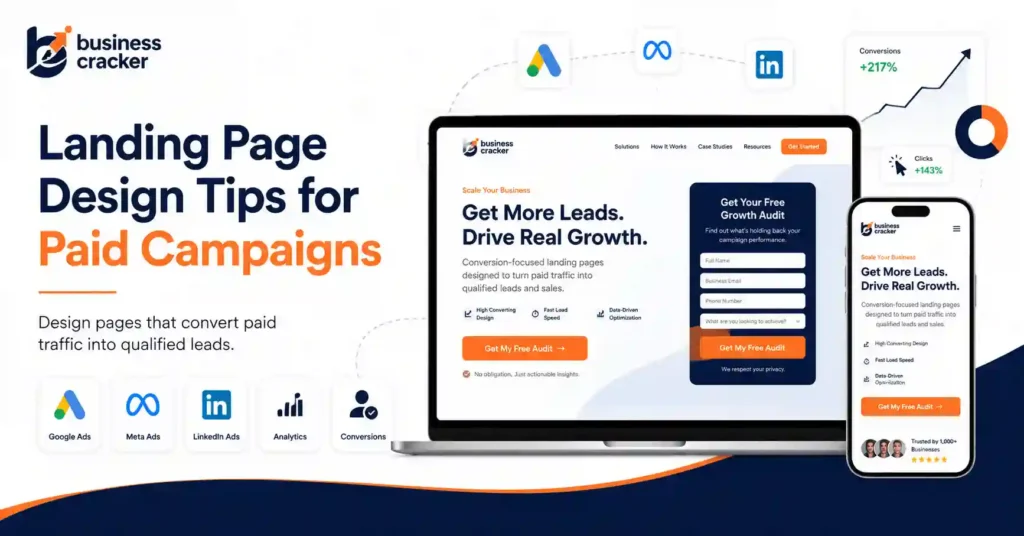
A campaign landing page should focus on one audience, one offer, and one primary conversion goal.
A practical landing-page structure includes:
- A headline that matches the traffic source
- A concise explanation of the offer
- The main business benefit
- Relevant evidence
- Objection handling
- A focused CTA
- A short and usable form
- Privacy and expectation-setting information
Unbounce’s benchmark data shows why message matching matters. The company specifically recommends aligning landing-page messaging with the advertisement that brought the visitor to the page.
Business Cracker’s performance marketing services connect audience targeting, paid campaign structure, landing-page intent, remarketing, and conversion tracking.
Blog Posts: Attract and Educate
Most blog readers are not ready to contact sales immediately. That does not make blog traffic useless.
Helpful content can:
- Rank for informational searches
- Earn backlinks
- build brand awareness
- answer buyer questions
- support internal linking
- establish subject-matter expertise
- introduce visitors to commercial services
- assist existing prospects during evaluation
A blog article should have a relevant next step, but that next step must fit the reader’s intent.
Examples include:
- Read a related guide
- Review the relevant service
- Download a checklist
- Compare available approaches
- Request an audit
- Subscribe to useful updates
For a practical publishing process, use our on-page SEO checklist to review search intent, titles, headings, content depth, internal links, URLs, images, and page experience.
About Page: Reduce Perceived Risk
The About page is not the place for another generic company description.
It should help visitors understand:
- Why the company exists
- Who is responsible for the work
- What experience the team has
- How the company operates
- Which values affect delivery
- Whether the company appears credible and stable
Use real names, faces, roles, and experience. Buyers are more comfortable contacting a business when they can see who may be involved.
Contact Page: Remove Friction
The contact page should make starting a conversation easy.
Include:
- A short form
- Clear field labels
- An alternative contact method
- Expected response time
- Privacy reassurance
- Instructions for different enquiry types
- Business location or service area
- A confirmation that the form worked
Avoid treating the initial contact form like a complete sales-discovery interview.
Ask only for information that is necessary before the first response. Additional qualification can happen through conditional fields, a second step, or the sales conversation.
Thank-You Page: Continue the Journey
A generic “Thank you” message wastes an important opportunity.
The thank-you page should explain:
- That the submission was received
- What happens next
- Who may make contact
- When the visitor should expect a response
- What the visitor can prepare
- Which resources may help in the meantime
It may also include:
- Calendar booking
- A relevant case study
- An implementation checklist
- A product demonstration
- A newsletter signup
- A link to a useful guide
The page should also trigger the appropriate conversion event for analytics and advertising platforms.
Write a Value Proposition That Solves a Real Problem
A value proposition should connect the company’s service with a meaningful customer outcome.
Use this framework:
We help [specific audience] achieve [valuable outcome] through [service or method], without [major frustration or risk].
Examples:
We help B2B software companies build qualified organic pipeline through technical SEO, high-intent content, and relevant authority building.
We help regional healthcare providers replace outdated patient systems with secure, accessible software designed around staff workflows.
We help professional service firms turn paid traffic into qualified consultations through campaign-specific landing pages and conversion tracking.
The best value proposition is not always the most creative sentence. It is the statement that makes the business easiest to understand.
Use Forms That Balance Volume and Lead Quality
The common advice to “make every form shorter” is incomplete.
Shorter forms can reduce effort, but they may also produce more unqualified submissions. Longer forms can improve qualification, but they may discourage valuable prospects.
The correct form depends on:
- Offer value
- Service complexity
- Sales capacity
- Purchase urgency
- Traffic source
- Customer type
- Contract value
- Information needed for routing
Keep Essential Fields Simple
Typical initial fields include:
- Name
- Work email
- Company
- Service required
- Brief description
Additional fields may be useful when they affect qualification or routing:
- Budget range
- Project timeline
- Company size
- Current platform
- Location
- Required integration
- Monthly traffic or advertising spend
Explain Why Sensitive Information Is Needed
A prospect may hesitate to share budget, phone number, company revenue, or technical details.
Add a short explanation when necessary:
Your budget range helps us recommend a realistic delivery approach before the consultation.
This is more reassuring than marking the field as required without context.
Design for Real Form Behavior
Test:
- Mobile keyboards
- Autofill
- Field validation
- Error messages
- Tab order
- Contrast
- Labels
- Button size
- Confirmation behavior
- Spam protection
- CRM integration
- Notification delivery
A form that looks correct may still fail because messages are sent to spam, CRM records are duplicated, or required fields are difficult to use on mobile.
Make Mobile Performance a Revenue Requirement
Mobile optimization is no longer a secondary design consideration.
According to StatCounter Global Stats, mobile devices represented 51.51 percent of worldwide web traffic in June 2026, compared with 47.12 percent for desktop devices. The exact device mix will differ by industry, geography, and traffic source, so every business should review its own analytics.
A mobile lead generation page should have:
- Readable text without zooming
- Buttons that are easy to tap
- Short forms
- Click-to-call functionality where appropriate
- Stable layouts
- Compressed images
- Minimal intrusive popups
- Important content available on mobile
- Clear navigation
- Fast feedback after interaction
Google’s mobile-first indexing guidance also recommends maintaining equivalent primary content, meaningful headings, metadata, structured data, and image information across mobile and desktop experiences.
Improve Speed Without Chasing a Perfect Score
Page speed influences how quickly visitors can understand and use a website.
Google’s current Core Web Vitals guidance defines the following “good” thresholds:
- Largest Contentful Paint within 2.5 seconds
- Interaction to Next Paint of 200 milliseconds or less
- Cumulative Layout Shift of 0.1 or less
Google recommends measuring these thresholds at the 75th percentile of page loads, separately for mobile and desktop.
Common performance problems include:
- Oversized hero images
- Autoplay video
- Heavy sliders
- Too many plugins
- Excessive tracking scripts
- Unused JavaScript
- Render-blocking resources
- Poor hosting
- Unoptimized fonts
- Layout shifts caused by forms, banners, or widgets
Do not optimize the homepage alone. Test service pages, landing pages, blog templates, case studies, and contact pages.
Google states that Core Web Vitals are used by its ranking systems, but it also warns that strong scores do not guarantee top rankings. Relevance and overall usefulness remain essential. The practical goal is not a decorative score of 100. It is a fast and stable experience for real users.
For a deeper review of crawlability, indexing, Core Web Vitals, JavaScript, structured data, and site architecture, read our guide to technical SEO for business websites.
Treat Accessibility as Part of Conversion Design
Accessible design helps more people understand, navigate, and complete important actions.
The Web Content Accessibility Guidelines provide an international standard for making web content accessible to people with disabilities. W3C recommends using the latest version, WCAG 2.2. Its guidelines are organized around four principles: content should be perceivable, operable, understandable, and robust.
Lead generation pages should review:
- Color contrast
- Keyboard navigation
- Visible focus states
- Form labels
- Error identification
- Alternative text
- Heading structure
- Button clarity
- Video captions
- Touch-target size
- Screen-reader behavior
Accessibility is not an optional layer added after design. It should be considered during content planning, wireframing, development, and quality assurance.
Connect SEO, Content, and Link Building With Conversion
A lead generation website needs qualified visitors, not random visibility.
SEO supports lead generation when it targets searches connected to real buyer needs.
A useful SEO structure may include:
- Educational articles for problem awareness
- Comparison content for evaluation
- Service pages for commercial intent
- Location pages for regional searches
- Case studies for validation
- Pricing or cost guides for financial evaluation
- Technical resources for specialist buyers
- Contact or consultation pages for action
Internal links should move readers naturally from education to evaluation.
For example:
- A technical SEO guide links to SEO services
- A website conversion article links to web design services
- A backlink strategy guide links to link building services
- A reputation article links to ORM services
- A paid advertising article links to performance marketing services
Backlinks should also support the larger commercial strategy. The objective is not to collect the greatest possible number of referring domains. It is to strengthen pages, topics, and brand signals that matter.
Our guide to custom link building services explains how target pages, competition, search intent, industry relevance, and business priorities should shape a campaign. Companies with original research, useful tools, strong data, or newsworthy expertise can also use digital PR link building to earn authority and brand coverage.
Track the Metrics That Explain Business Performance
A single website conversion rate does not explain enough.
A business should measure the full path from visitor to revenue.
Acquisition Metrics
What to Measure
- Relevant organic sessions
- Non-branded search visibility
- Paid traffic quality
- Click-through rate
- Referral traffic
- Engaged landing-page visits
- Cost per visitor
- Traffic by location and device
Conversion Metrics
What to Measure
- CTA click rate
- Form-start rate
- Form-completion rate
- Call clicks
- Calendar bookings
- Chat interactions
- Landing-page conversion rate
- Conversion rate by source
- Conversion rate by device
Lead-Quality Metrics
What to Measure
- Qualified-lead rate
- Rejected-lead rate
- Rejection reasons
- Cost per qualified lead
- Opportunity rate
- Lead response time
- Sales acceptance rate
Revenue Metrics
What to Measure
- Lead-to-customer rate
- Customer acquisition cost
- Pipeline value by source
- Closed revenue by landing page
- Average contract value
- Marketing return on investment
- Customer lifetime value
Segment these metrics by:
- Traffic source
- Campaign
- Landing page
- Device
- Location
- Service
- New versus returning visitors
- Branded versus non-branded search
An overall conversion rate may look healthy while hiding a serious mobile, campaign, or lead-quality problem.
Build a Useful Measurement Setup
At minimum, track:
- Form starts
- Successful form submissions
- Phone-number clicks
- Email-address clicks
- Calendar bookings
- Chat starts
- Downloads
- Video engagement where commercially relevant
- Thank-you-page views
- Campaign parameters
- Original traffic source
- CRM qualification status
- Opportunity creation
- Closed revenue
Tracking should be tested after implementation. Do not assume an event works because it appears in a tag-management interface.
Submit test leads and confirm that:
- The analytics event fires once
- The CRM creates the correct record
- The source is preserved
- Notifications reach the correct person
- Automated messages are delivered
- Spam filters are not blocking legitimate leads
Prioritize Website Improvements by Business Impact
Not every website issue deserves equal attention.
Use a simple prioritization model:
Priority = Estimated business impact × Confidence ÷ Implementation effort
High-priority problems often include:
- Broken forms
- Missing conversion tracking
- Important pages not indexed
- Slow mobile landing pages
- Unclear primary offer
- Incorrect contact routing
- Major message mismatch
- Missing calls to action
- Weak proof on high-intent pages
Lower-priority items may include:
- Decorative animation changes
- Minor icon adjustments
- Small color preferences
- New stock photography
- Layout changes without evidence of a problem
Start with issues that directly affect high-value pages, qualified traffic, contact completion, or sales response.
A 30-Day Lead Generation Website Improvement Plan
Week 1: Diagnose
- Validate forms and conversion tracking
- Review traffic sources and landing pages
- Identify high-value pages
- Review mobile performance
- Study form-abandonment behavior
- Interview sales staff about lead quality
- Categorize rejected enquiries
Week 2: Improve Relevance and Messaging
- Clarify the value proposition
- Match pages to search and campaign intent
- Rewrite vague headlines
- Improve service-page explanations
- Add clearer CTAs
- Remove distracting content
Week 3: Strengthen Trust and Reduce Friction
- Add relevant case studies
- Improve testimonials
- Explain the delivery process
- Shorten or restructure forms
- Add response-time expectations
- Improve mobile usability
- Address common objections
Week 4: Connect Marketing With Sales
- Confirm CRM routing
- Create lead qualification rules
- Define response-time expectations
- Improve confirmation emails
- Set up nurturing for early-stage leads
- Build a qualified-lead dashboard
- Prioritize the next testing cycle
Final Lead Generation Website Checklist
Before investing in more traffic, confirm that your website can answer yes to these questions:
- Does each important page have a clear purpose?
- Can visitors understand the offer quickly?
- Does the message match the traffic source?
- Are the most valuable pages easy to find?
- Do service pages answer buyer questions?
- Is proof placed near important claims?
- Are calls to action appropriate for buyer readiness?
- Are forms easy to complete on mobile?
- Are response expectations clear?
- Does the website meet acceptable performance standards?
- Are important pages crawlable and indexable?
- Do blog posts link naturally to relevant services?
- Does the CRM preserve the original lead source?
- Can marketing report qualified leads and revenue?
- Does sales follow up consistently?
If several answers are no, increasing traffic will not fix the underlying system.
Turn Your Website Into a Measurable Growth System
A successful lead generation website does more than attract visitors and display contact forms.
It brings together:
- Relevant traffic acquisition
- Search-intent alignment
- Clear messaging
- Useful content
- Credible evidence
- Conversion-focused design
- Mobile performance
- Accessible experiences
- Accurate tracking
- Lead qualification
- Fast sales follow-up
At Business Cracker, our work connects SEO, link building, performance marketing, website design and development, and online reputation management with practical business growth goals.
If your website receives traffic but does not produce enough qualified opportunities, request a consultation with Business Cracker. We will help you identify whether the main problem is visibility, traffic quality, page experience, trust, conversion, measurement, or follow-up.
Frequently Asked Questions About Lead Generation Website Design
1. What is a lead generation website?
A lead generation website is designed to attract relevant visitors, answer their questions, build confidence, and encourage an appropriate action such as requesting a quote, booking a consultation, starting a trial, or calling the business. It also connects those actions with qualification, CRM routing, analytics, and sales follow-up.
2. What is the most important element of lead generation website design?
There is no single element that guarantees results. The most important requirement is alignment. The audience, traffic source, page message, offer, proof, CTA, form, and follow-up process must support the same customer need and business objective.
3. How many fields should a lead generation form have?
Use the minimum number of fields required to support the next step. A simple consultation form may need only a name, email, company, service, and message. A high-value or technically complex service may require additional qualification fields. Test form completion and lead quality together rather than optimizing only for submission volume.
4. How do SEO and link building support website lead generation?
SEO helps a website appear for searches connected to customer problems and commercial needs. Link building can strengthen authority, support competitive pages, generate relevant referral traffic, and increase third-party brand visibility. Both work best when the destination pages are useful, trustworthy, technically sound, and designed to convert qualified visitors.
5. How should a business measure lead generation website performance?
Track more than form submissions. Measure traffic quality, CTA clicks, form starts, completed enquiries, qualified-lead rate, cost per qualified lead, opportunity rate, response time, close rate, pipeline value, and revenue by source. The best-performing website is the one that creates meaningful business outcomes, not necessarily the one with the highest raw conversion rate.