April 26, 2026
What Is Link Building in SEO and Why Does It Still Matter?
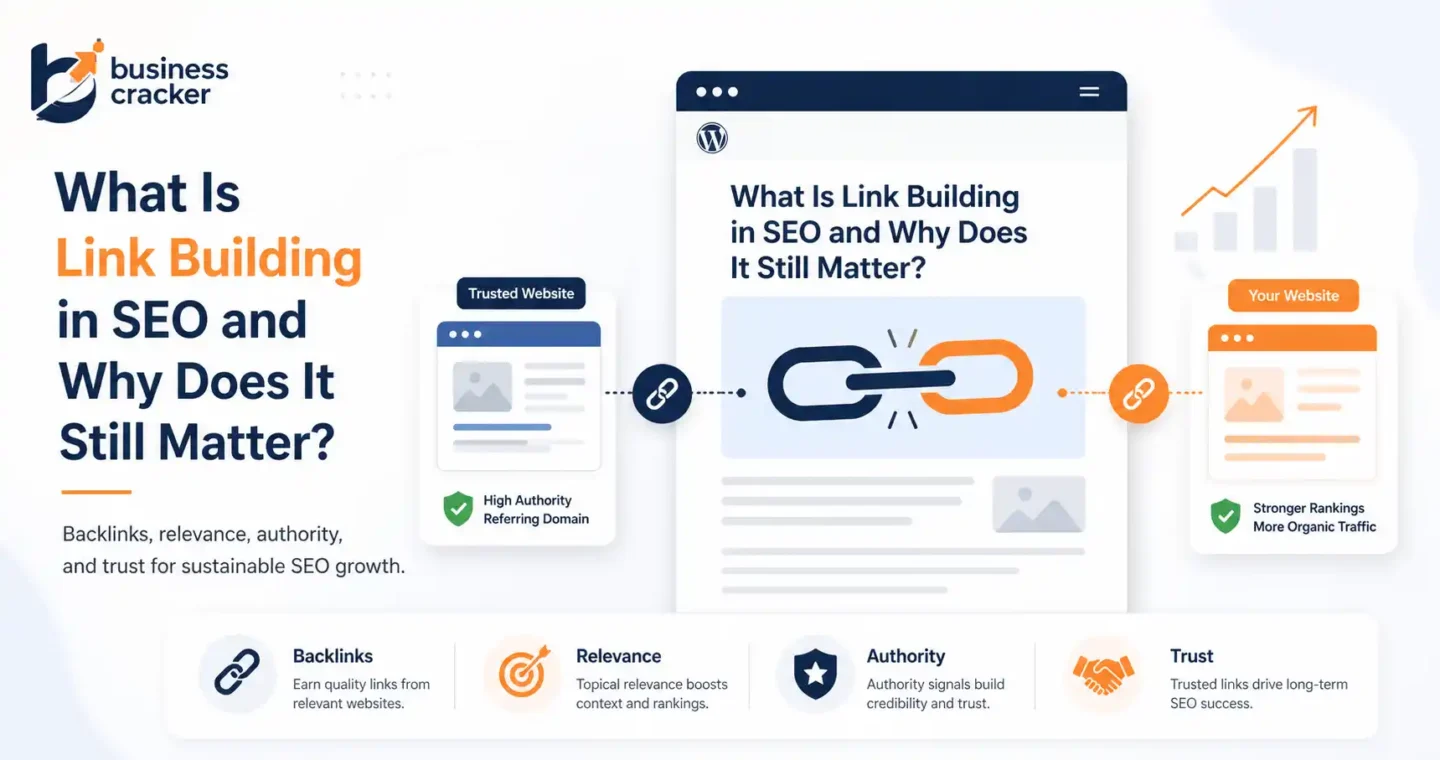
Link building in SEO is the process of earning links from other websites to your website. These links are called backlinks. A backlink works like a reference. When a relevant and trusted website links to your page, it gives search engines another signal that your content, service, or brand may be worth paying attention to.
That does not mean every backlink helps. In 2026, the problem is not whether backlinks still matter. The real problem is that many businesses still treat link building like a numbers game. They chase directory links, paid guest posts, random outreach, low-quality placements, and exact-match anchors without asking whether the link is relevant, trustworthy, useful, or safe.
Current SEO community discussions show the confusion clearly. Marketers and beginners are asking whether backlinks still move rankings, which off-page SEO methods still work, whether old backlink tactics are obsolete, and how to build links without getting caught in low-quality link networks. The common answer from experienced practitioners is consistent: backlinks still matter, but volume alone is not the strategy anymore. Relevance, editorial context, domain quality, page quality, and anchor control matter more than raw link count.
The Problem This Article Solves
Most business owners and marketers hear two opposite opinions about backlinks.
One side says link building is dead.
The other side says links are still everything.
Both views are incomplete.
Link building is not dead, but outdated link building is risky and often useless. A business website does not need hundreds of weak backlinks from irrelevant domains. It needs a clean backlink profile, relevant mentions, strong internal pages worth linking to, and a process for earning links that support real search visibility.
This article explains what link building in SEO means, why backlinks still matter, what link building mistakes hurt businesses, and how to approach backlinks in a safer and more practical way.
Desired Reader Outcome
After reading this article, you should be able to:
- Understand what backlinks are and how they support SEO
- Separate useful links from weak or risky links
- Know why link relevance matters more than volume
- Avoid common link spam problems
- Build a simple off-page SEO process for a business website
- Decide when your website may need professional link building services
What Is Link Building in SEO?
Link building is the process of getting other websites to link to your website.
Google explains that links help it discover pages and understand what linked pages are about, especially when anchor text is clear and relevant.
A backlink may point to:
- Your homepage
- A service page
- A blog post
- A case study
- A research page
- A product page
- A tool, template, or resource
Google’s link guidance states that links help Google discover pages and can be used as a signal when determining the relevance of pages. Google also recommends descriptive anchor text so users and search engines can understand the linked page.
In simple terms, backlinks help in three ways.
First, they help discovery. Search engines can find URLs through links.
Second, they help to increase authority. A link from a relevant, trusted website can support credibility.
Third, they help with context. The page that links to you, the surrounding content, and the anchor text all help explain what your page is about.
What Are Backlinks?
A backlink is a link from one website to another.
For example, if a business magazine links to your article about technical SEO, that is a backlink. If a local directory links to your company profile, that is also a backlink. If a partner site links to your case study, that is another backlink.
But these links are not equal.
A relevant backlink from a respected industry website is usually more valuable than dozens of links from unrelated directories. A link from a page with real traffic, clear editorial standards, and topical relevance is stronger than a link from a page created only to sell outbound links.
That is where many businesses go wrong. They count backlinks instead of evaluating them.
Why Link Building Still Matters
Backlinks still matter because search engines need signals beyond your own website.
A Backlinko analysis of 11.8 million Google search results found that the number one result had an average of 3.8 times more backlinks than results in positions two to ten.
Any business can write on its own site that it is trusted, experienced, and reliable. Backlinks from other credible websites help support that claim.
Semrush also reported in its ranking-factor research that backlink-related factors remain among the strongest correlating factors with ranking. In a 2025 Semrush article, the company stated that 8 of the top 20 factors with the strongest correlation to ranking were related to backlinks.
This does not mean backlinks guarantee rankings. Correlation is not the same as causation. Content quality, technical SEO, search intent, internal linking, page experience, and brand demand also matter. But for competitive business keywords, backlinks are still difficult to ignore.
Link Building Is Not a Shortcut Anymore
Old link building often focused on quantity.
Google’s spam policies warn against link spam, including links created mainly to manipulate search rankings, excessive link exchanges, automated link creation, and low-quality links placed in third-party content.
That approach looked like this:
- Buy 100 backlinks
- Submit to random directories
- Publish thin guest posts
- Use exact-match anchor text repeatedly
- Join link exchange groups
- Build private blog network links
- Add irrelevant blog comments
- Place links on expired domains
That type of off-page SEO is not a serious long-term strategy.
Google’s spam policies warn against link spam, including links intended to manipulate search rankings. These policies include buying or selling links for ranking purposes, excessive link exchanges, automated link creation, and low-quality links embedded in third-party content.
For a business website, the risk is clear. Poor link building can waste budget, create unnatural anchor patterns, and damage trust. Even when weak links do not cause a penalty, they often do nothing useful.
Modern link building has to be more selective.
What Makes a Backlink Valuable?
A useful backlink usually has five qualities.
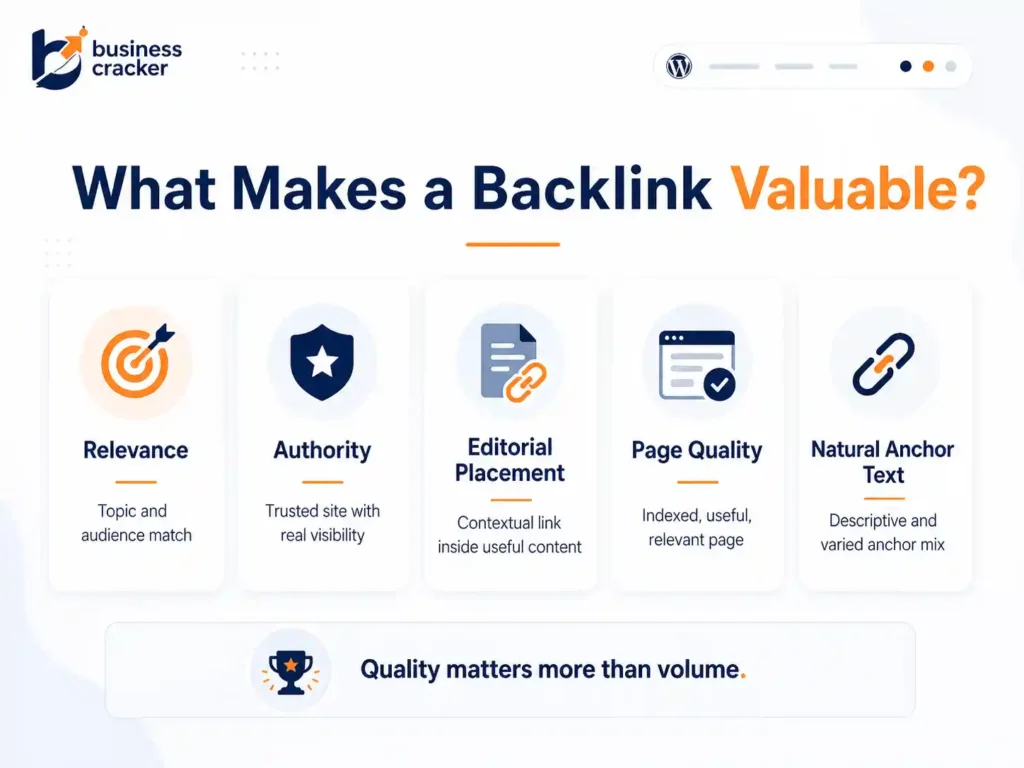
1. Relevance
The linking website should be related to your industry, audience, location, or topic.
For example, a digital marketing agency can benefit from links from SEO blogs, marketing publications, business directories, startup sites, SaaS blogs, web design resources, and local business websites.
A random casino, coupon, crypto, or unrelated directory link does not build the same trust.
Relevance is the first filter.
2. Authority
Authority is not only about third-party metrics like DA, DR, or authority score. Those metrics can help with evaluation, but they are not Google metrics.
A strong linking domain usually has:
- Real organic visibility
- Clear editorial standards
- Relevant topical coverage
- Natural outbound linking behavior
- A clean backlink profile
- Real users or readership
Ahrefs explains its Domain Rating metric as a third-party measure based on the quantity and quality of external backlinks to a website, while also noting that it is not a direct Google ranking factor.
Use third-party metrics as filters, not final judgment.
3. Editorial Placement
A link is stronger when it appears naturally inside useful content.
Examples:
- A quote in an expert roundup
- A reference inside a guide
- A link to a case study
- A citation to original research
- A resource mentioned in a useful article
- A link from a partner or client story
A link buried in a footer, author bio, sidebar, or unrelated list is usually weaker.
4. Page Quality
Do not judge only the domain. Judge the page.
Check:
- Is the page indexed?
- Does the page get traffic?
- Is the content useful?
- Is the topic relevant?
- Are there too many outbound links?
- Does the page look created only for links?
- Is the website filled with generic guest posts?
A high-domain website can still have weak pages.
5. Natural Anchor Text
Anchor text is the clickable text in a link.
For this article, the internal anchor link building services point to the Business Cracker link building service page. The anchor tells users and search engines what the linked page is about.
Good backlink anchors are usually mixed:
- Brand name
- Naked URL
- Partial-match keyword
- Page title
- Natural phrase
- Generic text used sparingly
A backlink profile with too many exact-match anchors can look unnatural. For example, if every backlink uses “best link building services” or “SEO services India,” that pattern may raise risk.
Link Building vs. Off-Page SEO
Link building is part of off-page SEO, but they are not exactly the same.
Off-page SEO includes all external signals that support your website’s authority and visibility.
This may include:
- Backlinks
- Brand mentions
- Digital PR
- Business profiles
- Reviews
- Local citations
- Social visibility
- Podcast mentions
- Expert quotes
- Partnerships
- Community visibility
Link building is narrower. It focuses specifically on earning backlinks.
A strong off-page SEO strategy does not depend only on links. It also builds brand trust, referral visibility, reputation, and topical authority outside your own website.
The Biggest Link Building Problems Businesses Face
Problem 1: Chasing Link Volume
Many businesses ask for a fixed number of backlinks per month. That is understandable from a reporting point of view, but it can create the wrong behavior.
If the goal is only volume, quality drops.
A better question is:
Which pages need authority, and what kind of links would make sense for those pages?
For example, a new SEO service page may need links from marketing resources, founder profiles, service directories, business publications, or relevant guest posts. A blog post may need links from guides, resource pages, or expert articles.
Volume without relevance is noise.
Problem 2: Building Links to the Homepage Only
Many websites build most backlinks to the homepage. That helps brand authority, but it may not be enough.
Commercial pages also need support.
For example:
- SEO service page
- Link building service page
- Web design service page
- Performance marketing service page
- Case studies
- High-value blogs
A smart link building plan distributes links across important URLs. The homepage should not carry the entire backlink profile.
Problem 3: Weak Content That Does Not Deserve Links
Link building becomes difficult when the website has nothing worth referencing.
Businesses often try outreach for pages that are too commercial, thin, or generic. Most publishers do not want to link to a basic service page unless there is a strong reason.
Create linkable assets first.
Examples:
- Original research
- Industry statistics
- Case studies
- Practical templates
- Checklists
- Free tools
- Detailed guides
- Comparison pages
- Data-backed opinions
If the page provides real value, outreach becomes easier.
Problem 4: Irrelevant Guest Posting
Guest posting can work, but only when the website, article, audience, and link are relevant.
Weak guest posting looks like this:
- Generic article
- Poor website
- No editorial review
- Irrelevant link
- Exact-match anchor
- Obvious paid placement
- Thin content created only for the backlink
Useful guest posting looks like this:
- Relevant publication
- Useful topic
- Natural author expertise
- Contextual link
- Real audience
- Clear editorial quality
- Anchor text that fits the sentence
The difference matters.
Problem 5: Ignoring Link Risk
Not every backlink is worth keeping.
Red flags include:
- Websites with hundreds of unrelated guest posts
- Domains with sudden traffic drops
- Pages with spammy outbound links
- PBN-style site networks
- Irrelevant foreign-language domains
- Exact-match anchor repetition
- Links from hacked pages
- Automated directory submissions
- Obvious paid link farms
Before building a link, inspect the site manually. Tools help, but manual review catches patterns that metrics miss.
A Practical Link Building Process for Business Websites
A safe link building process should start with the website, not outreach.
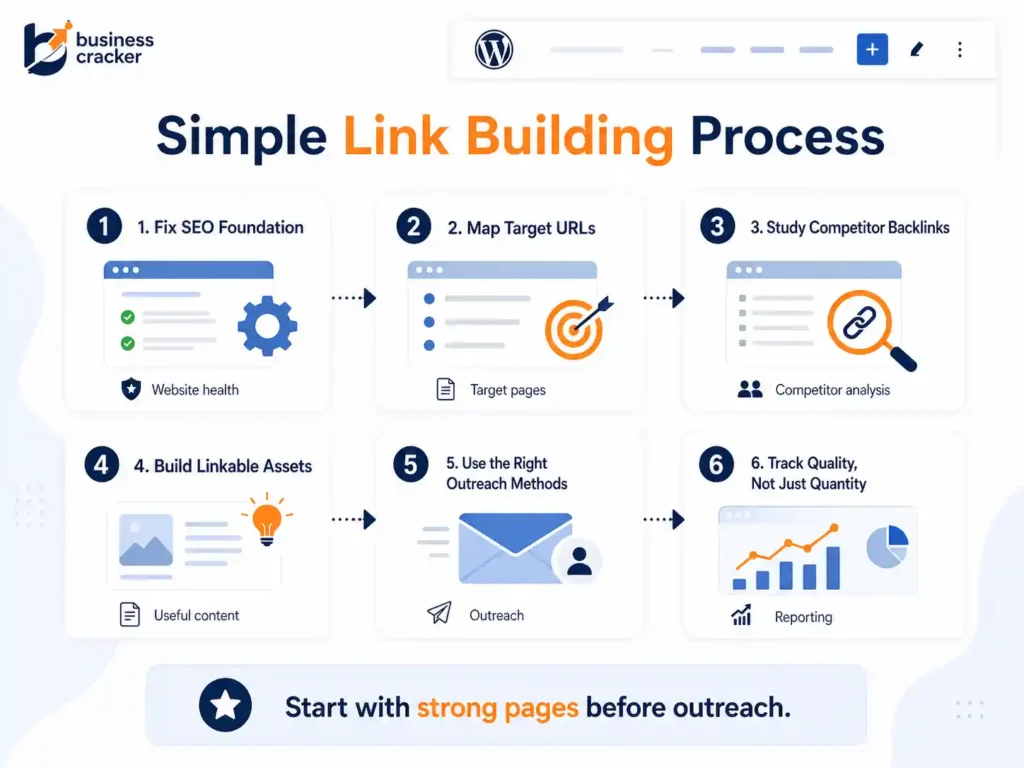
Step 1: Fix the SEO Foundation
Before building backlinks, make sure your important pages are technically sound and properly optimized.
Check:
- Pages are indexable
- Canonicals are correct
- Internal links are in place
- Titles and H1s match search intent
- Pages load properly on mobile
- Content answers the query clearly
- Contact and conversion paths work
Backlinks can support ranking, but they cannot fix a weak page.
If your core service pages need search visibility improvements, start with SEO services before scaling link acquisition.
Step 2: Map Target URLs
Choose the pages that need links.
A simple business website may prioritize:
- Homepage
- Main SEO service page
- Link building service page
- Web design page
- Two or three high-value blogs
- One or two case studies
Do not build links blindly to every URL. Prioritize pages that can rank, convert, or support authority.
Step 3: Study Competitor Backlinks
Review competitor backlink profiles to understand what kind of links are common in your niche.
Look for:
- Guest posts
- Directories
- Digital PR mentions
- Podcast links
- Partner pages
- Resource pages
- Industry publications
- Local citations
- Review platforms
- Case study mentions
Do not copy every competitor link. Use competitor data to identify patterns and opportunities.
Step 4: Build Linkable Assets
Outreach works better when you have something useful to share.
For a digital marketing business, linkable assets may include:
- Technical SEO checklist
- On-page SEO checklist
- Link building guide
- SEO audit template
- WordPress SEO checklist
- Case study on ranking improvement
- Local SEO checklist
- Digital marketing cost guide
These pages can attract links more naturally than a basic service page.
Step 5: Choose the Right Link Building Methods
Useful link building methods include:
- Digital PR
- Guest posting on relevant sites
- Expert quotes
- Resource page outreach
- Broken link building
- Partner mentions
- Business directories with real relevance
- Local citations
- Podcast guesting
- Case study collaborations
- Testimonials for tools or vendors
- Reclaiming unlinked brand mentions
Not every method fits every business. A local service business may start with citations and local partnerships. A SaaS company may focus on comparison content, data studies, and digital PR. A digital marketing agency may use expert commentary, guest posts, and niche resources.
Step 6: Control Anchor Text Risk
Anchor text should look natural.
A balanced backlink profile may include:
- Brand anchors: Business Cracker
- URL anchors: businesscracker.com
- Natural anchors: this SEO guide, this resource, the company’s service page
- Partial-match anchors: link building support, SEO service provider
- Exact-match anchors are used rarely and carefully
Avoid repeating the same commercial anchor across many domains.
Step 7: Track Quality, Not Only Quantity
A monthly link building report should not only say “10 backlinks built.”
Track:
- Linking domain
- Linking page URL
- Target URL
- Anchor text
- Link type
- Relevance
- Domain quality
- Page quality
- Indexing status
- Organic traffic of the linking page
- Placement context
- Follow or nofollow status
- Risk notes
This helps business managers understand whether the work is building authority or only adding numbers to a sheet.
Should You Buy Backlinks?
Buying backlinks for ranking purposes is risky.
Google’s spam policies include buying or selling links for ranking purposes under link spam. This includes exchanging money, goods, services, or other compensation for links that pass ranking credit. Google also recommends qualifying certain links with attributes such as rel=”sponsored” or rel=”nofollow” where appropriate.
In real SEO work, the situation is messy. Many publishers charge editorial or placement fees. Many agencies package paid guest posts as outreach. Many businesses buy links because competitors do it.
The safer position is this:
Do not build your long-term SEO strategy on links that exist only because you paid for ranking credit.
Instead, focus on earning placements where the website, content, audience, and link context make sense. If compensation is involved, understand the policy risk and link attribute requirements.
Are NoFollow Links Useful?
A nofollow link tells search engines not to treat the link as a normal endorsement. Google treats nofollow, sponsored, and ugc as hints, not simple commands in every context, but these attributes still matter for link qualification.
NoFollow links can still be useful when they provide:
- Referral traffic
- Brand visibility
- Trust
- Mentions from strong publications
- A natural backlink profile
- Discovery from real users
A backlink profile with only followed commercial links can look unnatural. A natural profile usually includes a mix of followed, nofollow, sponsored, branded, URL, and contextual links.
Do not reject a strong nofollow mention from a trusted publication just because it may not pass traditional link equity.
Link Building for New Websites
New websites face a specific problem. They often have few pages, no authority, and no brand demand.
For a new business website, the first link building phase should be conservative.
Start with:
- Google Business Profile if local
- Bing Places if local
- LinkedIn company profile
- Relevant business directories
- Founder profiles
- Partner or vendor mentions
- Guest posts on small but relevant websites
- Local citations
- Helpful blog content
- Case studies
- Resource pages
Avoid aggressive exact-match anchors early. Use branded and URL anchors first.
For a new website, the first goal is trust and discovery. Competitive rankings take more time.
Link Building for Service Pages
Service pages are harder to earn links to because they are commercial.
That does not mean they should receive no links. It means the strategy has to be careful.
Ways to support service pages:
- Link to them internally from related blogs
- Mention them naturally in guest posts
- Link from relevant business profiles
- Include them in case studies
- Use partial-match anchors
- Support them with linkable blog content
- Build topical authority around the service
For example, a blog about backlinks can naturally link to link building services when explaining when a business should seek help. That link is useful because the context matches the destination.
Link Building and Content Strategy Work Together
A website with poor content is hard to promote. A website with good content but no links may struggle in competitive markets.
The strongest SEO strategy combines:
- Technical SEO
- On-page SEO
- Helpful content
- Internal links
- Backlinks
- Brand mentions
- Conversion-focused service pages
Links are not separate from content. They amplify content that is worth referencing.
A good content plan should include pages built for ranking and pages built for earning links. They are not always the same.
For example:
Ranking pages:
- SEO services
- Link building services
- Website design services
- Performance marketing services
Linkable pages:
- SEO checklist
- Link building guide
- Marketing statistics
- Case studies
- Templates
- Tools
Both types matter.
How to Measure Link Building Success
Do not measure link building only by the number of links.
Better metrics include:
- Referring domains
- Quality of referring domains
- Relevance of linking websites
- Links to priority pages
- Anchor text mix
- Organic traffic to target pages
- Ranking improvements
- Search Console impressions
- Assisted conversions
- Referral traffic
- Brand search growth
- Link risk reduction
For business websites, the final goal is not backlinks. The goal is qualified visibility, trust, and leads.
A link building campaign should be judged by whether it supports business outcomes, not whether it fills a monthly quota.
Common Link Building Mistakes
Mistake 1: Buying Cheap Backlink Packages
Cheap backlink packages usually create weak links. Many come from irrelevant blogs, auto-generated pages, link farms, or sites with no real audience.
They may look good in a spreadsheet, but they rarely support durable rankings.
Mistake 2: Using the Same Anchor Text Repeatedly
Repeated exact-match anchors look unnatural.
Use variation. Mix branded, URL, partial-match, and natural anchors.
Mistake 3: Ignoring Relevance
A link from a relevant, smaller website can be more useful than a link from a larger but unrelated website.
Relevance should come before vanity metrics.
Mistake 4: Building Links to Weak Pages
If the target page is thin, slow, confusing, or poorly optimized, backlinks may not help enough.
Fix the page first.
Mistake 5: Treating All Guest Posts as Equal
A guest post on a real industry website is different from a guest post on a site that publishes anything for a fee.
Check the website before accepting the link.
Mistake 6: Forgetting Internal Links
External backlinks help, but internal links help distribute authority across your own site.
If a blog earns backlinks, link from that blog to relevant service pages.
Mistake 7: Reporting Links Without Context
A backlink report should explain why each link matters. A list of URLs is not enough.
Add notes on relevance, anchor, target page, and quality.
A Simple Link Building Checklist
Use this checklist before approving or building a backlink.
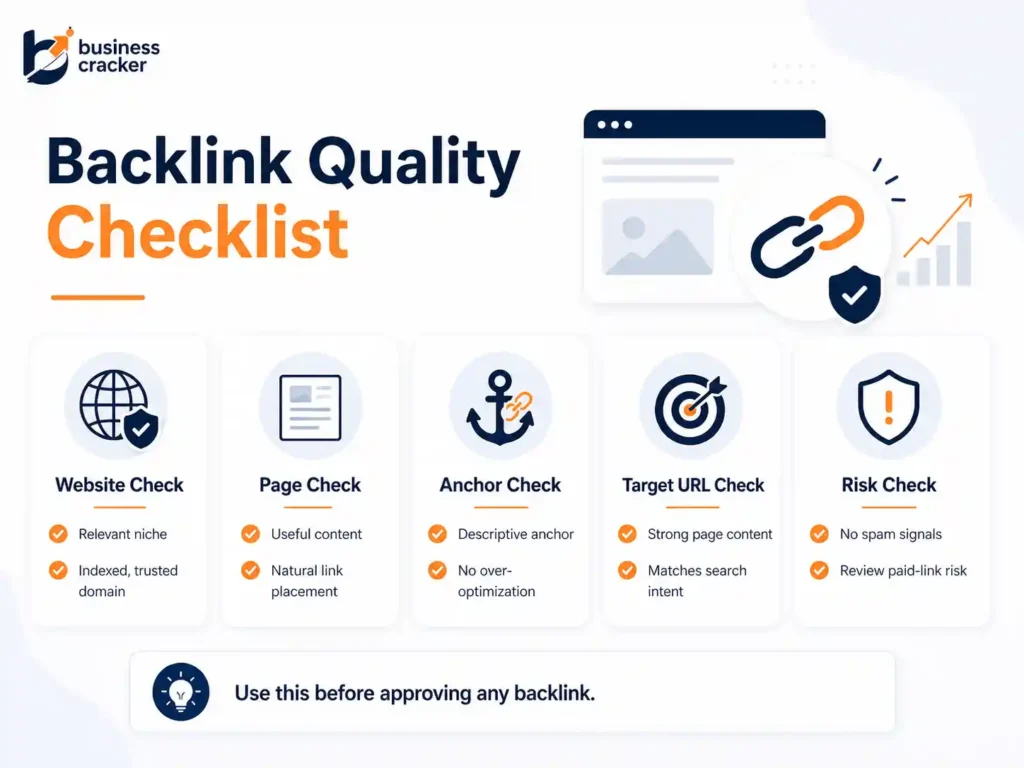
Website Check
- Is the website relevant to your niche?
- Does it have real content?
- Does it rank for any meaningful keywords?
- Does it have organic traffic?
- Does it publish too many unrelated guest posts?
- Does the site look built only for selling links?
- Is the domain indexed?
Page Check
- Is the linking page relevant?
- Is the content useful?
- Is the link placed naturally?
- Are there too many outbound links?
- Is the page likely to be indexed?
- Does the surrounding text support the link?
Anchor Check
- Is the anchor natural?
- Is it too commercial?
- Is the same anchor being repeated elsewhere?
- Does it accurately describe the target page?
Target URL Check
- Is the target page indexable?
- Is the content strong?
- Is the page internally linked?
- Does the page match the anchor text?
- Can the page convert traffic?
Risk Check
- Is the link paid?
- Should it use sponsored or nofollow?
- Is the website part of a network?
- Are there spam signals?
- Would this link make sense if SEO did not exist?
That last question is useful. If the link does not make sense without SEO, review it carefully.
Final Thoughts
Link building in SEO still matters, but the standard has changed. A useful backlink is not just a link on another website. It is a relevant reference from a page that makes sense for your topic, audience, and business.
For business websites, the right approach is selective. Build strong pages first. Link them internally. Create resources worth citing. Earn backlinks from relevant websites. Keep anchor text natural. Avoid shortcuts that create risk without value.
Backlinks are not the whole SEO strategy. They are one part of it. When combined with strong content, clean technical SEO, clear service pages, and useful internal links, link building can still support rankings, authority, and qualified organic growth.