July 13, 2026
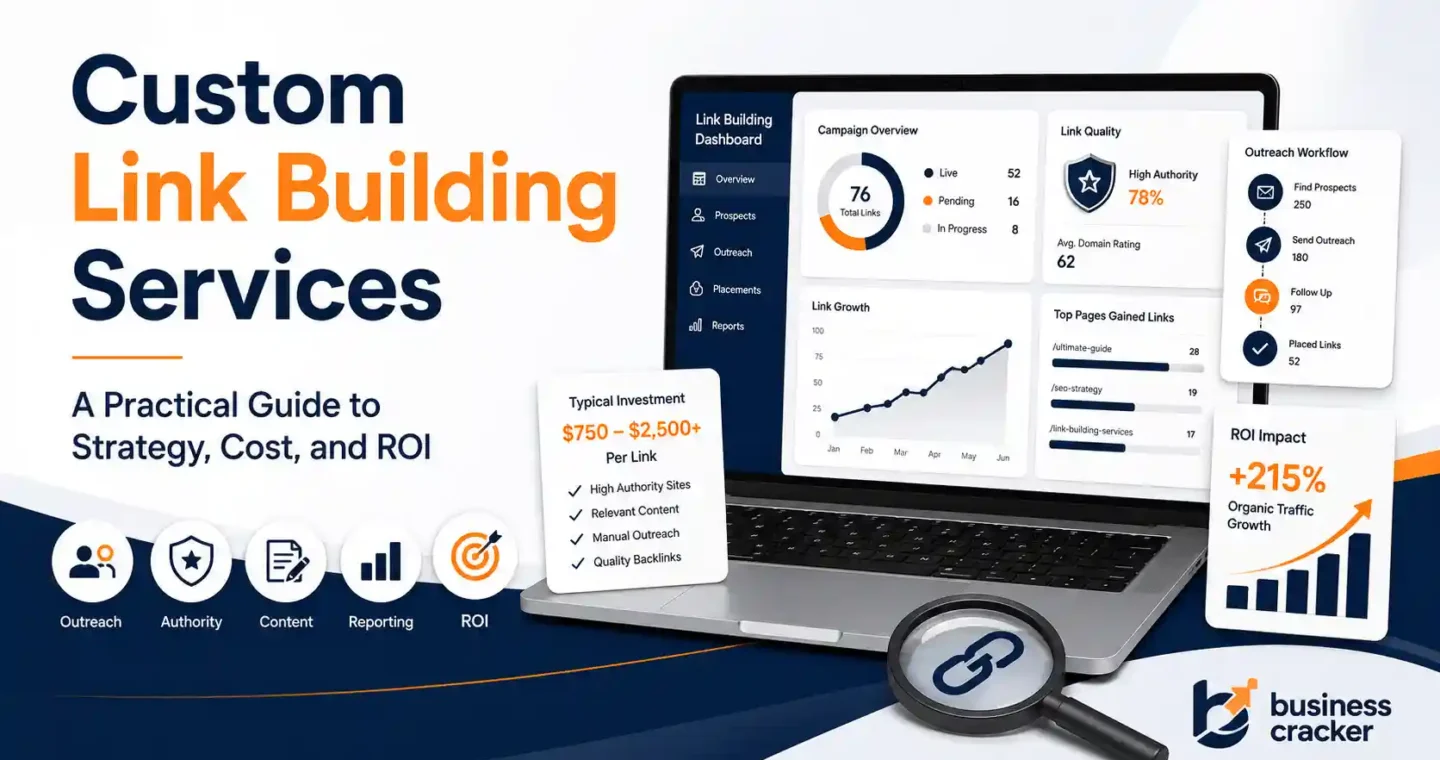
Custom Link Building Services: A Practical Guide to Strategy, Cost, and ROI
Most businesses do not need a standard package containing 10, 20, or 50 random backlinks.
They need links that support specific pages, keywords, audiences, and commercial goals.
That is the purpose of custom link building services.
A custom campaign does not begin by deciding how many backlinks to purchase. It begins by identifying why a website is not competing effectively, which pages have the greatest business potential, and what type of authority those pages need.
For one company, the answer may be editorial links to a high-value service page. Another may need digital PR coverage, local authority, product comparison mentions, partner links, or links to an original research asset.
The approach should change with the business.
At Business Cracker, our link building services are planned around backlink quality, target pages, competitive gaps, search intent, and business priorities. We also connect link acquisition with broader SEO services because backlinks cannot compensate for weak content, technical problems, or pages that do not meet search intent.
This guide explains how custom link building works, what it should cost, which strategies fit different companies, how to evaluate providers, and how to measure whether a campaign is creating real business value.
What Are Custom Link Building Services?
Custom link building services are professionally managed backlink campaigns designed around the specific condition, goals, competition, audience, and website of a business.
Instead of selling the same backlinks to every client, a custom provider analyzes factors such as:
- Current backlink profile
- Domain and page-level authority
- Target keyword competition
- Priority landing pages
- Anchor text distribution
- Existing content assets
- Competitor backlinks
- Industry restrictions
- Geographic market
- Sales cycle
- Business growth goals
- Previous link-building activity
The provider then selects the most appropriate combination of strategies, publishers, target pages, anchors, and campaign timing.
A local law firm, SaaS platform, ecommerce store, and national home-services company should not receive the same campaign. Their customers, competitors, content, authority requirements, and commercial priorities are different.
Custom link building recognizes those differences.
For a broader explanation of the services available, read our complete guide to link building services.
Why Backlinks Still Matter
Google states that it uses links as a signal when determining page relevance and as a way to discover new pages for crawling. Links are not the only factor involved in rankings, but they remain part of how Google understands relationships, context, and importance across the web.
The commercial value of higher search visibility can be substantial.
A Backlinko analysis of approximately 4 million Google results found that the first organic result received an average click-through rate of 27.6 percent. Only 0.63 percent of searchers clicked a result from the second page. These figures vary by query and search-results layout, but they illustrate why moving from an invisible position to a competitive first-page position can affect traffic and lead generation.
Relevant backlinks can contribute to:
- Stronger authority for priority pages
- Improved discovery and crawling
- Better rankings for competitive searches
- Referral traffic from relevant audiences
- Greater brand recognition
- Industry credibility
- Partnership opportunities
- More third-party mentions
- A stronger presence across the open web
However, links do not create these outcomes automatically. The source, placement, target page, anchor text, content, and reason for the link all matter.
Why Standard Link Packages Often Fail
Productized packages can make purchasing easier, but they frequently ignore the actual reason a website is struggling.
A package may promise:
- 10 DR 40 backlinks
- Five guest posts
- A fixed mix of niche edits
- A certain number of dofollow links
- Delivery within 30 days
None of those promises answers the most important question:
Will these links support pages that can generate meaningful business growth?
A campaign can deliver every promised link and still fail commercially.
The links may target the wrong pages
Some providers send most links to the homepage because it is convenient. Others let the client submit target URLs without reviewing whether those pages are strong enough to rank or convert.
A service page with poor content, unclear positioning, weak internal linking, or mismatched search intent may not benefit from additional authority.
The websites may be irrelevant
A high Domain Rating does not make a publisher relevant.
A cybersecurity company may gain more value from a respected software, privacy, or compliance publication than from a higher-metric lifestyle blog with no connection to its customers.
The campaign may ignore existing authority
A website may already have strong homepage authority but very few links to important internal pages.
Adding more homepage links may improve a report without addressing the real gap.
The link velocity may be unrealistic
A new website that suddenly gains dozens of keyword-focused editorial links can create a very different pattern from an established brand receiving regular media coverage.
Campaign volume should reflect the website’s history, industry, content output, and existing visibility.
The provider may measure delivery instead of performance
A report that says “20 backlinks completed” only confirms that work was delivered.
It does not show:
- Whether target rankings improved
- Whether priority pages gained impressions
- Whether referral traffic increased
- Whether branded searches grew
- Whether the campaign generated leads
- Whether the links remained active
- Whether the placements were relevant
Custom campaigns should be accountable to a strategy, not only a link count.
When Does a Business Need Custom Link Building?
Link building is most useful when a website has pages worth ranking but lacks the authority or third-party recognition needed to compete.
A custom campaign may be appropriate when:
Strong content is not ranking competitively
Your pages are technically accessible, satisfy search intent, and provide useful information, but competitors with stronger backlink profiles continue to outrank you.
Commercial pages have little external authority
Your blog may attract links naturally while high-value service, category, comparison, or product pages receive none.
Competitors dominate third-party discussions
Competitors appear in industry articles, software comparisons, buying guides, directories, podcasts, expert roundups, and resource pages while your brand is absent.
Organic growth has plateaued
Technical SEO and content improvements have been completed, but keyword visibility has stopped improving.
Your internal team cannot scale outreach
Effective prospecting, contact research, pitching, follow-up, content coordination, placement review, and reporting require consistent time and specialist knowledge.
Previous providers delivered poor-quality links
A custom campaign can audit what was built, preserve legitimate links, identify risky patterns, and create a cleaner acquisition strategy.
You are entering a competitive market
New locations, services, products, or countries may require new topical, commercial, and geographic authority signals.
When Link Building Should Not Be the First Priority
A professional provider should be willing to say when a business is not ready for link building.
Building more backlinks may be premature when:
- Important pages are blocked from indexing
- The site has serious crawling or canonical problems
- Service pages contain thin or unclear content
- The website does not match search intent
- Conversion tracking is missing
- The offer is not competitive
- Internal linking is poor
- The target pages load slowly or provide a weak user experience
- Keyword cannibalization is unresolved
- The site has no useful content worth promoting
For example, a page that Google cannot index will not become competitive because an agency sends more links to it.
Our guide to technical SEO for business websites explains how crawling, indexing, canonicals, redirects, page performance, and site structure can limit organic visibility before link building begins.
The right sequence is often:
- Fix the technical foundation.
- Improve the target page.
- Strengthen internal links.
- Confirm search intent.
- Build relevant external authority.
- Track business impact.
Types of Custom Link Building Services
A custom campaign may combine several acquisition methods. The correct mix depends on what the business is trying to accomplish.
Manual Outreach Link Building
Manual outreach involves identifying relevant publishers, finding the correct contact, developing a useful pitch, and building a relationship that may lead to a link.
This is not the same as sending thousands of automated emails.
A strong outreach process includes:
- Careful prospect selection
- Contact verification
- Personalized messaging
- A clear reason for the publisher to care
- Follow-up
- Editorial coordination
- Placement review
- Relationship management
Best for
Manual outreach works well for B2B companies, SaaS brands, agencies, professional services, ecommerce companies, and businesses with useful content or expert knowledge.
Main limitation
Outreach cannot force a publisher to respond. The quality of the offer, content, prospect list, and message determines the result.
Guest Posting
Guest posting involves contributing an article to a relevant third-party publication.
A strong guest post provides value to the publication’s audience and includes a contextual reference only where it helps the reader.
A weak guest-post campaign typically involves:
- Websites that openly sell links in every niche
- Generic or AI-generated articles
- Exact-match commercial anchors
- Unrelated topics
- Minimal editorial review
- Hundreds of outbound links to clients
The commercial guest-post market requires careful scrutiny.
A 2026 BuzzStream analysis of nearly 500,000 guest-post websites classified 96.2 percent of the sites as low quality. The study also found that 39.6 percent had no estimated monthly organic traffic, while only 1.37 percent qualified as high quality or top tier under its methodology.
The lesson is not that all guest posting is bad. It is that domain metrics and vendor promises are not enough.
Best for
Guest posting can work for brands with subject-matter expertise, original opinions, educational content, and access to relevant publications.
Main limitation
Large-scale, low-quality guest posting can create weak or manipulative patterns.
Niche Edits and Editorial Link Insertions
A niche edit adds a relevant link to an existing page.
This can be legitimate when a publisher updates an article with a useful new source, tool, statistic, or resource. It becomes questionable when an unrelated commercial link is inserted into old content solely because someone paid for placement.
Before approving a niche edit, review:
- The age and current quality of the page
- Topical relevance
- Organic visibility
- Surrounding paragraph
- Existing outbound links
- Anchor text
- Why the new source improves the article
- Whether compensation is involved
- Whether the link should be qualified
Google’s spam policies prohibit links created primarily to manipulate Search systems. Google also explains how paid, sponsored, and user-generated links should be qualified in its outbound-link documentation.
Digital PR
Digital PR earns coverage through stories, data, commentary, research, trends, and useful public information.
Campaign formats may include:
- Original surveys
- Product-usage data
- Industry reports
- Expert commentary
- Newsjacking
- Local data studies
- Interactive tools
- Public-interest research
- Founder insights
- Trend forecasts
Digital PR can generate links and brand mentions from editorial publications, but it does not guarantee that every article will include a followed backlink.
Best for
Digital PR is well suited to brands with proprietary data, expert teams, interesting customer insights, strong opinions, or stories with broader relevance.
Main limitation
The campaign requires a genuinely newsworthy idea. A promotional press release is not automatically digital PR.
Resource Page Link Building
Resource pages collect useful guides, organizations, tools, statistics, templates, or educational materials.
This tactic works when your resource clearly improves the page.
Strong resources may include:
- Original research
- Industry statistics
- Checklists
- Templates
- Calculators
- Training materials
- Free tools
- Comprehensive guides
A standard service page is rarely compelling enough for resource-page inclusion.
Broken Link Building
Broken link building identifies external links that no longer work and suggests a relevant replacement.
The replacement must match the purpose of the original resource.
If a page contains a broken link to a local SEO checklist, the appropriate replacement is an updated local SEO checklist. A homepage or unrelated service page will not solve the publisher’s problem.
Link Reclamation
Link reclamation recovers authority that a website has already earned.
Opportunities include:
- Backlinks pointing to 404 pages
- Links to outdated URLs
- Lost links
- Incorrect URLs
- Unlinked brand mentions
- Links affected by a migration
- Redirect chains
- Changed product or category pages
Link reclamation can produce faster wins than cold outreach because the relationship or reference already exists.
Listicle and Comparison Page Outreach
Listicle outreach seeks inclusion in relevant “best,” “top,” “alternative,” “comparison,” and category pages.
This is particularly useful for:
- SaaS products
- Professional service providers
- Agencies
- Technology platforms
- Business tools
- Ecommerce brands
The goal should not be inclusion in every list available. Prioritize pages that rank for real decision-stage queries, serve your target audience, and apply reasonable editorial standards.
Local Link Building
Local businesses often benefit more from geographically relevant links than generic national placements.
Potential sources include:
- Chambers of commerce
- City publications
- Community organizations
- Local associations
- Event pages
- Sponsorship pages
- Regional suppliers
- Local business directories
- Neighborhood guides
- Local podcasts
A smaller community website can provide stronger local relevance than a large general publication.
Partner and Integration Link Building
Real business relationships can produce defensible backlinks.
Examples include:
- Technology integration pages
- Supplier directories
- Partner profiles
- Certification pages
- Client case studies
- Reseller pages
- Association memberships
- Vendor marketplaces
- Implementation partner listings
These links often exist because there is a genuine relationship, which makes them easier to justify to users and search engines.
White Label Link Building
White label link building allows an SEO or marketing agency to offer backlink services under its own brand while another provider manages fulfillment.
A white label relationship may include:
- Strategy support
- Prospecting
- Outreach
- Content production
- Publisher communication
- Reporting
- Link monitoring
- Replacement support
The agency remains responsible for the quality delivered to its client.
A white label provider should not be treated as an invisible black box. The agency needs clear publisher standards, approval rights, communication rules, and quality-control processes.
How a Custom Link Building Campaign Works
A reliable campaign follows a structured process. It does not start by opening a spreadsheet of websites for sale.
Step 1: Define the Business Objective
The first conversation should focus on the business, not backlinks.
Questions should include:
- Which services or products generate the most value?
- Which markets are priorities?
- Which pages currently convert?
- What is the average sales cycle?
- Which keywords influence revenue?
- Where is organic growth stuck?
- What outcomes does management expect?
A campaign for brand visibility will differ from one designed to improve rankings for a specific product category.
Step 2: Review SEO and Content Readiness
Before choosing target URLs, review:
- Indexability
- Technical health
- Search intent
- Content depth
- Conversion elements
- Internal links
- Page experience
- Current rankings
- Competitor quality
The goal is to avoid investing in authority for a page that is not ready to perform.
Step 3: Audit the Existing Backlink Profile
The audit should examine:
- Referring domains
- Backlink quality
- Anchor text
- Target-page distribution
- Follow and nofollow attributes
- New and lost links
- Historical link velocity
- Broken backlinks
- Suspicious patterns
- Links generated by previous providers
A backlink audit should not automatically lead to disavowal. Many strange-looking links are simply ignored or provide little value.
Our guide to toxic backlinks explains how to distinguish low-value links from genuinely manipulative patterns.
Step 4: Analyze Competitor Link Gaps
Competitor backlink analysis should identify repeatable opportunities and market patterns.
Useful questions include:
- Which publications link to multiple competitors?
- Which content assets attract links?
- Are competitors appearing in comparison pages?
- Which associations or directories matter?
- What types of stories earn media coverage?
- Which commercial pages receive direct links?
- Where are competitors overdependent on weak tactics?
Do not copy every competitor backlink. Competitors can have irrelevant, paid, outdated, or toxic links too.
Step 5: Prioritize Target Pages
Target pages should be selected based on business and SEO potential.
A useful scoring model can consider:
| Factor | Question |
|---|---|
| Commercial value | Can this page generate leads or sales? |
| Ranking potential | Is the page already within reach of stronger positions? |
| Link gap | Do competing pages have significantly more authority? |
| Content quality | Is the page strong enough to deserve visibility? |
| Search demand | Do the target queries have meaningful demand? |
| Conversion readiness | Can visitors take a useful next step? |
| Internal support | Is the page connected to the wider site structure? |
Not every link should point directly to a commercial page.
Some campaigns should earn links to research, guides, tools, and resources, then use internal links to distribute authority to service or product pages.
Step 6: Choose the Campaign Mix
The provider should choose tactics based on the opportunity.
For example:
- Digital PR for proprietary data
- Listicle outreach for SaaS comparison visibility
- Local links for a regional service business
- Guest contributions for founder authority
- Broken-link outreach for an educational guide
- Link reclamation after a migration
- Partner links for a technology platform
- Resource outreach for a free tool
A custom strategy may run several methods at the same time.
Step 7: Create or Improve Linkable Assets
Publishers need a reason to reference your site.
Linkable assets can include:
- Original research
- Data studies
- Statistics pages
- Calculators
- Templates
- Definitive guides
- Industry benchmarks
- Case studies
- Free tools
- Visual resources
- Expert analysis
If the website has nothing worth referencing, creating a stronger asset may be more valuable than beginning outreach immediately.
Step 8: Research and Vet Prospects
Prospect research should go beyond DA and DR.
Review:
- Topical relevance
- Audience overlap
- Organic visibility
- Publishing history
- Editorial standards
- Page quality
- Outbound-link patterns
- Brand safety
- Ownership history
- Indexation
- Link placement
- Referral potential
Prospect approval should occur before content is produced or a placement is finalized.
Step 9: Conduct Personalized Outreach
Effective outreach answers three questions quickly:
- Why are you contacting this person?
- Why is the idea relevant to their audience?
- What value are you offering?
Personalization does not mean inserting a first name into a template. It means connecting the pitch to the publication, page, audience, or current editorial need.
Step 10: Review Every Placement
Before approving a live link, check:
- Correct target URL
- Natural anchor text
- Relevant surrounding content
- Indexable page
- Appropriate link attribute
- No hidden or misleading placement
- No excessive unrelated outbound links
- Accurate brand information
- Acceptable content quality
A provider should be willing to reject a placement that fails quality control.
Step 11: Report and Optimize
Monthly reporting should include more than completed links.
Track:
- Referring domain
- Source URL
- Target URL
- Anchor text
- Link attribute
- Placement date
- Relevance
- Page quality
- Domain visibility
- Link status
- Referral traffic
- Target-page impressions
- Ranking movement
- Organic conversions
- Campaign observations
The campaign should evolve as rankings, competitors, content, and business priorities change.
The Business Cracker R.E.A.L. Link Framework
At Business Cracker, a backlink should pass four practical tests before it is treated as a valuable campaign opportunity.
R: Relevance
The source should make sense for the business and the reader.
Domain relevance
Does the website cover your industry, market, audience, location, or an adjacent topic?
Page relevance
Is the specific page related to the destination URL?
Audience relevance
Could the publication’s readers reasonably care about your company, expertise, product, or content?
Destination relevance
Does the linked page provide a useful next step?
A relevant DR 35 website can be more valuable than an unrelated DR 70 site.
E: Editorial Legitimacy
The link should fit a real editorial environment.
Ask:
- Does the site have recognizable authors or editors?
- Is the content written for a consistent audience?
- Is the link useful within the article?
- Would the article still make sense without the backlink?
- Does the website publish in every unrelated industry?
- Does it openly sell exact-match links?
A backlink should not look embarrassing under manual review.
A: Audience and Authority
Authority is broader than one third-party metric.
Evaluate:
- Real organic visibility
- Audience trust
- Quality of existing content
- Relevant referring domains
- Brand reputation
- Referral traffic potential
- Industry recognition
- Page-level strength
DA and DR can help with initial sorting, but they are not Google metrics and do not guarantee quality.
L: Long-Term Business Impact
The final question is whether the link supports a durable business objective.
A valuable link may help:
- Improve visibility for a priority page
- Introduce the brand to qualified users
- Generate referral traffic
- Strengthen category credibility
- Support a partnership
- Increase branded searches
- Earn additional citations
- Improve authority over time
The link should create value beyond a row in a report.
How Much Do Custom Link Building Services Cost?
Custom link building prices vary widely because the amount of work and difficulty varies by industry, publisher, strategy, and campaign goal.
Common pricing structures include:
| Pricing model | How it works |
|---|---|
| Per-link pricing | The client pays for each approved placement |
| Monthly retainer | The provider manages an ongoing campaign for a fixed fee |
| Campaign pricing | A defined project, such as a digital PR campaign, has a fixed budget |
| Hourly consulting | The provider advises an internal team |
| White label pricing | Agencies receive wholesale or volume-based rates |
| Hybrid model | A strategy fee is combined with placement or performance costs |
What affects the price?
Pricing may depend on:
- Industry competitiveness
- Geographic market
- Content requirements
- Publisher difficulty
- Outreach volume
- Digital PR production
- Target-page complexity
- Required expertise
- Approval workflow
- Reporting depth
- Placement quality
- Campaign management
- Link monitoring
- Replacement terms
Current pricing data
BuzzStream’s 2026 pricing analysis found:
- An average vendor price of $461 for a guest post
- An average of $179 for link insertions
- An estimated $1,250 to $1,500 cost per digital PR link
- An average of $3,130 for guest posts it classified as high quality
These are market observations, not recommended prices. Actual value depends on quality, strategy, and commercial impact.
The same study found that top-tier placements could cost thousands of dollars, while a large portion of the lower-priced marketplace consisted of weak websites. Paying more does not guarantee quality, but extremely cheap links often leave little budget for research, outreach, content, editing, and quality control.
Why Cheap Link Building Can Become Expensive
A $50 backlink is not inexpensive if it does nothing.
Low-quality services can create costs through:
- Wasted campaign budget
- Weak or ignored links
- Irrelevant referral traffic
- Poor brand associations
- Content cleanup
- Backlink audits
- Link removal
- Disavow reviews
- Replacement campaigns
- Lost management time
- Ranking instability
The company may eventually pay twice: once for the weak links and again for a professional campaign to replace or review them.
A better purchasing question is:
What does it cost to earn an appropriate link that supports a valuable business page?
How Long Does Custom Link Building Take?
There is no responsible universal timeline for ranking improvements.
The outcome depends on:
- Current domain strength
- Website history
- Industry competition
- Target keyword difficulty
- Quality of target pages
- Internal linking
- Crawl frequency
- Link quality
- Number of relevant referring domains
- Content updates
- Search intent
- Algorithm changes
It is useful to separate four timelines.
Campaign setup
Auditing, competitor research, target-page selection, prospecting, and asset development may take several weeks.
Link acquisition
Some outreach opportunities can close quickly. Editorial relationships, digital PR, and premium placements may take longer.
Search response
Google must discover and process the link. Ranking movement is rarely immediate or perfectly attributable to one placement.
Business results
Traffic, leads, sales, and pipeline impact usually emerge after the target pages gain greater visibility and attract qualified searchers.
Link building should be viewed as a compounding process, not an instant ranking switch.
How to Measure Link Building ROI
ROI should not be calculated from link count or Domain Rating alone.
A complete measurement model includes campaign, SEO, and business indicators.
Campaign Metrics
Track:
- Qualified prospects researched
- Outreach emails sent
- Positive response rate
- Approved publishers
- Live placements
- Average placement time
- Link retention
- Cost per qualified link
- Percentage of links relevant to the niche
- Percentage of links supporting priority pages
SEO Metrics
Track:
- Referring domains
- Target-page rankings
- Organic impressions
- Organic clicks
- Keyword coverage
- Share of voice
- Target-page authority
- New and lost links
- Branded searches
- Indexation
Business Metrics
Track:
- Qualified leads
- Demo requests
- Ecommerce revenue
- Assisted conversions
- Organic conversion rate
- Sales pipeline
- Customer acquisition cost
- Referral leads
- Revenue from organic landing pages
A simple ROI example
Assume a company invests $4,000 per month for six months.
After the campaign and related SEO work:
- Organic traffic to priority pages increases by 4,000 visits per month
- 2.5 percent of visitors submit a qualified inquiry
- 8 percent of inquiries become customers
- Average customer value is $3,000
The calculation would be:
- 4,000 visits × 2.5 percent = 100 inquiries
- 100 inquiries × 8 percent = 8 customers
- 8 customers × $3,000 = $24,000 in attributed monthly revenue
This is a simplified model. Link building usually works alongside content, technical SEO, internal links, brand demand, and conversion improvements. Attribution should therefore be handled carefully.
The purpose of the model is to connect authority-building work to commercial performance rather than reporting backlinks as an isolated success.
Can Link Building Improve AI Search Visibility?
Backlinks and third-party mentions may support a stronger brand presence across the web, but no backlink guarantees inclusion in an AI-generated answer.
AI visibility depends on many factors, including:
- Brand mentions
- Source credibility
- Search visibility
- Topical coverage
- Entity clarity
- Content usefulness
- Structured information
- Query relevance
- Citations across third-party websites
An Ahrefs study of 75,000 brands found that branded web mentions had a 0.664 correlation with visibility in Google AI Overviews, compared with 0.218 for raw backlink count. Brands in the highest quartile for web mentions averaged more than 10 times as many AI Overview mentions as brands in the next quartile. Ahrefs clearly noted that correlation does not prove causation.
The practical lesson is that a modern authority campaign should not chase dofollow links alone.
It should also seek:
- Credible brand mentions
- Expert citations
- Relevant listicle inclusion
- Industry coverage
- Reviews and comparisons
- Podcast and video appearances
- Consistent entity information
- Useful third-party references
Our guide to AI-powered search optimization explains how technical SEO, content clarity, citations, entity signals, and answer-ready information work together.
Custom Link Building by Business Type
SaaS Companies
SaaS campaigns may prioritize:
- Integration pages
- Feature pages
- Comparison pages
- Alternative pages
- Templates
- Research reports
- Software directories
- Industry listicles
- Partner marketplaces
- Technology publications
The campaign should reflect the SaaS sales journey, which may include educational, comparison, evaluation, and decision-stage searches.
Ecommerce Brands
Ecommerce link building may focus on:
- Category pages
- Buying guides
- Gift guides
- Seasonal trends
- Original product data
- Digital PR
- Product education
- Influencer resources
- Visual assets
- Tools and calculators
Product pages rarely earn links naturally, so supporting category and content assets may be more effective.
Local Businesses
Local businesses can pursue:
- Chambers
- Local associations
- City publications
- Sponsorships
- Local directories
- Supplier pages
- Community partnerships
- Event websites
- Regional podcasts
- Neighborhood resources
Geographic and industry relevance often matter more than national domain metrics.
B2B Service Companies
B2B campaigns may use:
- Thought leadership
- Expert commentary
- Case studies
- Industry publications
- Partner content
- Original surveys
- Podcasts
- Professional associations
- Resource outreach
The best links often come from sources that already influence the buyer’s research process.
Startups
Startups can build early authority through:
- Founder interviews
- Product launches
- Startup directories
- Partnership announcements
- Original research
- Community involvement
- Expert commentary
- Industry newsletters
- Early customer case studies
New websites should usually prioritize branded and natural anchors over aggressive commercial anchor text.
Marketing Agencies
Agencies may need white label link building that supports multiple clients and industries.
Important requirements include:
- Publisher preapproval
- Clear wholesale pricing
- Branded reporting
- Client confidentiality
- Quality standards
- Anchor-text controls
- Replacement policies
- Scalable communication
- Reliable delivery
- Niche coverage
The agency must retain visibility into how each link is earned.
In-House, Outsourced, or Hybrid Link Building?
| Model | Best for | Main advantage | Main limitation |
|---|---|---|---|
| In-house | Companies with ongoing volume and specialist staff | Maximum control and retained knowledge | Hiring, tools, training, and management cost |
| Outsourced | Businesses without outreach capacity | Access to expertise and publisher research | Requires provider oversight |
| Hybrid | Companies with an internal SEO lead | Combines strategy control with execution scale | Responsibilities must be clearly defined |
| White label | Agencies reselling SEO services | Adds capacity without a full internal team | Quality depends on fulfillment partner |
A hybrid model often works well.
The internal team controls:
- Business priorities
- Target pages
- Brand positioning
- Subject-matter expertise
- Final approvals
The provider manages:
- Prospecting
- Contact research
- Outreach
- Follow-ups
- Content coordination
- Placement review
- Reporting
How to Choose a Custom Link Building Provider
Do not choose a provider based only on price, number of links, DA, or DR.
Ask how the work is performed.
Questions to ask
- How do you research prospects?
- Can we approve websites before placement?
- Do you own or control any publisher websites?
- Do you use private blog networks?
- Are any placements paid?
- How do you evaluate topical relevance?
- Who creates the content?
- How is anchor text selected?
- How do you assess organic traffic?
- What happens if a link is removed?
- How long do you monitor links?
- Can you show a sample report?
- How do you connect links to target-page performance?
- Are there long-term contracts?
- How do you protect brand safety?
- Can you work within regulated industries?
- How do you identify link farms?
- How are sponsored placements qualified?
- What does your quality-control process include?
- How do you adjust the campaign when results are weak?
Our guide to choosing a link building agency provides a more detailed vendor evaluation checklist.
Red Flags to Avoid
Be cautious when a provider offers:
- Guaranteed first-page rankings
- Guaranteed increases in DA or DR
- Hundreds of backlinks within days
- No visibility into publishers
- The same package for every company
- Exact-match anchor guarantees
- Links from every possible industry
- No content-quality review
- Reporting limited to domain metrics
- “Permanent links” without conditions
- No explanation of acquisition methods
- No discussion of target-page quality
- No disclosure of paid placements
- Private networks presented as outreach
- Bulk AI-generated guest posts
- No replacement or monitoring policy
A legitimate provider should be able to explain why each link belongs in the campaign.
How Business Cracker Approaches Custom Link Building
At Business Cracker, we do not begin by deciding how many links a business should purchase.
We begin by reviewing:
- Business goals
- Target audience
- Existing search visibility
- Priority pages
- Competitor authority
- Current backlinks
- Content quality
- Technical readiness
- Linkable assets
- Commercial opportunity
Our custom link building services can include prospect research, manual outreach, guest-post opportunities, niche-edit evaluation, broken-link outreach, digital PR support, link tracking, and reporting.
The exact mix depends on the website.
Link building also works best as part of a connected growth strategy. Business Cracker provides broader digital marketing services across SEO, performance marketing, web design, social media optimization, and online reputation management.
Our objective is not to produce the largest backlink spreadsheet.
It is to help businesses earn relevant authority that supports:
- Competitive search visibility
- Stronger priority pages
- Qualified organic traffic
- Brand credibility
- Leads and conversions
- Sustainable long-term growth
Frequently Asked Questions
What is a custom link building service?
A custom link building service creates and manages a backlink campaign based on your website, competitors, target pages, audience, and business goals. It may combine outreach, guest posting, digital PR, link reclamation, broken-link building, listicle outreach, and other relevant methods.
How is custom link building different from a backlink package?
A backlink package normally delivers a fixed number or type of links. A custom campaign first determines which pages need support, what authority gaps exist, and which acquisition methods fit the business.
Are custom link building services safe?
They can be safer when the provider uses relevant prospects, natural anchor text, manual review, editorial-quality content, transparent reporting, and appropriate link attributes. No provider should claim that every link-building activity is risk-free.
How much does custom link building cost?
Pricing can range from per-link fees to monthly retainers or campaign-based agreements. Cost depends on industry difficulty, publisher quality, content, outreach, strategy, reporting, and campaign management.
How quickly will link building improve rankings?
There is no guaranteed timeline. Results depend on competition, target-page quality, website authority, crawl frequency, technical health, and the relevance of the acquired links.
Final Thoughts
Custom link building is not about creating a more complicated backlink package.
It is about making better decisions.
The right campaign identifies which pages can generate business value, what prevents those pages from competing, and which credible websites can help close the authority gap.
That requires more than DA, DR, and link count.
It requires:
- Business context
- Search strategy
- Relevant publishers
- Strong content
- Manual judgment
- Quality control
- Transparent reporting
- Commercial measurement
A successful campaign should improve more than your backlink report. It should support greater visibility, qualified traffic, stronger brand credibility, and measurable growth.
Business Cracker provides link building services and SEO support for businesses that want a custom, quality-focused approach instead of a generic link package.
To discuss your website, target pages, or current backlink profile, contact Business Cracker for a consultation.