July 12, 2026
Toxic Backlinks: How to Find and Fix Harmful Links Without Hurting Your SEO
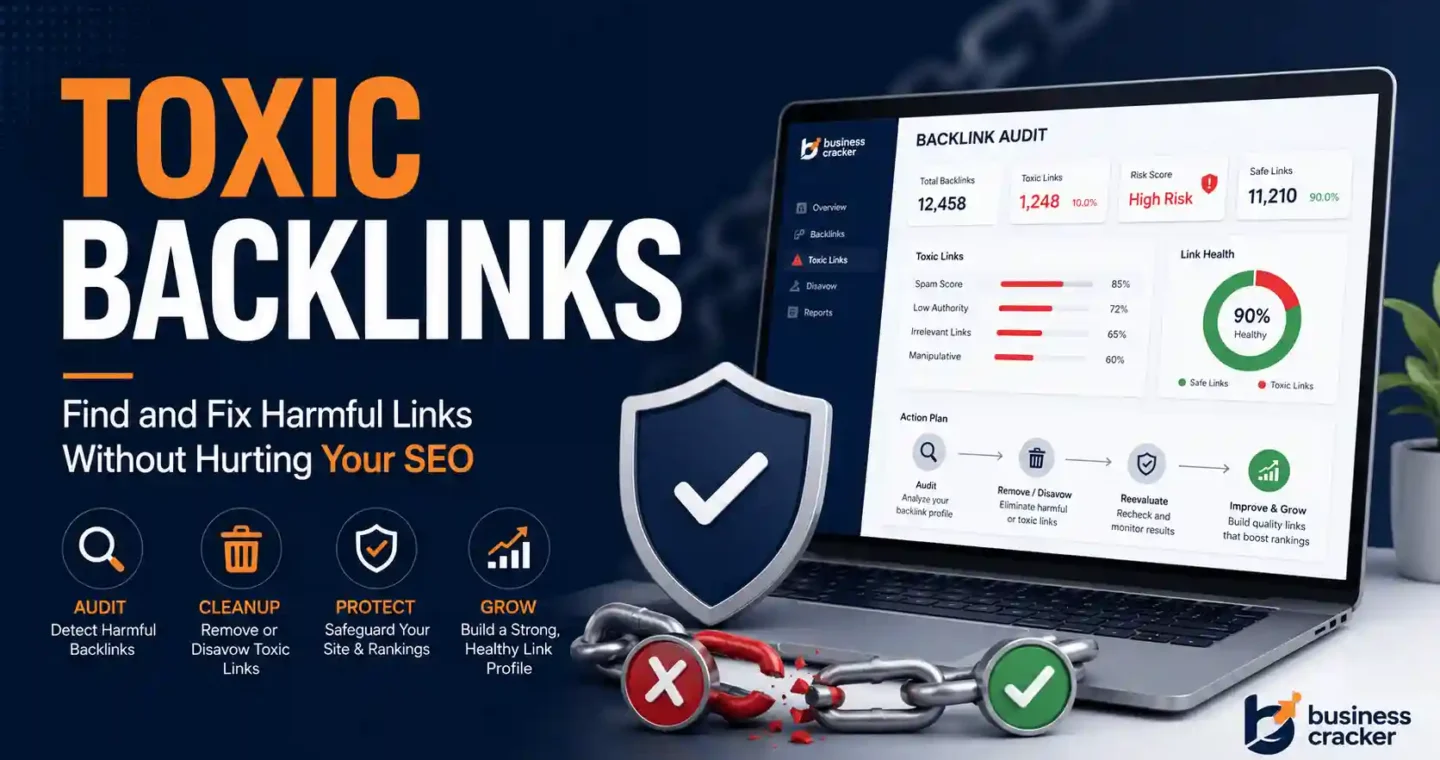
A suspicious backlink appears in your SEO report.
The referring website has little traffic, an unfamiliar domain name, irrelevant content, and a high toxicity score. Your first reaction may be to remove or disavow it immediately.
That is not always the right decision.
Most websites collect low-quality and irrelevant backlinks over time. Scrapers copy content, automated websites generate pages, old domains change ownership, directories republish business information, and spam bots post links without permission.
Many of these links provide no value, but that does not automatically make them dangerous.
Google states that most websites do not need to use its disavow tool because its systems can assess which links to trust. Google recommends considering disavowal only when a website has a considerable number of spammy, artificial, or low-quality links and those links have caused, or are likely to cause, a manual action.
The real challenge is not finding links that look bad. It is determining which links are harmless, which deserve monitoring, and which form part of a manipulative pattern that requires action.
At Business Cracker, we provide SEO services and link building services focused on relevance, editorial quality, and sustainable organic growth. This guide explains the same practical process we use to think about backlink risk: investigate the evidence, identify the business impact, and take the least destructive action.
Quick Answer: What Are Toxic Backlinks?
Toxic backlinks are incoming links that may damage a website’s search visibility because they form part of an unnatural, deceptive, or manipulative linking pattern.
A toxic backlink is not simply:
- A link from a low-authority website
- A nofollow link
- A link from another country
- A link from an unrelated website
- A link with a high third-party Spam Score
- A backlink that sends no referral traffic
- A link from a new domain
Those factors can help prioritize an investigation, but none proves that a backlink is harmful.
Google focuses on patterns and intent. Its spam policies describe link spam as links created primarily to manipulate search rankings rather than provide genuine value to users.
A backlink becomes more concerning when several signals appear together, such as:
- The link was purchased specifically to pass ranking value
- Exact-match commercial anchors appear across many websites
- The websites belong to the same private network
- Links were generated automatically at scale
- The placement has no editorial or audience value
- Hundreds of similar links appeared during a short period
- The business or its SEO provider deliberately participated in the campaign
The important word is pattern. Google’s manual-action documentation also refers to a pattern of unnatural, artificial, deceptive, or manipulative links, not one random backlink in isolation.
Bad Backlinks and Toxic Backlinks Are Not Always the Same
SEO tools often divide backlinks into good and toxic categories. Real backlink profiles are more complicated.
A better classification system includes five levels.
| Link classification | What it means | Recommended response |
| Valuable | Relevant, editorial, credible, and useful to readers | Keep and monitor |
| Neutral | Provides little SEO or referral value but shows no manipulation | Ignore |
| Suspicious | Contains warning signs that require context | Review manually |
| Manipulative | Created primarily to influence rankings | Remove or qualify |
| Harmful pattern | Large-scale or systematic manipulation with real penalty risk | Remove, document, and consider disavowal |
A low-quality backlink may be neutral because Google simply ignores it. A backlink from an otherwise respectable website can still be manipulative if it was purchased, hidden, or inserted without editorial justification.
This distinction protects businesses from two expensive mistakes:
- Ignoring a genuine link scheme because the domains have impressive authority metrics
- Disavowing legitimate backlinks because an automated tool classified them as toxic
What Current Link-Building Data Tells Us
The commercial backlink market contains a large amount of low-quality inventory.
A 2026 BuzzStream analysis of guest-post websites reviewed nearly 500,000 sites and retained 257,267 sites with complete data. The study found:
- 96.2 percent were classified as low quality
- 39.6 percent had no estimated monthly organic traffic
- Only 1.37 percent qualified as high quality or top tier
- The average vendor price for a guest post was $461
The study used Domain Rating and estimated organic traffic as its main quality indicators. These metrics do not prove whether a backlink violates Google’s policies, but the data illustrates why businesses should not purchase placements based only on a domain score.
A high price, impressive authority metric, or “news website” label does not guarantee a real audience or editorial credibility.
Backlink audits are also useful for more than identifying spam. An Ahrefs link-rot study examined links pointing to more than 2 million websites and found that at least 66.5 percent had become dead over nine years. That means an audit can also uncover valuable links that have disappeared, changed destination, or started pointing to broken pages.
A complete audit should therefore answer two questions:
- Which backlinks create unnecessary risk?
- Which valuable backlinks have been lost or weakened?
How Google Treats Suspicious Backlinks
Not every suspicious link produces the same outcome.
Ignored Backlinks
Google may determine that a link is unreliable and choose not to give it meaningful ranking weight.
This is the likely outcome for many automatically generated, scraped, or obviously spammy links that website owners did not create.
An ignored backlink may look terrible in an SEO tool while having little practical effect on rankings.
Devalued Link Patterns
A website may have benefited from manipulative links in the past. When Google becomes better at recognizing the pattern, those links may stop contributing value.
This can create a ranking decline without a visible manual action. The site may not have received a new penalty. It may simply have lost authority that should never have been counted.
Manual Actions
A manual action occurs when a human reviewer determines that a website violates Google’s spam policies.
Google Search Console can report an “unnatural links to your site” action when Google detects a pattern of manipulative inbound links. Some or all of the website can be affected until the problem is corrected and a reconsideration request is approved.
You can check this under:
Google Search Console > Security & Manual Actions > Manual Actions
Review Google’s official Manual Actions report guidance before starting a penalty recovery project.
When Should You Investigate Your Backlinks?
You do not need to launch an emergency cleanup every time a strange domain links to your website.
A detailed backlink investigation is justified when one or more of the following conditions apply.
You Received a Manual Action
This is the clearest reason to begin an immediate backlink review.
Follow Google’s instructions, document your work, make good-faith removal attempts, and prepare a reconsideration request.
You Previously Purchased Links
Past link-building campaigns may include paid follow links, PBN placements, bulk guest posts, homepage links, sitewide links, or niche edits created only to manipulate rankings.
Even if the campaign happened years ago, it may deserve review.
A Previous SEO Provider Used Undisclosed Methods
Businesses sometimes inherit backlink risk from an agency, freelancer, employee, acquisition, or previous domain owner.
Warning signs include:
- The provider guaranteed a fixed number of links
- Placements were selected only by DA or DR
- Source websites were not disclosed
- Reports contained hundreds of links from unrelated sites
- Exact-match anchor text was used repeatedly
- The provider promised first-page rankings
- Links appeared on websites created mainly for guest posts
Backlinks Increased Suddenly
A sudden increase is not automatically negative SEO. A viral article, product launch, press story, partnership, scraping event, or sitewide link can also create a spike.
Investigate the source, anchor text, target pages, timing, and similarity between domains before deciding what happened.
Rankings Dropped After a Manipulative Campaign
Timing alone does not prove causation, but a ranking decline that follows a large paid-link or automated-link campaign deserves investigation.
Your Company Is Buying or Acquiring a Domain
Historical backlink due diligence is essential when purchasing a domain, website, or online business.
An attractive domain may carry years of PBN activity, hacked links, irrelevant redirects, or aggressive anchor-text manipulation from a previous owner.
Nine Common Sources of Toxic Backlinks
1. Paid Links That Pass Ranking Value
Paying for advertising, sponsorships, influencer partnerships, directory listings, or product reviews is not automatically a violation.
The problem occurs when compensation is exchanged for a normal link intended to pass ranking value.
Google recommends qualifying paid links with:
rel=”sponsored”
or, when appropriate:
rel=”nofollow”
Google explains these attributes in its guide to qualifying outbound links.
A paid placement becomes risky when it is designed to look like an independent editorial recommendation while passing PageRank.
2. Private Blog Networks
A private blog network is a group of websites controlled for the purpose of building links to target sites.
Common PBN characteristics include:
- Similar website templates
- Shared hosting or ownership patterns
- Expired domains with unrelated new content
- Little or no real audience
- Commercial anchors pointing to selected clients
- Thin articles published only to hold links
- Frequent links to unrelated industries
- Weak editorial and author information
A single shared IP address does not prove a PBN. Many legitimate websites use the same hosting infrastructure. Look for multiple connected signals.
3. Automated Link-Building Campaigns
Bots can generate links through:
- Blog comments
- Forum profiles
- Public user pages
- Free directories
- Guestbooks
- Wiki pages
- Scraped content
- Automatically generated websites
These links usually lack editorial judgment and appear in repetitive patterns.
Be cautious when a provider promises hundreds or thousands of backlinks within days.
4. Excessive Link Exchanges
Natural business relationships often result in reciprocal links. A supplier may link to a partner, an association may link to a member, or two experts may cite each other’s work.
The risk begins when exchanges are arranged at scale for SEO rather than readers.
Three-way or ABC exchanges are not automatically safe simply because the pattern is less obvious. If the arrangement exists primarily to manipulate rankings, changing its structure does not change its intent.
5. Low-Quality Directories
Legitimate directories can help customers find businesses and may provide valuable local or industry visibility.
A low-quality directory usually has:
- No meaningful editorial review
- Thousands of unrelated categories
- Thin listing pages
- Aggressive advertising
- Broken navigation
- No real audience
- Listings created automatically
- Keyword-rich anchors sold as an SEO feature
Evaluate whether real customers could reasonably use the directory. Do not judge it solely by Domain Authority.
6. Sitewide Footer, Sidebar, and Widget Links
A link repeated across every page of a website can create thousands of backlinks from one domain.
Some sitewide links are legitimate, such as platform credits, accessibility providers, or technology partners. Others are inserted primarily to influence rankings.
Widget and template links deserve particular attention because publishers may not have chosen the destination or anchor text.
7. Hacked Website Links
Hackers may inject:
- Hidden footer links
- Spam pages
- Cloaked content
- Redirects
- Pharmaceutical keywords
- Gambling links
- Adult-content links
- Malware-related pages
A hacked backlink can come from a historically reputable domain. That is why domain-level authority is not enough. The specific page and placement must be reviewed.
Google’s spam documentation explains that hackers may add hidden links or injected content that is difficult for site owners and visitors to notice.
8. Expired Domain Redirects
Expired domains are sometimes purchased and redirected to another website to transfer historical authority.
A legitimate acquisition or rebrand can justify a redirect. A collection of unrelated expired domains redirected only for ranking manipulation creates a different pattern.
Review:
- The domain’s historical topic
- Previous ownership
- Historical anchor text
- Old backlinks
- Redirect destinations
- Whether users would expect the redirect
9. Negative SEO
Negative SEO involves creating spammy backlinks to another website in an attempt to damage its rankings.
Google’s systems can ignore many obvious spam links, so businesses should not assume that every sudden backlink spike will cause harm.
However, monitoring remains useful when links show coordinated characteristics, such as:
- Thousands of links appearing within days
- Repeated exact-match anchors
- Adult, gambling, or pharmaceutical sources
- Similar templates and IP patterns
- Links targeting one important commercial URL
- A corresponding manual action
The correct response is evidence collection, not panic.
How to Identify Toxic Backlinks
No single metric can identify a harmful backlink with certainty.
Use domain metrics to prioritize the review, then evaluate the page, link, intent, and broader pattern manually.
Source-Level Signals
Website purpose
Ask whether the website exists to serve an audience or sell links.
A real website generally has a consistent topic, identifiable audience, useful navigation, editorial standards, and content created for purposes beyond backlink placement.
Traffic and visibility
Low traffic does not automatically make a site toxic. New, niche, local, and specialized publications may have small audiences.
However, a website claiming to be a major publication while receiving no search visibility deserves closer inspection.
Publishing pattern
Review whether the website publishes hundreds of unrelated articles covering software, gambling, health, law, home improvement, loans, and cryptocurrency without a coherent audience.
Ownership and history
Use historical tools to see whether the domain previously covered a different topic or was repurposed after expiration.
Page-Level Signals
Content quality
Check whether the linking page provides original information, useful context, named authorship, and an understandable reason for mentioning your website.
Link placement
A contextual citation inside useful content generally has more editorial credibility than a link hidden in a footer, author biography, comment, or unrelated paragraph.
Outbound-link behavior
Pages that link to dozens of unrelated commercial sites may be created primarily to sell backlinks.
Indexability and accessibility
Determine whether the page is accessible, returns a valid status code, and can be found through the website’s normal navigation.
Do not rely solely on a site: search to determine indexing. Google describes the operator as a diagnostic tool, not a complete index report.
Pattern-Level Signals
Anchor-text concentration
A natural profile normally includes:
- Brand names
- Naked URLs
- Page titles
- Author names
- Generic references
- Partial-match descriptions
- Occasional exact-match keywords
A high concentration of exact-match commercial anchors may indicate deliberate manipulation, particularly when the links come from unrelated or low-quality sites.
Link velocity
Link velocity refers to how quickly a website gains or loses backlinks.
Rapid growth is not automatically unnatural. News coverage, viral content, product launches, data studies, and sitewide references can create legitimate spikes.
Compare the growth with business events and campaign activity.
Target-page concentration
Manipulative campaigns often point a high percentage of keyword-rich links to one service, product, category, or location page.
Network similarities
Look for shared templates, ownership details, author profiles, analytics codes, hosting patterns, and linking behavior. No single similarity proves common ownership, but multiple connections can reveal a network.
Intent-Level Signals
Intent is one of the most important factors.
Ask:
- Who created or requested the link?
- Was money, a product, or a service exchanged?
- Did the publisher make an independent editorial decision?
- Does the link help the reader?
- Would the link exist if search engines did not count backlinks?
- Was the anchor text controlled by the linked business?
- Is the placement part of a repeated system?
A link created mainly to manipulate rankings deserves more concern than an accidental link from an unattractive website.
A Practical Backlink Risk-Scoring Framework
At Business Cracker, we recommend using a transparent scoring method rather than accepting a tool’s toxicity label as a final verdict.
The following framework can help prioritize manual reviews.
| Risk factor | Score |
| Clear editorial reason and user value | 0 |
| Weak but plausible editorial reason | 1 |
| No clear reason for the link | 2 |
| Strong evidence of paid or manipulative intent | 3 |
| Highly relevant source and page | 0 |
| Partial relevance | 1 |
| Completely unrelated context | 2 |
| Natural anchor text | 0 |
| Mildly commercial anchor | 1 |
| Repeated exact-match commercial anchor | 2 |
| Editorial placement | 0 |
| Author bio, directory, footer, or sidebar | 1 |
| Hidden, injected, or automated placement | 2 |
| Independent website | 0 |
| Some network similarities | 1 |
| Strong PBN or coordinated-network evidence | 2 |
| Isolated link | 0 |
| Several similar links | 1 |
| Large-scale repeated pattern | 2 |
Interpreting the Score
| Total score | Suggested action |
| 0 to 3 | Keep or ignore |
| 4 to 6 | Monitor |
| 7 to 9 | Investigate and consider removal |
| 10 to 13 | Escalate for removal or disavow review |
This is not a Google metric. It is an internal prioritization framework designed to make decisions more consistent.
How to Conduct a Backlink Audit Step by Step
Step 1: Define the Business Problem
Do not begin with “find every bad link.”
Begin with a specific question:
- Did backlinks cause our ranking decline?
- Did our old agency create risky links?
- Do we have a manual action?
- Are we evaluating a domain acquisition?
- Are our most valuable links disappearing?
- Is our link-building budget producing business value?
The question determines the scope and prevents unnecessary cleanup.
Step 2: Export Backlink Data
Start with the Google Search Console Links report.
Export:
- Top linking sites
- Latest links
- Top linked pages
- Top linking text
Search Console may not provide every backlink you can find in third-party databases. For a broader view, combine it with tools such as Ahrefs, Semrush, Majestic, or Moz.
Step 3: Combine and Deduplicate the Data
Create one master spreadsheet.
Recommended columns include:
- Referring domain
- Source URL
- Target URL
- Anchor text
- First-seen date
- Last-seen date
- Follow, nofollow, sponsored, or UGC attribute
- Estimated traffic
- Topical relevance
- Link placement
- Domain history
- Suspected acquisition method
- Risk score
- Recommended action
- Evidence
- Outreach status
- Disavow status
Group links by referring domain. Ten thousand links from one domain require a different analysis than ten thousand independent referring domains.
Step 4: Check Manual Actions and Security Issues
Open Google Search Console and review:
- Manual Actions
- Security Issues
- Page Indexing
- Performance
- Links
A hacked website, indexing problem, or technical issue may explain the business impact more accurately than toxic backlinks.
Step 5: Analyze Anchor Text
Categorize anchors as:
- Branded
- Naked URL
- Generic
- Page title
- Partial match
- Exact match
- Irrelevant or spam
- Image or empty anchor
Do not search for an ideal universal percentage. Natural distributions vary by brand, industry, domain history, and link acquisition strategy.
Focus on unusual concentrations and how they were created.
Step 6: Review Link Growth
Create a timeline showing:
- New referring domains
- Lost referring domains
- New backlinks
- Lost backlinks
- Major outreach campaigns
- PR events
- Website migrations
- Ranking changes
- Google updates
- Manual actions
This makes it easier to separate coincidence from plausible causation.
Step 7: Review Important Domains Manually
Prioritize domains with:
- High risk scores
- Many backlinks
- Exact-match anchors
- Links to commercial pages
- Recent link growth
- Known paid placements
- Strong PBN indicators
- Hacked or hidden content
Open the actual source page. Metrics alone cannot show whether a link makes editorial sense.
Step 8: Assign an Action
Every reviewed domain should receive one of five actions:
- Keep
- Ignore
- Monitor
- Remove or qualify
- Disavow review
Record the reason. Documentation prevents future teams from repeating the audit or reversing decisions without evidence.
Step 9: Review Valuable Lost Links
Do not limit the audit to harmful links.
Look for valuable backlinks that now point to:
- 404 pages
- Old HTTP URLs
- Redirect chains
- Removed content
- Incorrect canonical URLs
- Discontinued products
- Changed slugs
Recovering one strong editorial backlink may create more value than removing hundreds of harmless spam links.
Step 10: Monitor the Outcome
Track:
- Manual-action status
- Organic clicks and impressions
- Target-page rankings
- Referring-domain quality
- Anchor-text distribution
- Lost high-value links
- Referral traffic
- Leads and conversions
- New suspicious patterns
Backlink cleanup should be connected to business and search outcomes, not just a lower toxicity score in a third-party tool.
Did Toxic Backlinks Really Cause Your Ranking Drop?
A ranking decline should not automatically trigger a disavow project.
Google’s guide to debugging search traffic drops identifies several possible causes, including technical problems, algorithmic updates, changing search demand, seasonality, security issues, spam issues, and reporting problems.
Use this diagnostic sequence.
1. Check for a Manual Action
A manual action provides direct evidence of a policy problem.
Without one, continue investigating before blaming backlinks.
2. Identify the Affected Pages and Queries
Use Search Console to determine whether the decline affected:
- The entire website
- One directory
- One page type
- Commercial keywords
- Informational queries
- Branded queries
- A specific country or device
A decline limited to one template may indicate a technical or content problem.
3. Compare the Timing With Google Updates
Check Google’s official Search Status Dashboard and ranking-update documentation.
A date correlation does not prove the update targeted backlinks, but it helps define the investigation window.
4. Review Technical SEO
Check:
- Indexing
- Canonical tags
- Robots directives
- Redirects
- Internal links
- Server errors
- Sitemap changes
- JavaScript rendering
- Page speed
- Mobile usability
Our guide to technical SEO for business websites explains how these problems can suppress visibility even when a page has good content and backlinks.
5. Review Content and Search Intent
Competitors may have created better pages, search intent may have changed, or your content may no longer satisfy the query.
Use our on-page SEO checklist to review page structure, intent, internal links, content depth, and conversion paths.
6. Check for Lost Valuable Links
A ranking decline may be connected to losing legitimate authority rather than gaining toxic links.
7. Compare the Backlink Timeline
Only after checking the other causes should you determine whether suspicious link growth aligns with the affected pages, queries, and dates.
Should You Ignore, Remove, Qualify, or Disavow a Backlink?
| Situation | Recommended response |
| Random scraper or bot link with no broader pattern | Ignore |
| Low-authority but legitimate niche website | Keep |
| Foreign-language link that makes contextual sense | Keep or monitor |
| High Spam Score with no other evidence | Review, do not automatically remove |
| Paid partnership link | Add rel=”sponsored” or rel=”nofollow” |
| Genuine natural reciprocal relationship | Usually keep |
| Large-scale link exchange created for rankings | Remove or qualify |
| Known PBN placement purchased by your business | Remove or consider disavowal |
| Hacked or hidden link | Request removal and investigate |
| Manual action for unnatural links | Remove, disavow unresolved links, and request review |
| Sudden spam attack without ranking impact or manual action | Document and monitor |
| Large historical link scheme with realistic manual-action risk | Conduct professional disavow review |
How to Request Backlink Removal
Contact the publisher when:
- You purchased the placement
- Your agency arranged it
- It was part of an exchange
- The anchor text was manipulated
- The link appears on a real website with accessible contact information
- Google has requested a good-faith removal effort
Keep the request short and specific.
Backlink Removal Email Template
Subject: Request to Remove or Qualify a Link
Hello,
I am contacting you regarding a link to our website on the following page:
Source page: [Insert source URL]
Link destination: [Insert target URL]
We are reviewing our historical backlink profile and would appreciate it if you could remove this link.
If removal is not possible, please add a rel=”nofollow” or rel=”sponsored” attribute so the link is properly qualified.
Please let us know when the change has been completed.
Thank you.
Do not threaten the publisher or accuse them of causing a penalty. In many cases, the current website owner may not know how the link was created.
Document:
- Contact date
- Email address
- Response
- Follow-up
- Removal status
- Qualification status
When Should You Use Google’s Disavow Tool?
Google describes disavowal as an advanced action that can harm search performance when used incorrectly.
According to Google’s disavow documentation, most websites do not need the tool.
Disavowal should generally be considered when both conditions apply:
- Your website has a considerable number of spammy, artificial, or low-quality backlinks
- Those links have caused, or are likely to cause, a manual action
Appropriate situations may include:
- An unnatural-links manual action
- A documented history of buying links
- Large-scale PBN participation
- Automated links created by your business or provider
- Extensive manipulative exchanges
- Historical campaigns that present a credible manual-action risk
- Links that cannot be removed after reasonable attempts
Do not disavow a backlink only because:
- Its DA or DR is low
- An SEO tool calls it toxic
- It is from another country
- It has no traffic
- It is nofollow
- The site design looks outdated
- The topic is not an exact match
- You do not recognize the domain
How to Create a Disavow File Safely
A disavow file is a plain text file containing the URLs or domains you want Google to disregard when assessing links to your property.
Sample Disavow File
# Links created by previous SEO provider
domain:example-spam-network.com
domain:paid-links-example.net
# Individual pages that could not be removed
Important Formatting Rules
- Use one URL or domain per line
- Use domain: to disavow an entire domain
- Do not add spaces after domain:
- Use # for comments
- Save the file as .txt
- Review every entry before uploading
- Keep a backup of the previous file
- Upload it to the correct Search Console property
Google states that uploading a new disavow list replaces the existing list for that property. Always merge valid old entries into the new file before uploading it.
Google also says processing can take several weeks as it recrawls and reprocesses pages.
How to Recover From an Unnatural Links Manual Action
Google recommends the following process.
Step 1: Download Your Backlinks
Export links by hostname and recent date from Search Console.
Step 2: Identify Policy-Violating Links
Prioritize websites that link most frequently and links created recently.
Step 3: Make Good-Faith Removal Attempts
Contact publishers and ask them to remove the links or prevent them from passing PageRank.
Google warns that blindly adding every backlink to a disavow file without attempting removal may not be enough for a successful reconsideration request.
Step 4: Disavow Unresolved Manipulative Links
Include links that could not be removed after reasonable attempts.
Avoid disavowing legitimate editorial links.
Step 5: Submit a Reconsideration Request
Explain:
- What caused the violation
- Which links were removed
- Which links were disavowed
- Why some links could not be removed
- What controls you introduced
- How future link building will comply with Google’s policies
Be honest. Do not blame an agency without accepting responsibility for correcting the work.
Step 6: Wait for Google’s Review
Google will notify you in Search Console when the request has been reviewed.
There is no guaranteed recovery date or ranking outcome. Removing a manual action does not guarantee that the website will return to its previous position, especially if the old rankings depended on manipulative links.
How Often Should You Audit Your Backlink Profile?
The right frequency depends on the size and activity of the website.
Monthly Monitoring
Recommended for:
- Websites running active link-building campaigns
- Competitive SaaS and ecommerce companies
- Large publishers
- Websites with previous manual actions
- Businesses working with multiple SEO vendors
- Domains receiving thousands of new links
Quarterly Audits
Appropriate for:
- Small and medium-sized business websites
- Professional service companies
- Local businesses
- Sites with moderate link growth
- Businesses using controlled outreach campaigns
Event-Based Audits
Conduct an audit after:
- A ranking decline
- A manual action
- A website acquisition
- A domain migration
- A change of SEO provider
- A large digital PR campaign
- A sudden backlink spike
- The discovery of historical paid links
Monitoring should focus on changes and patterns, not repeatedly reviewing every harmless scraper link.
The Business Cost of Poor Backlink Decisions
Backlink management is not only an SEO issue.
A risky link-building campaign can affect:
- Organic lead volume
- Customer acquisition costs
- Brand credibility
- Referral quality
- Website valuation
- Acquisition due diligence
- Agency expenditure
- Management time
- Recovery costs
- Investor confidence
Overaggressive cleanup also creates risk. Disavowing legitimate backlinks can remove authority that took years to build.
The goal is not to produce the cleanest-looking SEO report. The goal is to protect and improve commercial search performance.
How to Prevent Toxic Backlink Problems
Prevention is less expensive than manual-action recovery.
Establish Link Quality Standards
Every placement should be evaluated for:
- Topical or audience relevance
- Editorial legitimacy
- Content quality
- Website history
- Real traffic potential
- Natural placement
- Anchor-text suitability
- Outbound-link behavior
- Long-term stability
Our guide to getting high-quality backlinks explains how to evaluate opportunities based on relevance, editorial legitimacy, audience value, and longevity.
Use Safer Link-Building Methods
Focus on:
- Digital PR
- Original research
- Useful industry resources
- Expert contributions
- Relevant guest content
- Broken-link outreach
- Partnership links
- Unlinked brand mentions
- Local and industry associations
- Valuable tools and templates
Read our guide to white hat link building for sustainable authority-building methods.
Control Anchor Text
Allow publishers to choose natural wording whenever possible.
Avoid giving every publisher the same exact-match commercial anchor.
Keep a Link-Acquisition Log
Record:
- Source website
- Contact person
- Placement date
- Target page
- Anchor text
- Payment or compensation
- Link attribute
- Campaign owner
- Business purpose
This makes future audits faster and more accurate.
Review Vendors Carefully
Before hiring a provider, ask:
- How are websites selected?
- Are placements manually reviewed?
- Do you use PBNs?
- Do you guarantee a fixed number of links?
- Can we approve every target site?
- Do you disclose paid relationships?
- How do you handle sponsored attributes?
- Who controls anchor text?
- Do you report traffic and relevance?
- How do you prevent duplicate outreach?
- What happens when a link disappears?
- Can you explain why each placement benefits our audience?
Our link building services guide explains how businesses can compare providers beyond link volume and domain metrics.
How Business Cracker Approaches Backlink Quality
At Business Cracker, we do not treat link building as a race to collect the largest number of referring domains.
Our link building services focus on:
- Relevant prospect research
- Manual outreach
- Guest-post opportunities
- Niche-edit evaluation
- Broken-link building
- Digital PR support
- Placement tracking
- Clear reporting
Backlinks work best when they support useful content, technically healthy pages, and a clear organic search strategy. That is why our link-building work can be combined with broader SEO services when a website also needs technical, on-page, content, or search-intent improvements.
The objective is not just to build links. It is to create stronger authority signals that support visibility, qualified traffic, leads, and long-term growth without exposing the business to unnecessary risk.
Frequently Asked Questions About Toxic Backlinks
Can One Toxic Backlink Hurt My Website?
One random low-quality backlink is unlikely to create a major problem by itself. Risk normally comes from broader patterns, manipulative intent, or a large number of unnatural links.
Does a High Spam Score Mean a Backlink Is Toxic?
No. Spam Score, Toxicity Score, Domain Rating, Domain Authority, Authority Score, and Trust Flow are third-party metrics. They can help prioritize reviews, but they are not Google penalties or definitive quality judgments.
Are Nofollow Backlinks Toxic?
No. Nofollow links can be natural and may provide referral traffic, brand visibility, discovery, and a more realistic backlink profile. A nofollow attribute is also commonly used to qualify links that should not be treated as normal editorial endorsements.
Are Links From Foreign Websites Harmful?
Not automatically. An international company can naturally receive links from multiple countries and languages. Even a local business may receive coverage from foreign publications, software directories, suppliers, or customers. Investigate relevance and intent rather than geography alone.
Can Negative SEO Destroy a Website?
Google can ignore many obvious spam links, so most random attacks do not require emergency action. Monitor the pattern, document unusual growth, review Search Console, and escalate only when there is evidence of real impact or policy risk.
Final Thoughts
The purpose of a backlink audit is not to identify the largest possible number of bad-looking links.
It is to understand how your backlinks were created, whether they form a manipulative pattern, what business impact they may have, and which response creates the lowest risk.
Most suspicious backlinks can be ignored or monitored. Some should be removed or properly qualified. Disavowal should be reserved for serious situations supported by evidence.
The safest long-term strategy is to combine regular monitoring with relevant, editorially credible link acquisition.
Business Cracker helps companies review backlink quality, improve off-page SEO, and build authority through practical link building services. To discuss your backlink profile, ranking decline, or authority-building strategy, contact Business Cracker for a consultation.