July 15, 2026
How to Increase Referral Traffic: A Practical Guide to More Leads, Sales, and SEO Authority
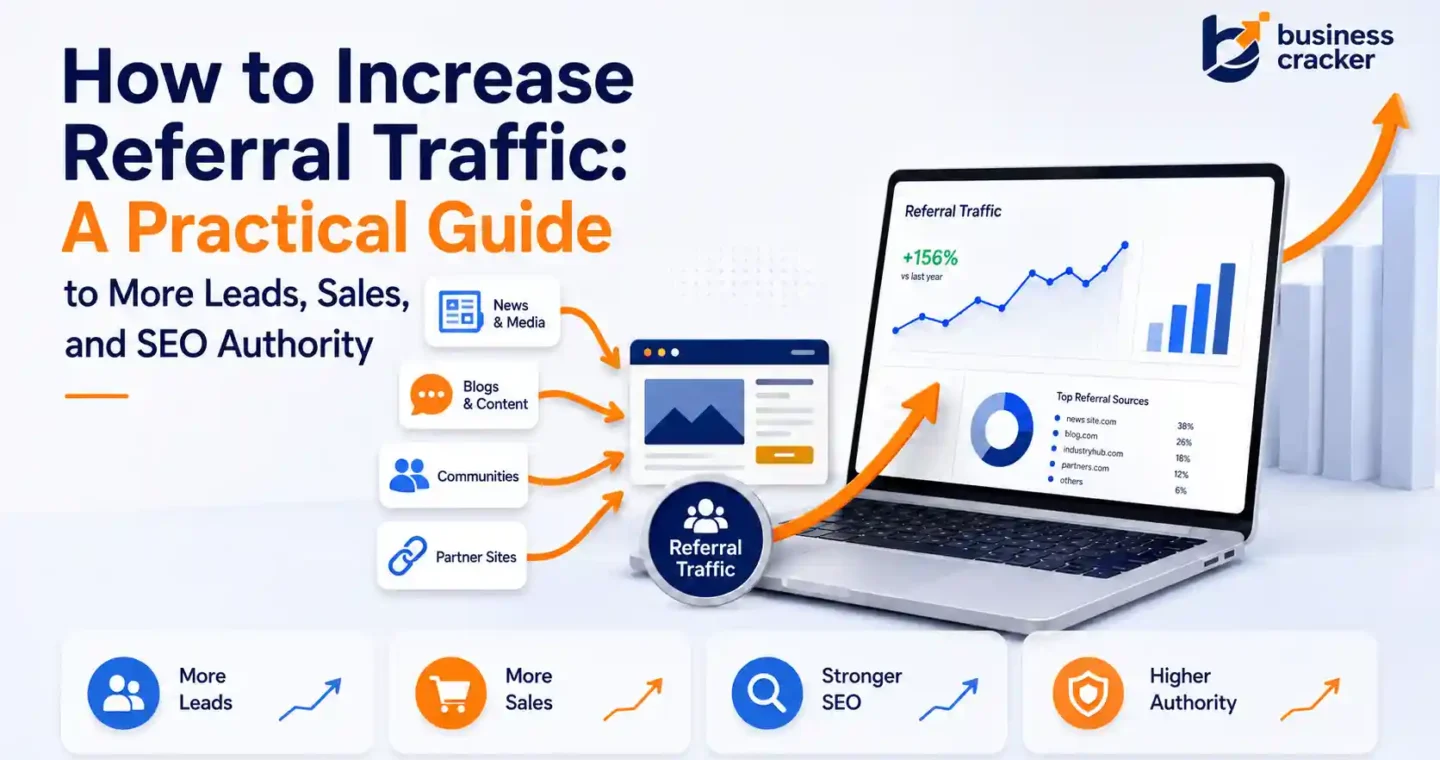
Most businesses do not have a simple traffic problem.
They may already receive visitors from Google, paid ads, social media, email, or direct searches. The real problem is that too few of those visitors become qualified leads or customers.
Referral traffic can help solve this problem when it comes from websites, publishers, communities, partners, and review platforms that your target audience already trusts.
However, increasing referral traffic is not as simple as collecting backlinks. A website can have hundreds of backlinks and receive almost no useful referral visits. Another business may receive fewer links but generate qualified enquiries every month because those links appear on the right pages, reach the right audience, and point to the right destination.
A productive referral traffic strategy connects five elements:
Relevant referring page → contextual link → qualified visitor → appropriate landing page → measurable business result
This guide explains how to build that system.
Quick Answer: How Do You Increase Referral Traffic?
To increase referral traffic, earn relevant links and mentions from websites your potential customers already visit. Prioritize contextual placements on industry publications, comparison pages, review websites, partner sites, directories, newsletters, and trusted communities.
Send those visitors to a landing page that matches the original recommendation, then track engagement, leads, sales, and revenue by source.
The most effective referral traffic strategies include:
- Publishing original research and linkable resources
- Contributing expert content to relevant publications
- Reclaiming unlinked brand mentions
- Using digital PR and expert commentary
- Securing placements in listicles and comparison pages
- Building partnerships and integrations
- Replacing relevant broken links
- Improving directory and review-site visibility
- Participating in niche communities
- Launching customer referral programs
- Measuring and improving referral conversion rates
What Is Referral Traffic?
Referral traffic consists of visitors who reach your website by clicking a link on another website.
For example, imagine that a software publication publishes an article about the best project management platforms. The article includes a link to your product page. Anyone who clicks that link and visits your website may be recorded as referral traffic.
Referral traffic can come from:
- Industry blogs
- News websites
- Review platforms
- Business directories
- Partner websites
- Association websites
- Resource pages
- Online communities
- Forums
- Customer websites
- Vendor websites
- Affiliate publishers
- Digital PR coverage
- Podcast show notes
- Email newsletters
- Product comparison pages
Social networks may send visitors to your website, but Google Analytics often categorizes those visits under organic social, paid social, or another social channel rather than referral.
Referral Traffic vs. Backlinks
Referral traffic and backlinks are connected, but they are not the same thing.
What Is a Backlink?
A backlink is a clickable link from an external website to your website.
Search engines may use links to discover pages and understand relationships and relevance between online resources. Google explains this in its official link best practices documentation.
What Is a Referring Page?
A referring page is the exact webpage containing the link.
For example:
- Referring domain: example.com
- Referring page: an article on example.com reviewing marketing agencies
- Backlink: the clickable link inside that article
- Referral traffic: visitors who click that link and reach your site
What Is a Referring Domain?
A referring domain is the website from which one or more backlinks originate.
A single referring domain can contain several referring pages. A single referring page can also contain more than one backlink to your website.
Why the Difference Matters
A backlink can support search visibility without generating meaningful clicks. A referring page can generate valuable leads even when its domain does not have an impressive third-party authority score.
You should therefore evaluate both:
- SEO value: Can the link strengthen the authority and relevance of the destination page?
- Business value: Can the placement reach potential customers and influence a useful action?
The best opportunities can do both.
Why Referral Traffic Matters More in 2026
Businesses should not depend on a single source of website traffic.
Search remains important, but organic click patterns are changing. An Ahrefs study using 300,000 keywords and aggregated Google Search Console data found that the presence of an AI Overview correlated with a 58% lower average click-through rate for the top-ranking page in its December 2025 dataset. This does not mean SEO has stopped working, but it strengthens the business case for building traffic sources beyond traditional search results. Read the complete Ahrefs AI Overview click-through rate study.
Referral traffic offers several important advantages.
It Diversifies Website Acquisition
A business that depends almost entirely on Google rankings, paid advertising, or a single social platform is exposed to changes outside its control.
Referral partnerships, publisher relationships, directory profiles, review placements, and editorial links create additional paths through which potential customers can find the business.
Diversification does not mean abandoning SEO. It means building a broader acquisition system in which SEO services, content, link building, digital PR, partnerships, and conversion optimization support each other.
It Creates Third-Party Validation
People are more receptive when a recommendation comes from a source they already know or trust.
Nielsen reported that 88% of global respondents in its Trust in Advertising study trusted recommendations from people they knew more than any other channel. A website link is not automatically a personal recommendation, but relevant editorial mentions, expert reviews, customer referrals, and partner endorsements can provide a similar layer of external validation. Read Nielsen’s discussion of consumer trust and recommendations.
It Can Reach Buyers During Evaluation
Commercial listicles, review pages, directories, case studies, and comparison articles often reach visitors who are already researching a solution.
BrightLocal’s 2026 Local Consumer Review Survey of 1,002 US adults found that 97% of respondents read reviews for local businesses. It also found that 66% conducted further research after reading a positive review, while 34% were ready to purchase or make a booking. These findings illustrate why review platforms and third-party validation pages can influence both referral traffic and the wider buying journey. Explore the full BrightLocal Local Consumer Review Survey 2026.
It Can Support Organic Search Performance
Backlinks remain associated with stronger search rankings, although correlation should not be confused with direct causation.
Backlinko’s analysis of 11.8 million Google search results found that the number-one result had an average of 3.8 times more backlinks than results in positions two through ten. The study also clearly states that its findings show correlation rather than proof that every backlink improves rankings. Review the Backlinko search results study.
The practical lesson is not that businesses should acquire as many links as possible. It is that relevant authority and useful content remain important in competitive search markets.
It Helps Valuable Content Reach an Audience
Publishing excellent content does not guarantee that people will discover it.
Ahrefs studied approximately 14 billion pages and estimated that 96.55% received no organic traffic from Google. The company identified backlinks, search demand, search intent, and indexing among the factors that can separate discoverable pages from pages receiving no search traffic. Review the complete Ahrefs search traffic study.
Referral distribution gives original research, guides, tools, templates, case studies, and product resources additional opportunities to reach readers.
What Does High-Quality Referral Traffic Look Like?
High-quality referral traffic comes from relevant sources and has a realistic chance of producing a useful business outcome.
A high-quality referral visitor may:
- Read the destination page carefully
- View a service or product page
- Download a useful resource
- Start a free trial
- Request pricing
- Book a consultation
- Join an email list
- Return through another channel
- Become a qualified sales opportunity
- Complete a purchase
High traffic volume alone does not establish quality.
A publisher may send 5,000 visitors who leave without engaging. A specialized industry newsletter may send 80 visitors who generate eight sales conversations.
The second source is likely more valuable.
The Business Cracker Referral Opportunity Score
Businesses need a consistent way to prioritize referral opportunities. Third-party metrics such as DA, DR, or authority scores can help with initial filtering, but they should not make the final decision.
At Business Cracker, we recommend evaluating opportunities through a broader commercial and editorial framework.
| Evaluation factor | Suggested weight |
| Topical relevance | 20 |
| Audience overlap | 20 |
| Editorial credibility | 15 |
| Page visibility and traffic potential | 15 |
| Link placement and click potential | 10 |
| Commercial intent | 10 |
| Destination-page alignment | 5 |
| Acquisition feasibility | 5 |
| Total | 100 |
This is a campaign-planning framework, not a metric used by Google.
1. Topical Relevance
Does the referring page discuss a subject closely related to your service, product, audience, or destination page?
A link to a cybersecurity company from an article about data protection is more relevant than a link from an unrelated entertainment website.
2. Audience Overlap
Does the publisher reach people who could realistically become customers, partners, journalists, employees, or industry advocates?
A smaller publication with the correct audience can be more valuable than a popular general-interest website.
3. Editorial Credibility
Review whether the website:
- Publishes original content
- Identifies authors
- Maintains editorial standards
- Updates old content
- Avoids excessive sponsored posts
- Covers a coherent range of topics
- Has a real business or publishing purpose
- Provides useful information beyond selling links
4. Page Visibility and Traffic Potential
Evaluate the specific page, not only the domain.
Check whether it:
- Ranks for relevant keywords
- Receives estimated organic traffic
- Has backlinks of its own
- Is indexed
- Is internally linked
- Is updated regularly
- Appears prominently in the site structure
- Is likely to remain live
5. Link Placement
A contextual link inside the main article can attract more attention than a link hidden in a footer, author box, or long directory page.
Ask whether a real reader would notice the link and understand why it is useful.
6. Commercial Intent
A link on a page titled “Best Accounting Software for US Startups” may have more immediate commercial potential than a general article explaining the history of accounting.
Both can be useful, but they serve different goals.
7. Destination-Page Alignment
The linked page should continue the conversation started by the referring page.
A visitor reading a comparison article should reach a relevant product, service, case study, pricing, or evaluation page, not an unrelated blog post.
How to Build a Referral Traffic Strategy
Before choosing tactics, build a clear operating process.
Step 1: Define the Business Outcome
Do not begin with, “We need more backlinks.”
Begin with a measurable objective such as:
- Generate more demo requests
- Increase qualified service enquiries
- Improve sales for a product category
- Support rankings for a priority landing page
- Build awareness in a new industry
- Enter a new geographic market
- Improve partner-sourced pipeline
- Earn media coverage
- Reduce dependence on paid acquisition
The business outcome determines which sources, pages, and placements matter.
Step 2: Choose the Right Destination Page
Avoid pointing every link to the homepage.
Possible destination pages include:
- Product pages
- Service pages
- Category pages
- Location pages
- Original research
- Free tools
- Templates
- Case studies
- Comparison pages
- Calculators
- Statistics pages
- Industry guides
- Consultation landing pages
The destination page must be useful enough to deserve the referral.
Businesses planning authority campaigns can review our guide to custom link building services, strategy, cost, and ROI before selecting target pages.
Step 3: Map Where Customers Research Solutions
Identify where your target audience spends time before making a decision.
Research:
- Industry publications
- Trade associations
- Professional communities
- Comparison websites
- Review platforms
- Newsletters
- Podcasts
- Conferences
- Vendor ecosystems
- Technology marketplaces
- Reddit communities
- LinkedIn groups
- Local business directories
- Specialist blogs
- Customer education platforms
Do not limit prospecting to websites with high authority scores. Look for places that influence actual decisions.
Step 4: Analyze Competitor Referring Pages
Competitor backlink research can reveal:
- Publications that cover your market
- Resource pages accepting useful additions
- Listicles mentioning competing products
- Associations listing relevant businesses
- Guest-contribution opportunities
- Podcasts featuring industry experts
- Partnerships and integrations
- Original resources that naturally attract citations
Do not copy a competitor’s backlink profile blindly. Determine why each link exists and whether you can provide equal or greater value.
Step 5: Create a Real Value Exchange
Most outreach fails because the sender asks for a favor without offering a meaningful benefit.
A strong value exchange may include:
- Original research
- An expert quote
- A better replacement for a broken resource
- A detailed guest contribution
- Updated information
- A free tool
- A useful visual
- Product access for an honest evaluation
- A customer case study
- A joint webinar
- A partner integration
- Promotion to a relevant audience
The question is not simply, “Why should they link to us?”
The better question is, “How does this addition improve their content or help their audience?”
Step 6: Match the Landing Experience
The destination page should match the referring context.
For example:
- A link from a technical SEO article should lead to a technical guide, audit resource, or SEO service page.
- A link from a product comparison should lead to a product or comparison page.
- A link from a podcast should lead to the resource discussed in the episode.
- A link from a local directory should lead to a location-relevant page.
- A link from an original research citation should lead directly to the study.
This principle is known as message matching.
Our guide to website design for lead generation explains how relevance, trust, calls to action, forms, follow-up, and measurement work together to turn traffic into qualified leads.
11 Strategies to Increase Referral Traffic
1. Publish Original Research and Linkable Assets
Original information gives writers, journalists, educators, analysts, and marketers a reason to reference your website.
Useful linkable assets include:
- Industry surveys
- Benchmark reports
- Proprietary platform data
- Market analyses
- Calculators
- Free tools
- Templates
- Statistics collections
- Interactive databases
- Maps
- Checklists
- Detailed technical tutorials
- Original experiments
- Data visualizations
How to Create Research Without a Large Budget
You can produce useful findings by analyzing:
- Anonymized customer data
- Public government datasets
- Search trends
- Job postings
- Product pricing
- Customer reviews
- Support questions
- Industry reports
- Survey responses
- Public company disclosures
The asset should answer a question that publishers and customers genuinely care about.
Make the Asset Easy to Reference
Include:
- A clear methodology
- The sample size
- Collection dates
- Important limitations
- Quotable findings
- Downloadable charts
- Definitions
- Author information
- A publication date
- A visible last-updated date
Good research attracts links because it becomes a source, not because it repeatedly asks people for backlinks.
2. Contribute Expert Guest Content
Guest publishing can generate referral traffic when the host site has a relevant audience and the article provides real editorial value.
A good contribution should:
- Address a problem the publication has not covered well
- Match its writing style and readership
- Include original examples
- Demonstrate genuine expertise
- Avoid excessive self-promotion
- Use contextual links only where helpful
- Remain valuable without the backlink
Choose publishers based on audience and editorial fit, not only domain metrics.
For a detailed comparison of common placement approaches, read guest posting vs. niche edits.
3. Reclaim Unlinked Brand Mentions
An unlinked mention occurs when a website references your company, product, research, founder, or visual without adding a clickable link.
These are often strong prospects because the publisher already knows the brand.
Monitor mentions of:
- Your company name
- Product names
- Founder and executive names
- Proprietary frameworks
- Research titles
- Branded statistics
- Images and charts
- Common brand misspellings
Contact the author or editor, thank them for the mention, and explain how linking to the original source would help readers verify or explore the information.
Keep the request short and specific.
Example Outreach Message
Subject: Source link for your article
Hi [Name],
Thank you for mentioning our [research, product, or company] in your article about [topic].
Would you be open to linking the mention to the original source? It would give readers direct access to the supporting information.
Here is the relevant page: [URL]
Thank you again for including us.
Best,
[Name]
4. Use Digital PR and Expert Commentary
Digital PR can generate referral traffic, backlinks, brand searches, and media credibility.
Potential campaigns include:
- Original research
- Newsworthy company data
- Expert reactions to industry developments
- Forecasts
- Survey findings
- Consumer trend analysis
- Product launches with genuine significance
- Public-interest resources
- Local market data
- Industry rankings with transparent methodology
The story must be relevant to the journalist’s audience.
Avoid sending one generic press release to hundreds of unrelated contacts. Develop several angles based on publication type, location, readership, and news relevance.
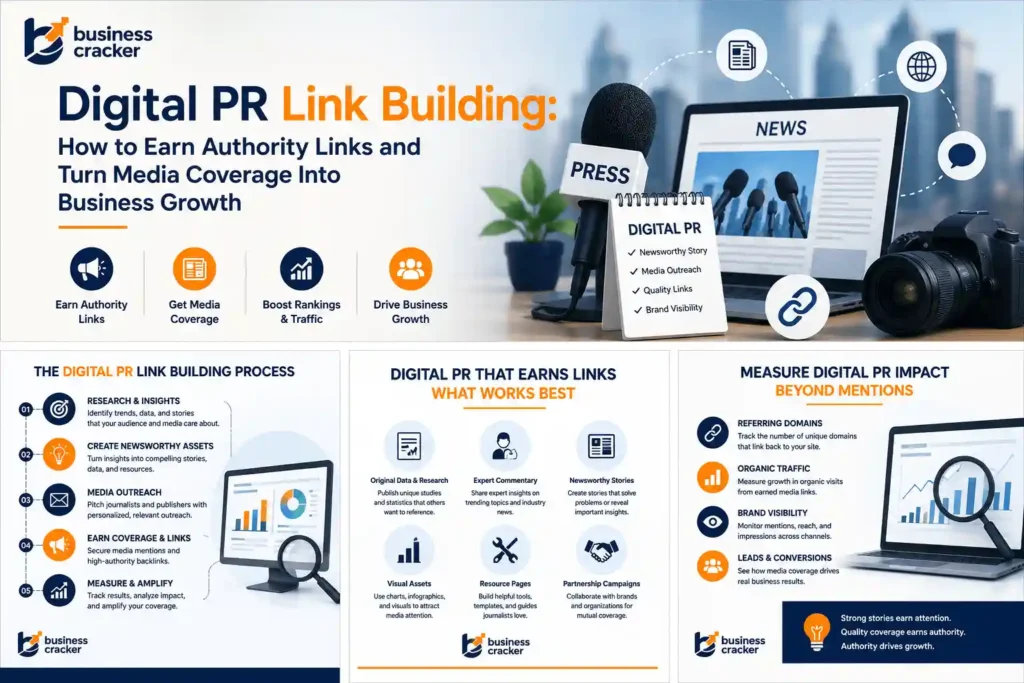
Our detailed guide to digital PR link building explains how to connect media coverage with authority, referral traffic, and measurable business growth.
5. Build Broken-Link Replacement Campaigns
Broken-link building helps a publisher repair an outdated or unavailable resource.
A complete process includes:
- Find a relevant article containing a broken external link.
- Confirm that the destination is genuinely unavailable.
- Understand what information the original resource provided.
- Create or identify a suitable replacement.
- Confirm that your page matches the surrounding context.
- Contact the editor with the exact broken URL and replacement.
- Explain how the correction helps readers.
- Monitor whether the link is updated.
Do not suggest an unrelated sales page simply because it belongs to your website.
The replacement should perform the same function as the missing resource, preferably with more current or complete information.
6. Get Included in Listicles and Comparison Pages
Listicles and comparison articles often reach buyers with strong commercial intent.
Examples include:
- Best CRM platforms for small businesses
- Top cybersecurity agencies in the United States
- Leading Shopify SEO companies
- Best payroll software for startups
- Alternatives to a well-known platform
- Product A vs. Product B
- Best tools for remote development teams
How to Find Opportunities
Search for pages containing:
- Best
- Top
- Alternatives
- Reviews
- Comparison
- Software
- Tools
- Agencies
- Services
- Providers
- Companies
Focus on pages that rank for commercially relevant terms, receive traffic, and are updated.
What to Include in Your Pitch
Provide:
- A concise company description
- The audience you serve
- Important differentiators
- Product screenshots
- Pricing information
- A demonstration or trial
- Customer evidence
- Relevant certifications
- Accurate feature information
- A reason your addition improves the list
Ask to be evaluated. Do not insist on inclusion.
7. Develop Partnerships and Integrations
Partnership links can produce recurring traffic because they are connected to a real business relationship.
Potential partners include:
- Complementary software providers
- Consultants
- Agencies
- Suppliers
- Distributors
- Training businesses
- Associations
- Event organizers
- Technology marketplaces
- Customer communities
- Implementation partners
- Industry educators
Partnership opportunities may include:
- Integration directories
- Partner profiles
- Joint webinars
- Co-authored guides
- Customer case studies
- Newsletter swaps
- Resource libraries
- Event sponsorships
- Referral agreements
- Co-marketing campaigns
The strongest partnerships provide value beyond the backlink.
8. Improve Directory and Review-Site Visibility
Directories can generate valuable traffic when people genuinely use them to find or compare providers.
A directory is worth considering when it:
- Serves a relevant industry
- Ranks for commercial searches
- Has active users
- Verifies listings
- Provides useful company information
- Allows authentic reviews
- Maintains current data
- Has a clear editorial or business purpose
Avoid submitting your site to hundreds of generic directories.
Prioritize platforms that your customers consult during research.
Complete each profile with:
- Correct business information
- A useful description
- Relevant categories
- Product or service information
- Images
- Operating hours
- Contact options
- An appropriate landing-page link
- Accurate location information
- Current customer reviews
9. Participate in Communities Without Spamming
Niche communities can generate referral traffic and reveal what customers actually need.
Potential communities include:
- Quora
- Slack groups
- Discord communities
- Professional forums
- Facebook groups
- LinkedIn groups
- Product communities
- Trade association forums
Use a value-first approach:
- Read the rules.
- Observe common questions.
- Answer the question completely.
- Disclose your affiliation.
- Add a link only when it materially improves the answer.
- Avoid repeating promotional messages.
- Continue participating after sharing the link.
Your answer should still help the reader even when they never visit your website.
10. Use Social Listening to Discover Opportunities
Social listening helps identify conversations already happening around your brand, competitors, products, and industry.
Monitor:
- Unlinked brand mentions
- Journalist questions
- Competitor reviews
- New industry terminology
- Customer complaints
- Frequently asked questions
- Trending topics
- Outdated statistics
- Broken resources
- Requests for recommendations
Tag opportunities by type:
- Mention reclamation
- Expert commentary
- Partnership
- Guest contribution
- Review opportunity
- Content idea
- Customer support issue
- Journalist request
Social listening is valuable because it turns existing demand and conversation into targeted action.
11. Create a Customer Referral Program
Customer referral marketing differs from editorial referral traffic, but both can send qualified visitors to your website.
A referral program encourages existing customers to recommend your business to others.
Common incentive models include:
- Referrer-only rewards
- New-customer rewards
- Dual-sided rewards
- Account credits
- Discounts
- Cash rewards
- Loyalty points
- Free upgrades
- Service extensions
Before launching a program, calculate:
- Customer acquisition cost
- Gross margin
- Average order or contract value
- Reward cost
- Fraud risk
- Referred-customer retention
- Customer lifetime value
- Payback period
Use unique links, referral codes, CRM fields, and analytics events to distinguish customer referrals from other channels.
How to Convert Referral Traffic Into Leads and Sales
Getting the click is only the first half of the job.
Match the Page to the Referral Source
A visitor should immediately understand the connection between the referring content and the destination page.
Repeat the relevant:
- Topic
- Problem
- Product
- Service
- Offer
- Audience
- Use case
Do not make referred visitors search your website for the information they expected.
Use a Clear Call to Action
The correct call to action depends on buyer readiness.
Early-stage CTAs may include:
- Download the checklist
- View the research
- Compare the options
- Read the case study
- Use the calculator
- Subscribe for updates
High-intent CTAs may include:
- Request pricing
- Book a consultation
- Start a free trial
- Schedule a demonstration
- Get a project estimate
- Request an audit
Avoid presenting five competing primary actions on the same landing page.
Add Relevant Proof
Referral visitors may trust the publisher, but they still need reasons to trust your business.
Useful proof includes:
- Customer case studies
- Specific testimonials
- Independent reviews
- Certifications
- Client logos
- Product ratings
- Security information
- Process transparency
- Team experience
- Measurable outcomes
- Relevant media coverage
Place evidence near the claim it supports.
Reduce Conversion Friction
Check whether the landing page has:
- A clear headline
- Readable mobile content
- Fast loading
- A short and usable form
- Visible contact information
- Helpful error messages
- Privacy reassurance
- A clear next step
- Accurate product details
- Working buttons
- Confirmation after submission
Referral traffic cannot produce strong results when the destination page is confusing or unreliable.
How to Track Referral Traffic in GA4
Google Analytics 4 provides a Traffic acquisition report designed to show where new and returning sessions originated. Google’s official instructions place this report under Reports → Acquisition → Traffic acquisition.
To review referral sources:
- Open Google Analytics 4.
- Select Reports.
- Open Acquisition.
- Select Traffic acquisition.
- Review Session default channel group.
- Change or add the dimension Session source/medium.
- Filter for referral traffic.
- Compare sessions, engagement, key events, and revenue.
- Add landing-page dimensions where needed.
- compare performance over a consistent period.
Capitalization should be standardized in tracking conventions because inconsistent source names can divide reporting into separate rows.
Use UTM Parameters for Campaign-Level Tracking
Standard referral information may identify the domain but not the specific campaign, placement, article, or partnership.
Google recommends adding campaign parameters to destination URLs when you need to identify which campaigns refer traffic. Common parameters include utm_source, utm_medium, and utm_campaign. Review Google’s official campaign URL guidance.
Example UTM Structure
utm_source=industry_newsletter
utm_medium=referral
utm_campaign=benchmark_report_2026
utm_content=editorial_link
Create a written naming convention before multiple team members start building URLs.
Use Google Search Console for Link Discovery
Google Search Console can show:
- Top linked pages
- Top linking sites
- Common external link text
- Recently discovered links
- Sample external links
However, Google states that the Links report is not a comprehensive list of every backlink. Its tables may be limited or sampled, so use it alongside other analytics and backlink tools. Review the official Google Search Console Links report documentation.
Referral Traffic Metrics That Matter
Acquisition Metrics
Track:
- New referring domains
- New referring pages
- Live backlinks
- Lost backlinks
- Referral sessions
- New referral users
- Campaign cost
- Cost per acquired placement
- Outreach response rate
- Placement rate
Engagement Metrics
Track:
- Engaged sessions
- Engagement rate
- Average engagement time
- Pages viewed
- Key page visits
- Return visits
- Downloads
- Video engagement
- Scroll depth where configured
Lead Metrics
Track:
- Form submissions
- Consultation bookings
- Demo requests
- Qualified-lead rate
- Sales acceptance rate
- Opportunity creation
- Cost per qualified lead
- Lead response time
Revenue Metrics
Track:
- Purchases
- Revenue by referral source
- Pipeline value
- Closed revenue
- Average order value
- Average contract value
- Customer acquisition cost
- Customer lifetime value
- Marketing return on investment
Useful Referral Traffic Formulas
Referral Conversion Rate
Referral conversions ÷ Referral sessions × 100
Cost per Qualified Referral Lead
Referral campaign cost ÷ Qualified referral leads
Outreach Placement Rate
Placements acquired ÷ Qualified prospects contacted × 100
Referral Revenue per Session
Revenue attributed to referral traffic ÷ Referral sessions
Placement ROI
(Attributed gross profit – Campaign cost) ÷ Campaign cost × 100
Do not evaluate a referral source only through last-click revenue. Some referrals introduce the brand early and influence later direct, organic, or branded-search conversions.
Common Referral Traffic Mistakes
Chasing Domain Metrics Instead of Relevant Audiences
A high authority score does not guarantee:
- Relevant readers
- Search visibility
- Editorial quality
- Referral clicks
- Qualified leads
- Sales
Use authority metrics as screening inputs, not final decisions.
Sending Every Link to the Homepage
The homepage is not always the best destination.
Deep links to relevant services, products, research, case studies, or resources often provide a clearer experience.
Publishing Content Without Distribution
Creating a resource is not the same as promoting it.
Build a distribution plan before publication. Identify potential journalists, partners, communities, customers, newsletters, and websites that could find it useful.
Using Generic Outreach Templates
Editors can recognize mass-produced pitches immediately.
Personalize:
- The subject
- The article reference
- The reason for contacting them
- The value offered
- The recommended destination
- The next step
Personalization does not require writing a biography about the recipient. It requires demonstrating that the opportunity was selected intentionally.
Ignoring Landing-Page Performance
A strong placement can still fail when the landing page:
- Loads slowly
- Has an unclear offer
- Does not match the referral
- Lacks proof
- Uses a complicated form
- Has a weak mobile experience
- Provides no relevant CTA
- Fails to track conversions
Measuring Backlinks but Not Business Outcomes
A monthly report containing only backlink totals, DA, DR, and anchor text does not explain business performance.
Connect placement data with:
- Referral engagement
- Leads
- Lead quality
- Opportunities
- Sales
- Revenue
- Ranking movements
- Brand searches
Buying Risky Links
Google’s spam policies identify buying or selling links for ranking purposes, excessive link exchanges, automated link creation, advertorial links that pass ranking credit, and other manipulative practices as potential link spam. Review the official Google Search spam policies.
Paid advertising and sponsorships are normal business activities, but commercially arranged links should be qualified appropriately. Google recommends rel=”sponsored” for advertisements and paid placements, with nofollow remaining acceptable. User-generated links may use rel=”ugc”. Review Google’s guidance on how to qualify outbound links.
Businesses concerned about suspicious links should diagnose the situation carefully rather than disavowing every unfamiliar domain. Our guide to finding and fixing toxic backlinks explains how to evaluate risk without making unnecessary changes.
A 90-Day Referral Traffic Action Plan
Days 1 to 30: Audit and Prioritize
- Review referral traffic in GA4
- Export referring pages and domains
- Identify the highest-converting sources
- Review priority landing pages
- Analyze competitor backlinks
- Find unlinked brand mentions
- Locate lost and broken links
- Build an opportunity scorecard
- Select target pages
- Create a list of qualified prospects
Days 31 to 60: Create and Promote
- Improve one existing linkable asset
- Publish one original data or expert-led resource
- Begin unlinked-mention outreach
- Pitch relevant listicles
- Contact selected resource pages
- Start broken-link outreach
- Develop partner opportunities
- Prepare guest contributions
- Build referral-specific landing pages
- Add UTM tracking where appropriate
Days 61 to 90: Measure and Scale
- Compare sources by engagement and conversions
- Review lead quality
- Identify messages producing responses
- Reclaim newly lost links
- Update underperforming landing pages
- Expand relationships with successful publishers
- Stop pursuing low-value placements
- Document results and lessons
- Build the next quarterly prospect list
- Connect referral performance to pipeline and revenue
How Business Cracker Helps Build Referral Traffic
At Business Cracker, we provide link building services focused on relevance, editorial quality, target-page alignment, and long-term SEO value.
Our work can include:
- Link prospect research
- Competitor backlink analysis
- Outreach planning
- Guest posting
- Niche edits
- Broken-link building
- Digital PR support
- Link tracking
- Placement evaluation
- Backlink risk reviews
We do not treat link building as a fixed package of random backlinks. A productive campaign should be designed around the website’s current authority, priority pages, competitive market, audience, search goals, and business model.
Link building also works best as part of a broader strategy. Our SEO services connect technical performance, search intent, on-page optimization, content planning, and off-page authority so that acquired links support pages capable of ranking and converting.
Businesses can also review our guide to getting high-quality backlinks in 2026 for additional campaign ideas.
Referral Traffic FAQs
What is referral traffic?
Referral traffic consists of visitors who reach your website by clicking a link on another website. It is different from direct traffic, organic search traffic, paid search traffic, and traffic categorized under social channels.
Is referral traffic good for SEO?
Referral traffic and SEO are different outcomes, but they can support each other. A relevant editorial backlink may send visitors while also helping search engines discover and understand the linked page. The value depends on the referring page, context, link attributes, destination, and overall quality.
What is a good referral traffic percentage?
There is no universal referral traffic percentage that applies to every business. The appropriate level depends on your industry, acquisition model, partnerships, brand visibility, sales cycle, and traffic mix.Measure referral traffic through engagement, qualified leads, sales, revenue, and strategic value rather than comparing your website with a generic benchmark.
What is the best source of referral traffic?
The best source is the one that reaches your target audience and contributes to a meaningful objective.For a SaaS company, that may be a comparison website or integration partner. For a local business, it may be a review platform or local association. For an ecommerce brand, it may be an influential product review or gift guide.
How can I find websites referring traffic to my site?
Use GA4’s Traffic acquisition report to review session sources and mediums. Use Google Search Console and backlink analysis tools to identify external links and referring pages. Combine these datasets because no single report provides a complete view.
Final Thoughts
Increasing referral traffic is not about placing your link on as many websites as possible.
It is about earning visibility where your customers already research, compare, learn, and make decisions.
A successful strategy connects:
- The right referring source
- A relevant audience
- A credible recommendation
- A contextual link
- A useful destination page
- A clear conversion path
- Reliable attribution
- A measurable business result
The strongest backlink is not simply a link from a high-authority domain. It is a relevant, defensible, contextually placed link that reaches the right people and supports a real business objective.
Business Cracker helps companies build that type of link strategy through quality-focused outreach, SEO alignment, digital PR support, and practical performance measurement.
Contact Business Cracker to discuss a referral traffic and backlink strategy built around your website, target pages, audience, and growth goals.