June 19, 2026
How to Choose a Link Building Agency Without Wasting Budget
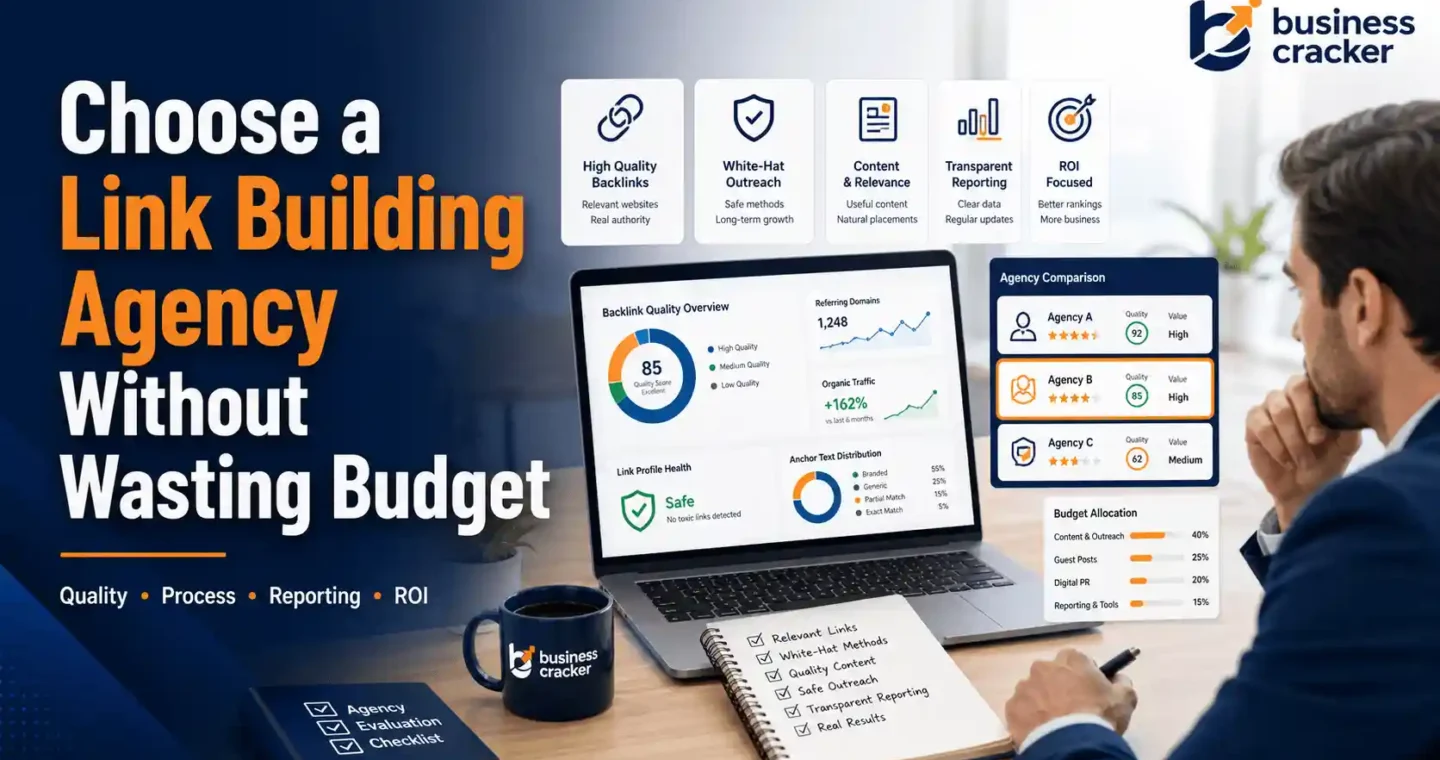
Hiring a link building agency is easy. Choosing one that will not burn your budget on weak backlinks is the hard part.
Most buyers already know they need links. The real problem is different: they cannot compare quality, process, pricing logic, reporting, and risk. One link building company promises “high authority backlinks.” Another talks about digital PR. Another sells fixed monthly packages. A full-service SEO agency may include link building inside a broader retainer, but it may not explain how links are actually earned.
That gap is where budgets get wasted.
In community discussions, buyers repeatedly ask the same kind of questions. One B2B marketer on Reddit said they understood the theory of backlinks but wanted to know how link building is actually done, not just the idea that “great content” magically earns links. Another buyer comparing agencies said one provider was strongly pushing link building while another said links were less important because they can be manipulated. In a local SEO discussion, users questioned which link building services were actually worth paying for and which were just noise.
That is the real search intent behind “link building agency.” Buyers are not looking for a definition. They are trying to make a commercial decision without getting trapped in vague promises.
This guide explains how to evaluate a link building agency before signing a contract.
The Problem This Article Solves
The main problem is not that buyers do not understand backlinks.
The problem is that they cannot tell the difference between:
- A real outreach-led link building agency
- A reseller selling links from a database
- A general SEO agency outsourcing link placements
- A white hat link building services provider with a clear process
- A low-quality vendor hiding behind DA, DR, and “premium sites”
The wrong choice can lead to wasted budget, irrelevant links, poor reporting, over-optimized anchors, ranking risk, and no measurable business impact.
Desired Reader Outcome
After reading this article, you should be able to:
- Understand what a link building agency should actually do
- Compare agencies beyond link count and domain metrics
- Know what questions to ask before paying
- Spot red flags in link building proposals
- Understand safe pricing logic
- Review sample reports properly
- Decide whether you need a dedicated link building company, a full SEO agency, or broader digital marketing services
- Choose a provider that fits your business goals, not just your backlink target
What Does a Link Building Agency Do?
A link building agency helps your website earn backlinks from other websites.
A backlink is a link from another website to your site. In SEO, backlinks can help search engines discover pages, understand authority, and evaluate how often other websites reference your content or business.
But a serious link building agency does more than “get links.”
It should help with:
- Backlink profile audit
- Competitor link analysis
- Target page selection
- Prospect research
- Website quality checks
- Outreach strategy
- Content planning
- Anchor text planning
- Link placement review
- Reporting
- Link retention tracking
- Performance review
If an agency starts by selling 10, 20, or 50 links without reviewing your website, competitors, content, target pages, or risk profile, it is probably selling inventory, not strategy.
Why Choosing the Right Agency Matters More in 2026
Link building is becoming more expensive and harder to judge.
Recent link building research shows that many SEOs are paying several hundred dollars per link, with 76 percent paying more than $300 per link and 47 percent paying more than $500 per link. Another 2026 pricing report found average guest post costs around $461, while high-quality guest posts can cost far more depending on traffic and quality standards.
That means a poor agency choice can waste thousands quickly.
At the same time, quality standards are rising. BuzzStream’s 2026 link building research reported that only a small share of guest post opportunities meet stronger quality standards, and many teams still struggle with process, measurement, and confidence in external link builders.
So the question is not “Who can get backlinks?”
The better question is:
Can this agency build relevant, safe, trackable links that support the right pages and business goals?
Start With Your Business Goal, Not the Agency Pitch
Before speaking to any link building agency, define why you want links.
Common goals include:
- Improve rankings for service pages
- Build authority for a new website
- Support content that already ranks on page two
- Close a competitor link gap
- Increase referral traffic
- Build local authority
- Support digital PR and brand mentions
- Improve visibility in AI and search results
- Strengthen trust around a product, service, or category
Your goal changes the agency you should hire.
For example, a local service business may need local citations, association links, partner links, and relevant local media mentions. A SaaS company may need product-led PR, comparison page mentions, integration partner links, and expert commentary. An ecommerce brand may need product reviews, buying guides, category page support, and digital PR.
A generic backlink package will not fit all three.
What the Best Link Building Agency Should Ask You
A good agency should ask questions before offering a plan.
If the first conversation jumps straight to pricing per link, be careful.
A serious provider should ask:
- What are your main business goals?
- Which services or products are most important?
- Which pages need stronger visibility?
- Which keywords are commercially valuable?
- Who are your real search competitors?
- What is your current backlink profile?
- Have you bought links before?
- Have you had traffic drops or manual actions?
- Which markets or locations matter?
- What content assets already exist?
- Do you have existing partners, vendors, or associations?
- What is your risk tolerance?
- How will success be measured?
- What budget range is realistic?
Google’s own hiring guidance says that choosing an SEO can improve a site and save time, but an irresponsible provider can also damage a site and reputation. Google recommends interviewing providers, asking for examples, checking whether they follow Google Search Essentials, and understanding how success will be measured.
That advice applies directly when hiring a link building agency.
The First Thing to Check: Process
The best link building agency should be able to explain its process clearly.
You do not need every internal detail. You do need enough clarity to know whether the agency is doing manual, relevant work or simply reselling placements.
Ask the agency to explain:
- How they find link prospects
- How they qualify websites
- How they check relevance
- How they review traffic
- How they avoid spam sites
- How they select target pages
- How they choose anchor text
- How outreach is handled
- Whether content is included
- How placements are approved
- How links are reported
- How removed links are handled
- How results are measured
If the agency says the process is secret, that is not a good sign. Some proprietary details can remain private, but the quality control system should be visible.
Do Not Judge Agencies Only by DA or DR
Domain Authority, Domain Rating, Authority Score, and similar metrics can be useful filters. They are not proof of link quality.
A link from a DR 70 site can still be poor if:
- The site publishes unrelated guest posts every day
- The article has no real audience
- The page is not indexed
- The content is thin
- The link is forced into irrelevant text
- The outbound links are spammy
- The site exists mainly to sell links
- The traffic is fake, irrelevant, or declining
A lower-metric website can sometimes be more useful if it is highly relevant, trusted in your niche, and read by potential buyers.
A practical rule:
Use metrics to shortlist. Use manual review to decide.
How to Check Link Quality Before Paying
Before approving any placement, review the website and page yourself.
A good link should pass most of these checks:
| Quality Area | What to Check | Why It Matters |
| Relevance | Is the site related to your industry, audience, location, or topic? | Irrelevant links rarely support real authority |
| Traffic | Does the site get organic traffic from relevant keywords? | A site with no visibility may offer limited value |
| Editorial quality | Are articles useful, edited, and written for readers? | Weak content suggests weak publishing standards |
| Outbound links | Does the site link to random industries or spam topics? | Bad outbound patterns can signal link selling |
| Indexation | Is the page likely to be indexed? | A non-indexed page may have little SEO value |
| Placement | Is the link placed naturally in the body content? | Forced links are easy to spot |
| Anchor text | Is the anchor natural and varied? | Repeated exact-match anchors can create risk |
| Audience fit | Would a real buyer or industry reader care? | Referral value matters |
| Permanence | Is the link expected to stay live? | Temporary links reduce ROI |
| Disclosure | Are paid or sponsored placements handled properly? | Link safety depends on policy compliance |
Do not approve a link only because the spreadsheet says “DA 60.”
Understand Google’s Link Rules Before Hiring Anyone
Link building is not automatically against Google’s rules. Manipulative link building is the problem.
Google’s spam policies include practices that attempt to manipulate rankings, and the policies warn that violations can lead to lower rankings or removal from search results. Google also specifically addresses hidden links, user-generated spam, and other manipulative practices.
Google’s link guidance also says that paid links should be qualified with rel=”sponsored” or rel=”nofollow”, and user-generated links should use ugc or nofollow where appropriate.
This matters because many agencies avoid discussing paid placements clearly.
Ask this directly:
“If money, products, or other compensation are involved in a placement, how do you handle disclosure and link attributes?”
A responsible agency should have a clear answer.
White Hat Link Building Services: What That Should Mean
Many agencies call their work “white hat.” That phrase is often used loosely.
White hat link building services should mean:
- Manual prospect research
- Relevance-based qualification
- Real outreach
- Useful content
- Editorial review
- Natural anchor text
- No private blog networks
- No hacked links
- No comment spam
- No automated bulk links
- No hidden placements
- No misleading reporting
- No false guarantee of rankings
If an agency claims to offer white hat link building but cannot explain the process, the label does not mean much.
Pricing Logic: Cheap Links Are Usually Expensive Later
Budget waste usually starts with pricing confusion.
Buyers often compare agencies like this:
- Agency A: 20 links for $500
- Agency B: 8 links for $1,500
- Agency C: Digital PR campaign for $4,000+
- Agency D: SEO retainer with link building included
The cheapest option looks attractive until you check quality.
The right way to judge pricing is not cost per link alone. Look at cost per qualified link.
A qualified link should meet relevance, traffic, editorial, placement, and safety standards.
Ask the agency:
- What is included in the price?
- Is strategy included?
- Is content included?
- Is prospecting included?
- Is outreach included?
- Are placement fees included?
- Are replacements included if links go down?
- Is reporting included?
- Is performance review included?
- Are there setup fees?
- Are there minimum contracts?
A $100 link can be expensive if it adds no value. A $700 link can be reasonable if it is relevant, visible, permanent, and supports a priority page.
Fixed Packages vs Custom Link Building
Fixed packages are common because they are easy to sell.
Example:
- 5 links per month
- 10 links per month
- 20 links per month
The problem is that your website may not need the same number or type of links every month.
A custom link building plan considers:
- Website age
- Current authority
- Competitor links
- Keyword difficulty
- Target pages
- Existing content
- Industry risk
- Local vs national reach
- Current backlink quality
- Internal linking
- Technical SEO condition
- Budget
- Sales cycle
For example, a new local business may first need citations, local partnerships, association links, and foundational trust signals. A B2B company with strong content may need digital PR and expert placements. An ecommerce brand may need product-led campaigns and category support.
If every client gets the same package, the agency is not building around your business.
Review the Agency’s Sample Report
Before hiring, ask for a sample report.
A weak report includes only:
- Live URL
- DA or DR
- Anchor text
A useful report includes:
- Live URL
- Target URL
- Anchor text
- Link type
- Follow, nofollow, sponsored, or UGC status
- Placement date
- Domain relevance
- Page relevance
- Estimated organic traffic
- Top ranking keywords of the linking page or site
- Indexation status
- Notes on content quality
- Notes on outbound link quality
- Whether the link is permanent
- Outreach status
- Link retention tracking
- Ranking and traffic movement for target pages
Good reporting should connect links to business outcomes.
BuzzStream’s 2026 research found that many link builders evaluate links through organic visibility, but fewer measure revenue, leads, or sales impact.
That is a problem for buyers. A link building campaign should not end at “links delivered.” It should show whether the right pages are gaining visibility, traffic, and qualified leads.
Ask How They Choose Target Pages
Target page selection is one of the most overlooked parts of link building.
Many agencies build links to:
- Homepage
- Random blog posts
- Easy guest post landing pages
- Pages they think are safer to link to
But your campaign should support business goals.
Target pages may include:
- Service pages
- Location pages
- Category pages
- Product pages
- Comparison pages
- Case studies
- Research pages
- Linkable assets
- Tools or templates
- Educational guides
For example, if your business wants to grow organic visibility around SEO, links may support both your SEO services page and supporting content. If your main growth need is off-page authority, your link building services page and related educational assets may need stronger support.
A good agency should explain why each target page deserves links.
Ask About Anchor Text Strategy
Anchor text is the clickable text used in a backlink.
Unsafe agencies often push exact-match anchors such as:
- link building agency
- best link building agency
- link building company
- white hat link building services
Using exact-match anchors sometimes is not automatically wrong. Repeating them aggressively across many placements can look unnatural.
A safer anchor mix includes:
- Brand anchors
- URL anchors
- Page title anchors
- Partial-match anchors
- Natural phrase anchors
- Topical anchors
- Generic anchors when they fit the context
Ask the agency:
- How do you decide anchor text?
- Do you track anchor distribution?
- How do you avoid over-optimization?
- Do you adjust anchors based on existing backlink profile?
- Can we approve anchors before placement?
If the agency gives every client the same keyword-heavy anchor strategy, be careful.
Ask Whether They Own, Rent, or Buy Their Network
This question matters.
Some agencies do genuine outreach. Some buy from publishers. Some use private networks. Some rent links. Some resell from broker lists.
Ask:
- Do you own any of the sites where links are placed?
- Do you use private blog networks?
- Do you buy placements from publisher lists?
- Do you disclose sponsored relationships?
- Are links permanent?
- Can placements be removed later?
- What happens if a link disappears?
- Can I review sites before approval?
A good provider should be honest about how placements are sourced.
If the agency says every link is “editorial” but cannot explain the publisher relationship, ask more questions.
What Red Flags Should Buyers Watch For?
Avoid or question any agency that offers:
- Guaranteed first-page rankings
- Hundreds of links for a very low price
- No backlink audit
- No competitor analysis
- No sample report
- No explanation of methods
- No target page strategy
- No anchor text planning
- No relevance checks
- No traffic checks
- No placement review
- No mention of Google policies
- No replacement policy
- No reporting beyond link count
- No willingness to discuss risk
- No clear contract terms
- No transparency about paid placements
- Same package for every business
Also be careful with vague phrases such as:
- High authority links
- Premium placements
- Google-safe links
- Manual outreach
- White hat backlinks
- Real sites
- Niche relevant links
These phrases are not bad by themselves. They become a problem when the agency cannot prove what they mean.
How to Compare Link Building Agencies
Use this scoring system before choosing a provider.
| Evaluation Area | Poor Agency | Better Agency |
| Discovery | Sells packages immediately | Audits website, competitors, and goals first |
| Prospecting | Uses a fixed database | Builds custom prospect lists |
| Quality checks | Focuses only on DA or DR | Checks relevance, traffic, content, and outbound links |
| Outreach | Generic templates at scale | Targeted outreach with clear value |
| Content | Thin guest posts | Useful content written for the publisher’s audience |
| Anchors | Exact-match heavy | Natural, varied, risk-aware |
| Reporting | URLs and metrics only | Links plus context, status, and performance |
| Risk | Avoids policy discussion | Explains paid, sponsored, nofollow, and spam risks |
| Pricing | Cheap bulk links | Pricing based on quality, effort, and goals |
| Measurement | Links delivered | Rankings, traffic, retention, and business impact |
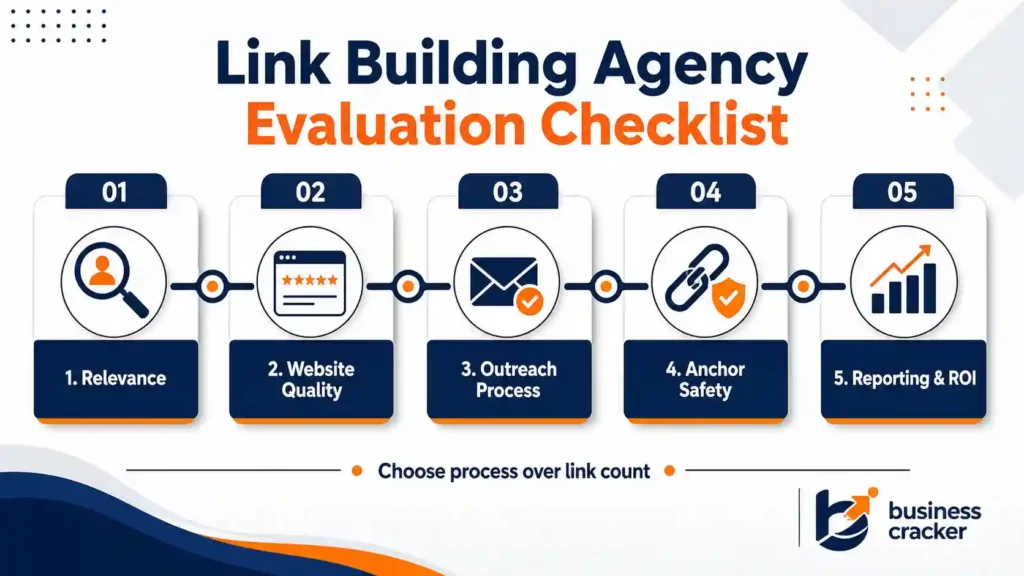
The best link building agency is not always the one with the most links. It is the one with the clearest process and the strongest quality control.
What Should Be Included in a Link Building Proposal?
A strong proposal should include:
- Current backlink profile summary
- Competitor backlink gap
- Target pages
- Recommended link types
- Monthly link range
- Quality standards
- Relevance criteria
- Outreach method
- Content requirements
- Anchor text approach
- Reporting format
- Timeline
- Budget
- Risk notes
- Link replacement policy
- Success metrics
A weak proposal usually says:
“We will build 10 high DA backlinks per month.”
That is not enough.
How Long Should You Wait for Results?
Link building is not instant.
Some links may be crawled quickly. Others may take longer to influence rankings. Results also depend on content quality, technical SEO, internal linking, keyword difficulty, competitor activity, and search intent.
A practical timeline:
- Month 1: audit, strategy, prospecting, outreach setup
- Month 2: first placements, early tracking
- Month 3: link growth and first movement on some pages
- Months 4 to 6: stronger visibility patterns, depending on competition
- Months 6+: clearer ROI review and strategy adjustment
If an agency guarantees major ranking jumps in 30 days, be cautious.
Should You Hire a Link Building Agency or a Full SEO Agency?
It depends on your website.
Hire a dedicated link building agency if:
- Your technical SEO is already stable
- Your content is strong
- Your target pages are clear
- You already have keyword strategy
- You need off-page authority
- You have in-house SEO support
Hire a full SEO agency if:
- Your website has technical issues
- Your service pages are weak
- Keyword targeting is unclear
- Internal linking is poor
- Content needs improvement
- You do not know which pages need links
- You need reporting across SEO, content, and authority
Use broader digital marketing services if link building is only one part of a larger growth plan involving SEO, web design, paid campaigns, social visibility, and reputation.
Link building works better when the website itself is ready to convert visitors.
What Good Link Building Looks Like in Practice
A safe process usually looks like this:
Step 1: Backlink Audit
The agency reviews current referring domains, anchor text, link velocity, toxic patterns, lost links, competitor gaps, and target page authority.
Step 2: Business and SEO Alignment
The agency identifies which pages matter most for revenue, leads, visibility, or authority.
Step 3: Competitor Research
The agency studies competitor backlinks to find useful patterns, not to copy every link.
Step 4: Prospect Research
The agency builds a relevant list of websites, publishers, partners, blogs, directories, associations, media outlets, and resource pages.
Step 5: Quality Filtering
Each prospect is checked for relevance, traffic, editorial quality, indexation, outbound links, and risk.
Step 6: Outreach
The agency pitches useful content, expert input, resources, or partnership opportunities.
Step 7: Content Support
If content is required, it should be original, useful, fact-checked, and suitable for the publisher’s audience.
Step 8: Placement Review
Before final approval, the agency checks the live page, link placement, anchor text, link attribute, and context.
Step 9: Reporting
The agency reports live links, target pages, anchors, quality notes, link type, and progress.
Step 10: Performance Review
The agency reviews ranking movement, traffic, referral visits, leads, link retention, and competitor movement.
This is the difference between buying links and building authority.
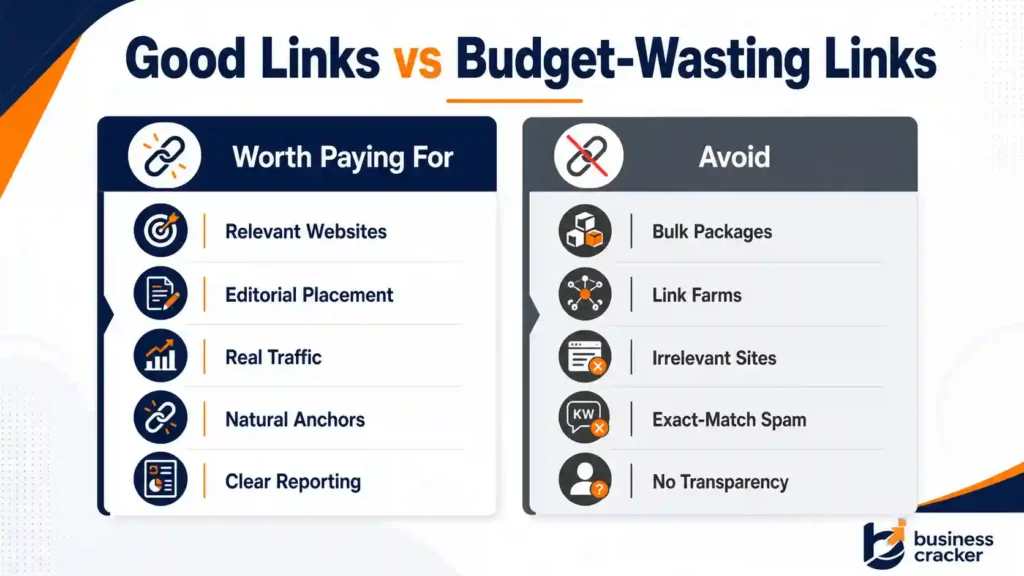
Questions to Ask Before Hiring a Link Building Company
Use these questions in your sales call:
- What is your link building process from audit to reporting?
- How do you choose websites?
- How do you define relevance?
- Do you check traffic and indexation?
- Do you use paid placements?
- How do you handle sponsored or nofollow links?
- Do you use private blog networks?
- Can we approve sites before placement?
- How do you choose anchor text?
- What pages should we build links to and why?
- What link types do you recommend for our business?
- What will the report include?
- How do you track link retention?
- What happens if a link is removed?
- How do you measure results beyond links delivered?
- What results are realistic in 3 to 6 months?
- What do you need from our team?
- What tactics do you avoid?
- Can you show a sample report?
- Can you show relevant case examples?
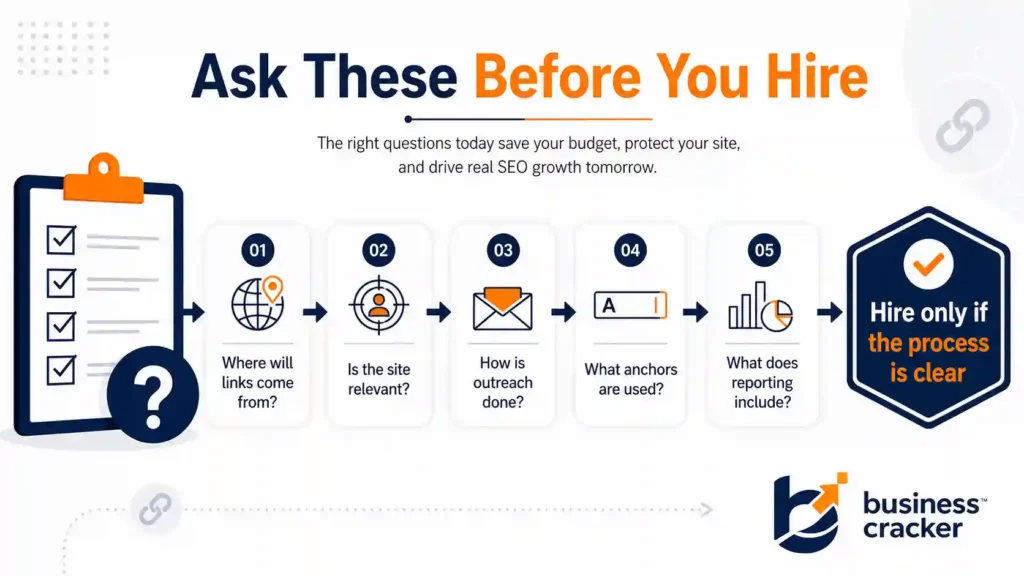
The answers will quickly separate serious agencies from link sellers.
How Business Cracker Approaches Link Building
Business Cracker treats link building as part of a wider SEO and digital growth system.
That means the focus is not just on backlinks. The focus is on building authority for the right pages through relevant, safe, and measurable off-page SEO work.
A proper plan may include:
- Backlink profile review
- Competitor link gap analysis
- Target page planning
- Guest posting opportunities
- Niche-relevant outreach
- Digital PR support
- Broken link building
- Resource page outreach
- Anchor text planning
- Link tracking and reporting
- SEO performance review
For businesses that need a complete foundation first, Business Cracker also provides SEO services and broader digital marketing services so link building does not sit outside the larger growth strategy.
If your business specifically needs off-page authority support, you can review Business Cracker’s link building services.
Final Checklist Before You Choose a Link Building Agency
Before signing, confirm:
- The agency understands your business goals
- They audited your backlink profile
- They reviewed competitors
- They explained their process
- They use relevance as a core quality filter
- They check traffic and content quality
- They do not rely only on DA or DR
- They explain paid placement risks
- They follow safe anchor text practices
- They provide sample reports
- They allow placement review
- They track link retention
- They measure rankings, traffic, and leads
- They are clear about pricing
- They do not promise guaranteed rankings
- They explain what they will not do
If an agency cannot answer these points, keep looking.
Final Thoughts
Choosing a link building agency is not about finding the cheapest provider or the biggest link count. It is about finding a partner that understands SEO, risk, relevance, reporting, and business outcomes.
The best link building agency should help you answer four questions:
- Which pages need authority?
- Which websites should link to them?
- Why would those links make sense?
- How will we measure whether the work is helping?
If the agency can answer those questions clearly, you are more likely to protect your budget and build links that support long-term visibility.
If your business needs a safer and more measurable link building strategy, contact Business Cracker to discuss the right approach for your website, SEO goals, and growth plan.