May 17, 2026
What Is SMO and Why Does It Matter for Business Growth?
Social media is no longer just a place where businesses post updates and wait for likes. It has become a discovery channel, a trust signal, a customer support touchpoint, a local visibility asset, and in some industries, a direct sales influence.
That shift has made SMO more important. SMO stands for social media optimization. It is the process of improving a business’s social media presence so that people can find, understand, trust, and engage with the brand more easily.
The problem is that many businesses still treat social media as a posting task. They publish offers, festival creatives, product images, or random updates without fixing the basics: profile clarity, content direction, audience relevance, visual consistency, engagement quality, and measurement.
That is where SMO services become useful. Good SMO is not about posting more. It is about making social media work as part of the larger growth system.
Why SMO Matters Now
The audience is already on social platforms. According to DataReportal’s Digital 2026 Global Overview Report, there are 5.66 billion active social media user identities globally, equal to 68.7 percent of the world’s population. The same report says social media user identities increased by 259 million over the previous year.
This does not mean every business should chase every platform. It means customers are already using social media to discover, compare, validate, and question brands.
HubSpot’s 2025 Social Trends Report also shows how search behavior is changing. It reports that 84 percent of marketers agree consumers will search for brands on social media, 69 percent agree more shopping will happen directly on social than on brand websites or third-party marketplaces, and 25 percent of consumers bought products directly from social media in the previous three months.
For businesses, this creates a clear issue. If someone searches your brand on Instagram, LinkedIn, Facebook, YouTube, or TikTok and sees an inactive profile, unclear bio, poor visuals, outdated posts, missing links, or weak reviews, the business loses trust before the website gets a chance.
The Real Problem Businesses Are Facing
Recent community discussions show the same pattern across small business owners, marketers, and social media managers.
One business owner on Reddit said they stopped social media marketing for a month and saw no drop in sales because their previous posting had low engagement and negligible traffic to the online store. The discussion was not about whether social media is useless. It was about whether unplanned posting creates enough value to justify the time spent.
Another marketer asked why a financial institution’s Instagram engagement had dropped so low that carousels, videos, and community posts were struggling to pass 10 likes, even though similar content worked better on Facebook. A reply pointed out that the content was talking about the institution instead of showing what the viewer gets from following or interacting with it.
A small business owner also asked how to manage social media while short on time and resources, explaining that consistency felt difficult while handling the rest of the business. The replies pointed toward batching content, scheduling, outsourcing, or getting focused help.
These are not isolated complaints. They point to five common problems:
- Businesses are active but not visible.
- Profiles exist, but do not build trust.
- Content is being posted, but not structured around audience needs.
- Engagement is low because the brand talks at people instead of creating useful interaction.
- Teams cannot maintain consistency because social media becomes one more operational burden.
SMO solves these problems by improving the foundation before scaling the activity.
What Is SMO?
SMO, or social media optimization, is the process of improving social media profiles, content structure, posting systems, engagement practices, and platform signals so the business becomes easier to discover, understand, and trust.
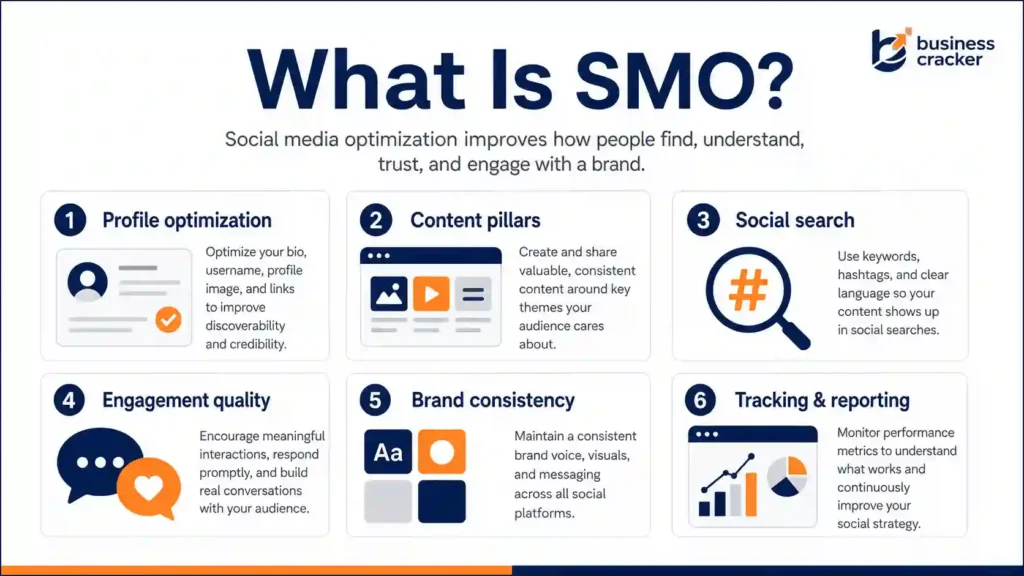
It includes:
- Social profile optimization
- Bio and description improvement
- Branded visual consistency
- Platform-specific content direction
- Social search keyword alignment
- Link and CTA placement
- Hashtag and topic structure
- Posting calendar improvement
- Audience engagement guidance
- Review and reputation alignment
- Performance tracking
The goal is not only social media visibility. The goal is better business visibility across the places where people already research brands.
SMO Is Not the Same as Social Media Marketing
Social media marketing is broader. It can include campaign planning, content production, paid social ads, influencer partnerships, community management, and conversion campaigns.
SMO is more foundational. It asks whether your social presence is ready to support discovery and trust.
For example, a business may be running Meta ads but sending users to a profile with:
- No clear service description
- Old branding
- Weak highlights
- Missing contact details
- No proof of work
- Poor review visibility
- Random content topics
- No clear CTA
In that case, the issue is not only advertising. The issue is poor optimization.
This is similar to paid campaigns. Ads can bring traffic, but if the landing page is weak, the campaign wastes money. Business Cracker has explained this connection in its article on SEO vs paid ads, where website quality, tracking, and trust signals influence whether traffic converts.
The same logic applies to SMO. Social platforms can create attention, but the brand still needs a clear and credible presence.
Why Social Media Visibility Matters for Business Growth
Social media visibility is not just follower count. A business can have thousands of followers and still get poor engagement, weak leads, or low trust.
Real social media visibility means the right people can find the brand, understand the offer, and see enough signals to take the next step.
This matters in several ways.
1. Social Platforms Are Becoming Search Engines
People do not only use Google to research businesses. They search on YouTube, Instagram, TikTok, LinkedIn, Reddit, and Facebook. They check comments, reviews, content quality, founder activity, product videos, and customer feedback.
HubSpot’s search behavior research states that consumers are increasingly searching for brands on social media and recommends a search-first mindset for social strategy.
That means social content should be discoverable, not just attractive.
A good SMO approach improves:
- Profile names
- Bio keywords
- Category selection
- Alt text where available
- Captions
- Hashtags
- Content themes
- Location signals
- Profile links
- Pinned posts
For example, a local web design agency should not only post “new project completed.” It should use a profile and content language that reflects how buyers search, such as WordPress website design, business website redesign, landing page design, ecommerce website support, or local service website.
2. SMO Builds Trust Before the First Inquiry
A buyer may see your website first, then check your Instagram or LinkedIn profile. Another buyer may see a post first, then visit your website. Someone else may hear your name from a friend and search for your brand on social media.
In every case, the profile is a trust layer.
Weak social profiles create doubts:
- Is this business active?
- Does it understand its market?
- Does it have real work?
- Are customers engaging?
- Is the brand professional?
- Can I contact them easily?
- Does the content match the website?
This is where SMO and ORM services connect. SMO improves the public-facing social presence. ORM supports brand trust, reviews, reputation signals, and negative perception management.
For many service businesses, trust is not built through one channel. It is built through repeated consistency across search, social, reviews, website pages, and direct communication.
3. SMO Helps Paid and Organic Campaigns Perform Better
Many businesses separate social media, SEO, paid ads, and website work. That creates gaps.
For example:
- Paid social ads run, but the brand profile looks inactive.
- SEO blogs rank, but social channels do not reinforce authority.
- Website pages look professional, but social content feels random.
- The business posts regularly, but there is no CTA to the right service page.
- Leads come from social, but tracking does not show which content influenced them.
A better approach connects channels.
If a company is already investing in performance marketing, SMO can support campaign credibility. Users who click an ad often check the profile before converting. A clean profile, relevant posts, strong highlights, and visible proof can reduce hesitation.
If a company is building SEO, social media can help distribute content, support brand searches, and create repeated exposure. It may not directly replace SEO, but it supports the buyer journey.
4. SMO Improves Content Direction
One of the biggest mistakes businesses make is posting from the company’s perspective instead of the customer’s perspective.
Common weak posts include:
- “We are happy to announce.”
- “Our team is excited.”
- “Contact us for the best services.”
- “Festival greetings”
- “New offer available”
- “We provide quality work.”
These posts are not always bad, but they rarely create consistent growth on their own.
Strong SMO changes the content lens.
Instead of asking “What should we post today?” the business asks:
- What problem is the audience trying to solve?
- What question appears before they contact us?
- What proof do they need?
- What objection prevents them from buying?
- What mistake are they making?
- What result do they want?
- Which format will communicate this best?
That is why profile optimization alone is not enough. Social media optimization services should include content direction. A business needs content pillars, not random posts.
For a digital agency, content pillars might include:
- Website mistakes that reduce leads
- SEO problems business owners overlook
- Social media profile fixes
- Paid ad landing page issues
- Local business visibility tips
- Reputation and review management
- Case study style before and after posts
- Short educational videos
This makes content easier to plan and easier for the audience to understand.
5. SMO Supports Business Managers Who Need Clarity
Business managers do not always need more posts. They need clarity.
They need to know:
- Which platforms matter for the business?
- What should be optimized first?
- How often should the business post?
- What type of content should be created?
- Who will respond to comments and messages?
- How will social activity connect to leads?
- What metrics should be reviewed?
- When should paid campaigns be added?
Without this clarity, social media becomes a cost center. Someone keeps posting, but no one can explain whether it is improving visibility, trust, traffic, or inquiries.
SMO gives structure to the channel.
What Should Be Included in SMO Services?
Not every business needs the same SMO scope. A SaaS company, an e-commerce brand, a real estate consultant, a clinic, a local service business, and a B2B agency all need different platform priorities.
Still, useful SMO services usually cover the following areas.
1. Social Media Audit
An SMO audit should review:
- Profile completeness
- Bio clarity
- Brand consistency
- Link accuracy
- CTA placement
- Content quality
- Posting frequency
- Platform fit
- Engagement patterns
- Competitor positioning
- Review and reputation signals
- Visual quality
- Search visibility within platforms
This audit should identify practical issues, not just count followers.
2. Profile Optimization
Profile optimization is one of the most important parts of SMO.
It includes:
- Clear business name
- Keyword-relevant bio
- Service or product clarity
- Correct category
- Location details where relevant
- Website link
- Contact options
- Branded profile image
- Professional cover image
- Pinned posts
- Highlights or featured sections
- Consistent naming across platforms
For example, if a business provides social media optimization services, the profile should say that clearly. It should not only say “We grow brands online.” That phrase sounds broad and does not help users understand the service.
3. Content Pillar Planning
Content pillars help the business post with direction.
A practical SMO plan may divide content into:
- Educational posts
- Problem and solution posts
- Case study posts
- Proof and results posts
- Behind-the-scenes posts
- Service explanation posts
- Customer question posts
- Comparison posts
- Trust-building posts
- Offer or CTA posts
This prevents the feed from becoming repetitive.
4. Social Search Optimization
Social search optimization means creating profiles and content that can be discovered when people search inside social platforms.
This includes:
- Keywords in profile names and bios
- Search-friendly captions
- Topic-based hashtags
- Location tags
- Video titles where applicable
- Descriptive alt text
- Clear board or playlist names
- Pinned educational content
- Platform native search behavior analysis
This is especially important for businesses targeting younger audiences, local customers, product discovery, or visual categories.
5. Engagement Improvement
Engagement is not only about likes. It includes saves, shares, replies, comments, profile visits, website clicks, DMs, mentions, and repeat interaction.
Good SMO improves engagement by making content more useful.
For example:
Weak post: “We offer website design services. Contact us today.”
Better post: “5 signs your business website is losing leads before users fill the form.”
The second version gives users a reason to stop, read, save, or message.
6. Brand Consistency
A business should look and sound consistent across platforms.
This includes:
- Logo usage
- Color palette
- Font style
- Post templates
- Tone of voice
- Bio wording
- Service descriptions
- CTA language
- Offer positioning
- Visual hierarchy
Brand consistency matters because users compare signals. If the website looks professional but social profiles look neglected, confidence drops. Business Cracker has also covered why website clarity and design influence trust in its article on website design for SEO and conversions.
7. Measurement and Reporting
SMO should be measured, but not only through vanity metrics.
Useful metrics include:
- Profile visits
- Website clicks
- Reach by content type
- Saves
- Shares
- Comments
- DM inquiries
- Follower quality
- Engagement rate
- Branded searches
- Referral traffic
- Lead quality
- Assisted conversions where tracking allows
Deloitte Digital’s 2025 State of Social Research shows why measurement matters. It found that 96 percent of social-first brands consider social commerce a high or very high priority, but only 39 percent say it is delivering high ROI for the brand. It also found that 61 percent of consumers discovered a new brand or product on social media in the previous 12 months.
The takeaway is simple. Social media can influence discovery, but businesses need better structure and measurement to turn discovery into business value.
SMO for Beginners, SEO Experts, Engineers, and Managers
Different readers care about SMO for different reasons.
For Beginners
SMO helps beginners understand that social media is not only about posting daily. The first step is making the profile useful, clear, and trustworthy.
A beginner should focus on:
- Clear bio
- Good profile image
- Working website link
- Simple content categories
- Consistent posting
- Basic engagement
- Customer questions
- Proof of work
For Advanced SEO Experts
For SEO professionals, SMO matters because search behavior is becoming more distributed. People research brands across Google, YouTube, Reddit, LinkedIn, Instagram, and niche communities.
SMO supports:
- Brand search demand
- Content distribution
- Trust signals
- Entity consistency
- Local visibility
- Social search discovery
- Referral traffic
- Reputation review signals
It does not replace technical SEO, content strategy, or link building. It strengthens the full organic ecosystem. If the website still has crawl, indexation, or on-page issues, the business should also review technical SEO and on-page optimization.
For Software Engineers and Product Teams
Engineers may not manage social content, but they influence the systems behind it.
SMO connects with:
- Website preview metadata
- Open Graph tags
- Share images
- Tracking parameters
- Fast landing pages
- Form tracking
- Conversion events
- Social login flows
- Product page shareability
- App store profile consistency
If a shared URL looks broken on LinkedIn or WhatsApp, that is not only a social media issue. It may be a metadata or implementation issue.
For Business Managers
Business managers need SMO because buyers check digital presence before they contact sales.
A manager should ask:
- Do our social profiles explain what we do within five seconds?
- Do we look active and credible?
- Are we posting what customers care about?
- Are we sending users to the right website pages?
- Are we tracking inquiries from social?
- Are reviews and reputation signals aligned?
- Are we choosing platforms based on audience behavior, not trends?
This is also why choosing the right partner matters. Business Cracker has already explained selection factors in its guide on how to choose the right digital marketing agency.
Common SMO Mistakes Businesses Should Avoid
Mistake 1: Posting Without Profile Optimization
If the profile is unclear, posting more will not fix the trust gap.
Fix the basics first:
- Bio
- CTA
- Website link
- Highlights
- Featured posts
- Contact details
- Visual identity
- Proof of work
Mistake 2: Treating Every Platform the Same
LinkedIn, Instagram, Facebook, YouTube, TikTok, Reddit, and Pinterest do not work the same way.
A B2B software company may need LinkedIn, YouTube, and founder-led content. A fashion ecommerce brand may need Instagram, Pinterest, short videos, UGC, and creator content. A local service business may need Facebook, Instagram, Google Business Profile, and review visibility.
Platform selection should follow audience behavior.
Mistake 3: Chasing Followers Instead of Buyers
Followers are useful only when they include the right audience.
Buying followers or chasing irrelevant reach can damage engagement quality. A Reddit discussion about organic growth shows users are still confused about whether daily posting, engagement, tools, or buying followers actually work. The stronger question is not “How do we grow fast?” It is “How do we attract the right people and give them a reason to trust us?”
Mistake 4: Ignoring Social Search
If captions, bios, and content themes do not reflect what people search for, the brand depends only on feed distribution.
Social search needs keyword-aware content, but without keyword stuffing.
For example, instead of writing only “We help businesses grow,” a better profile might say:
“SEO, SMO, web design, ORM, and performance marketing support for businesses that need stronger online visibility.”
That is clearer for users and platforms.
Mistake 5: Not Connecting Social Media to the Website
Social media should send users somewhere useful.
That may include:
- Service pages
- Contact page
- Case studies
- Blog guides
- Landing pages
- Booking forms
- Product pages
- Lead magnets
- WhatsApp or call links
For example, a post about social media profile mistakes should link users to the SMO services page. A post about negative reviews or brand trust should connect to ORM services. A post comparing organic and paid growth can connect to a guide, such as SEO vs paid ads.
What a Practical SMO Strategy Looks Like
A practical SMO strategy does not start with 30 post ideas. It starts with business clarity.
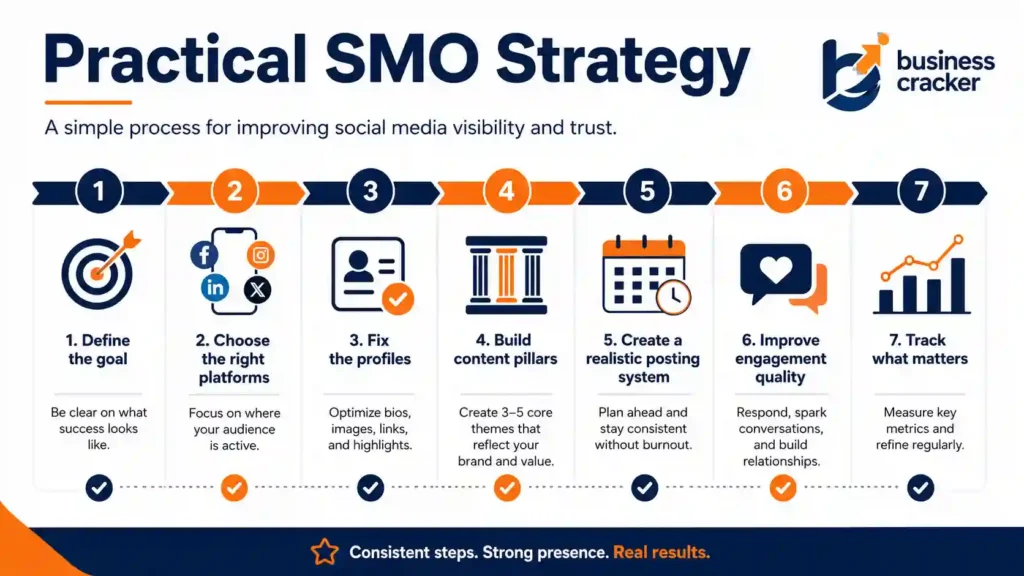
Step 1: Define the Business Goal
Choose the main goal:
- More brand visibility
- More inquiries
- Better profile trust
- More local discovery
- Better engagement
- Stronger recruiting presence
- Product discovery
- Customer education
- Reputation repair
- Community building
Different goals need different content and metrics.
Step 2: Choose the Right Platforms
Do not copy competitors blindly.
Ask:
- Where does the buyer research?
- Where does the buyer ask questions?
- Where does the category get discovered?
- Which platform supports our content format?
- Can the team maintain this platform consistently?
- Does the platform support our sales journey?
A business does not need to be everywhere. It needs to be strong where it matters.
Step 3: Fix the Profiles
Before publishing new content, optimize:
- Name
- Username
- Bio
- Category
- Contact options
- Website link
- Profile image
- Cover image
- Highlights
- Featured posts
- Pinned posts
- Review visibility
Profile optimization is the quickest SMO improvement for many businesses.
Step 4: Build Content Pillars
Create content pillars around buyer problems.
Example for a business services company:
- Problem education
- Service explanation
- Mistakes to avoid
- Case studies
- Customer questions
- Team expertise
- Industry updates
- Proof and results
- Offers and CTAs
Each pillar should support a business reason.
Step 5: Create a Realistic Posting System
Consistency matters, but only if the content is useful.
A realistic system may include:
- 3 posts per week
- 1 short video per week
- 1 carousel per week
- 1 proof-based post per week
- 15 minutes of engagement per working day
- Monthly profile review
- Monthly performance review
The exact volume depends on the team and market.
Step 6: Improve Engagement Quality
Engagement should not be forced.
Improve it by:
- Asking specific questions
- Replying to comments
- Using customer problems as content
- Creating save-worthy posts
- Sharing useful examples
- Showing proof
- Using clear CTAs
- Responding to DMs quickly
- Turning FAQs into posts
Users are more likely to engage when the content gives them something useful.
Step 7: Track What Matters
Track content and business signals together.
Review:
- Which posts drive profile visits?
- Which posts drive website clicks?
- Which posts generate DMs?
- Which topics get saves and shares?
- Which formats perform best?
- Which platform sends quality traffic?
- Which social touchpoints appear before inquiries?
- Which posts support reputation and trust?
Do not judge SMO only by likes.
When Should a Business Invest in SMO Services?
A business should consider social media optimization services when:
- Social profiles look inactive or inconsistent
- The brand posts regularly but gets weak engagement
- The business wants better social media visibility
- Paid social campaigns are running, but profile trust is weak
- Customers search for the brand on social media before contacting
- The company has no content direction
- Messaging differs across websites and social channels
- Reviews, comments, and social proof are not managed
- Competitors look more active and credible
- The internal team lacks time or clarity
SMO is especially useful before scaling paid campaigns, launching a new website, entering a new market, or rebuilding brand trust.
How SMO Supports Long-Term Business Growth
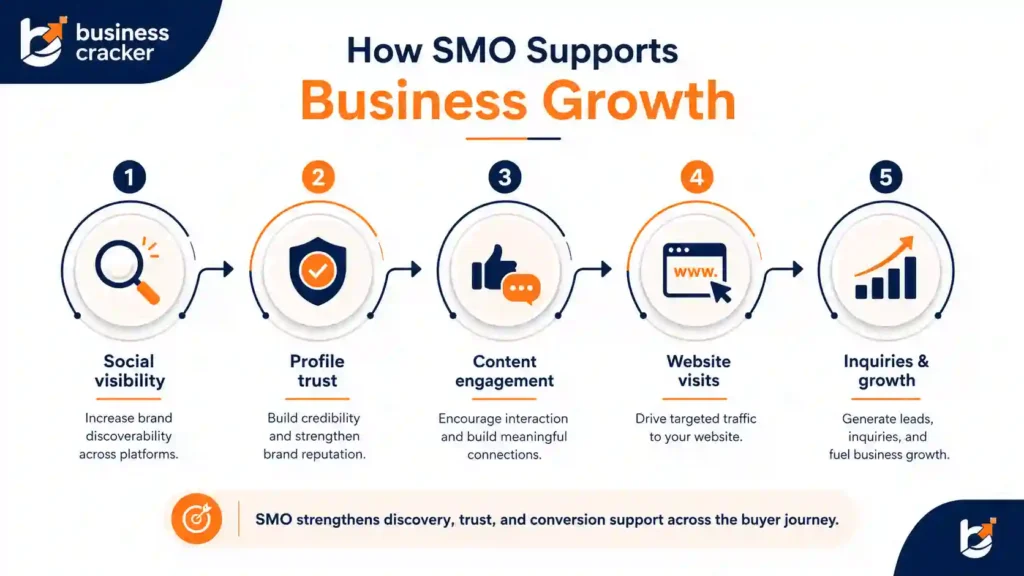
SMO matters because growth is not only about traffic. It is about being visible, credible, and easy to understand across the customer journey.
A buyer may discover the business through a Reel, compare it through Google, check reviews, read a blog, visit a service page, return to LinkedIn, and then submit a form. That journey is not linear.
SMO supports the parts of that journey where social media creates trust or doubt.
It helps businesses:
- Improve brand recognition
- Build stronger social proof
- Support website traffic
- Improve content distribution
- Strengthen customer trust
- Improve local and social discovery
- Support paid campaign credibility
- Create clearer communication
- Maintain consistency across platforms
- Reduce confusion for buyers
This is why SMO should not be treated as a side task. It should connect with SEO, content, website design, paid campaigns, and reputation management.
Final Thoughts
SMO is not about chasing every trend or posting every day without a plan. It is about making your social media presence clearer, more discoverable, more trustworthy, and more useful for the people who may become customers.
For many businesses, the issue is not that social media does not work. The issue is that the profile, content, message, and measurement are weak. When those foundations improve, social media becomes a stronger support channel for visibility, trust, traffic, and inquiries.
If your business needs clearer social media visibility, better profile optimization, stronger content direction, or a more practical social presence, contact Business Cracker for a focused review of your current social media setup and growth priorities.