May 23, 2026
Social Media Optimization Checklist for Business Profiles
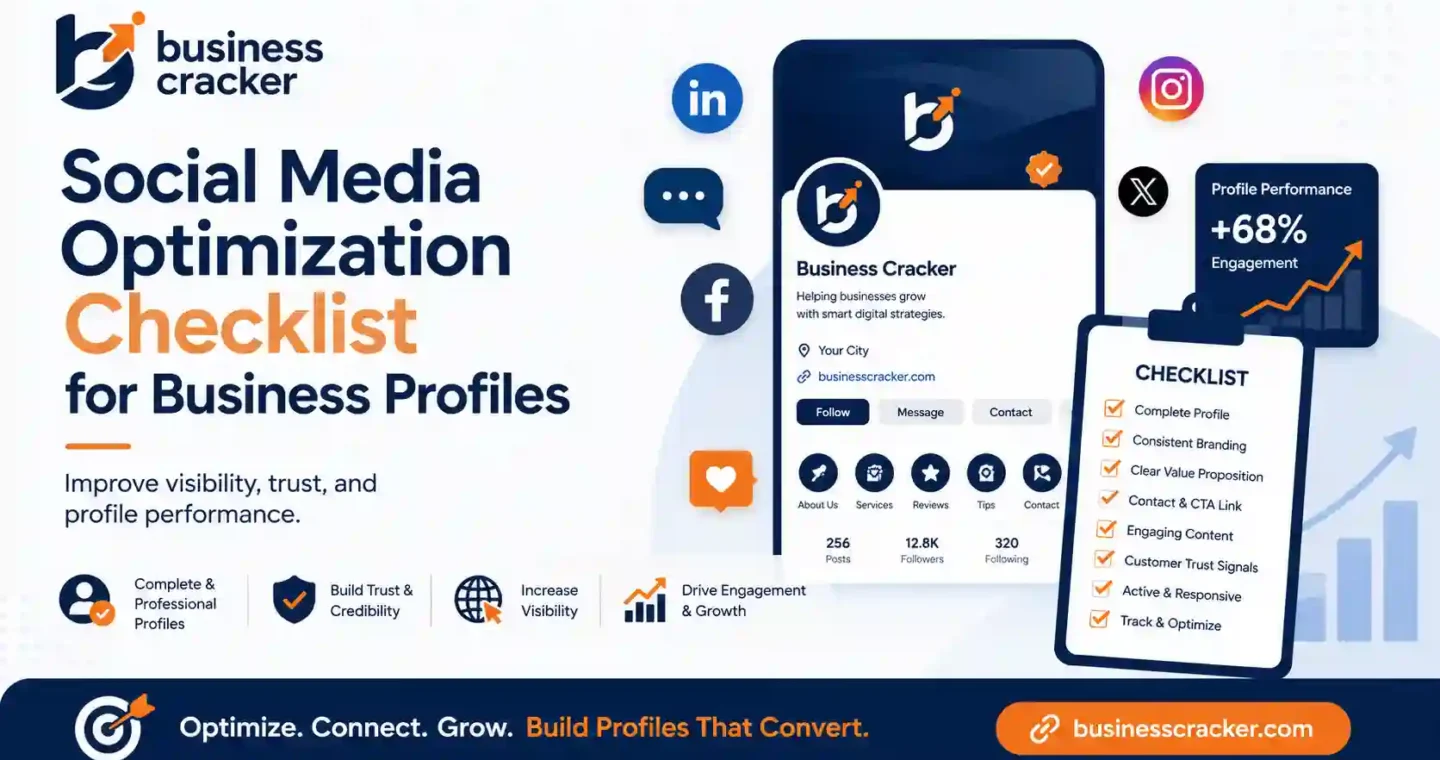
Most businesses do not fail on social media because they post too little. They fail because their profiles are unclear, inconsistent, hard to trust, or disconnected from the rest of their digital presence.
A business may post three times a week and still see weak reach, low engagement, poor profile visits, and almost no inquiries. That is not always a content volume problem. Often, it is a social media profile optimization problem.
This social media optimization checklist is written for marketers, business owners, SEO professionals, software teams, and managers who want to review business profiles properly before spending more time on content or ads.
The Problem This Article Solves
Many businesses have active social profiles but weak social media visibility. Their bios are vague, profile links are outdated, service messaging is inconsistent, pinned posts are missing, branding changes across platforms, and there is no clear path from profile visit to business inquiry.
This creates a simple but costly issue. People discover the business on social media, but they do not understand what the company does, why it is credible, or what action they should take next.
Recent discussions from small business and marketing communities show the same pattern. Business owners are spending hours posting but seeing low engagement and little traffic, while marketers are dealing with poor reach, even after testing different formats and posting frequencies. Some users also question whether social media is worth the time when it does not lead to measurable results.
Desired Reader Outcome
After reading this article, you should be able to:
- Review your business profiles across major social platforms
- Find gaps in bio, branding, links, content, trust signals, and tracking
- Improve social media visibility without posting random content
- Build a cleaner business social media checklist for your team
- Decide when your business needs structured SMO services
Why Social Media Profile Optimization Matters Now
Social media is now part of brand discovery, comparison, customer support, reputation, and purchase behavior. DataReportal’s global social media statistics reported 5.79 billion social media user identities worldwide at the start of April 2026. That scale makes social platforms one of the largest digital discovery environments for businesses.
HubSpot’s 2025 Social Media Trends Report also shows why profile quality matters. It reports that 84 percent of marketers agree consumers will search for brands on social media, 69 percent agree more shopping will happen directly on social platforms than on brand websites or third-party marketplaces, and 25 percent of consumers have bought products directly from social media in the past three months.
The practical point is clear. Your social profile is not only a content feed. It is often a search result, landing page, trust signal, customer touchpoint, and conversion path.
If a user lands on your Instagram, LinkedIn, Facebook, YouTube, TikTok, or X profile and sees unclear messaging, inconsistent branding, weak proof, or a broken link, the business loses trust before the website gets a chance.
What Is Social Media Optimization?
Social media optimization is the process of improving your social media profiles, content structure, brand presentation, engagement practices, and platform signals so your business becomes easier to find, understand, trust, and contact.
A good SMO checklist covers:
- Profile clarity
- Bio and description quality
- Brand consistency
- Service messaging
- Link and CTA setup
- Pinned posts and highlights
- Visual identity
- Social search keywords
- Content pillars
- Review and reputation signals
- Engagement readiness
- Tracking and reporting
- Technical sharing elements
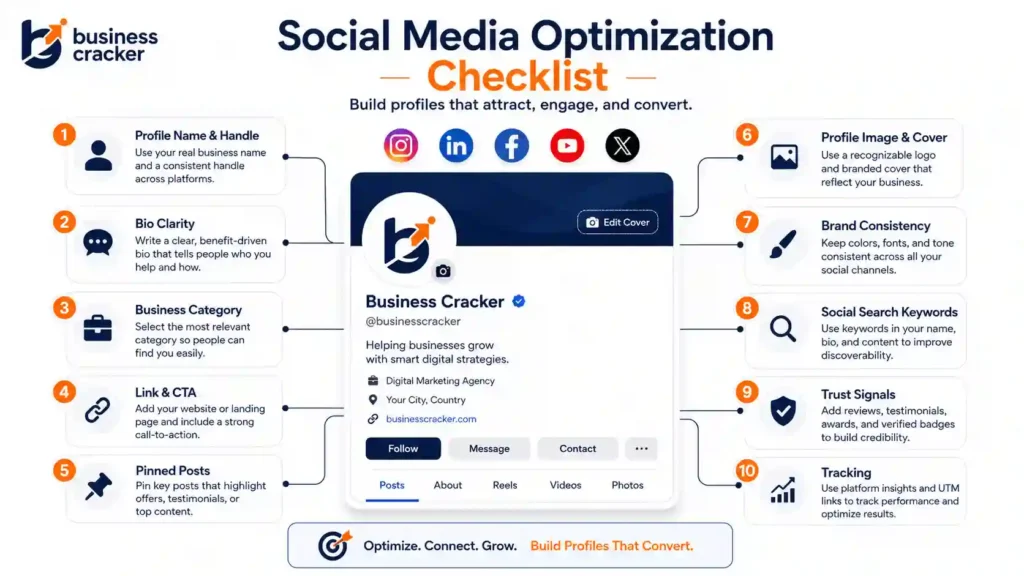
This is why social media optimization services should not only focus on content calendars. A calendar helps only after the profile foundation is correct.
1. Check Profile Name, Handle, and Brand Consistency
Start with the basics. Your social profile name and handle should be clear, consistent, and easy to recognize.
Check:
- Is the brand name spelled the same across platforms?
- Is the username easy to search?
- Are unnecessary numbers, underscores, or location tags avoided unless needed?
- Does the profile name include the business name clearly?
- Is the same brand identity used on LinkedIn, Instagram, Facebook, YouTube, X, and other active channels?
- Are old or duplicate profiles removed, merged, or clearly marked inactive?
For example, if the website says “Business Cracker” but the Instagram handle, Facebook page, and LinkedIn page use different naming patterns, users may hesitate. Consistency supports trust.
For multi-location businesses, include the location only when it helps discovery. A local clinic, restaurant, or real estate office may benefit from city-level naming. A national service company may not.
2. Rewrite the Bio for Clarity, Not Creativity
A weak bio usually tries to sound clever. A strong bio explains what the business does, who it helps, and what action users should take.
Your bio should answer three questions quickly:
- What do you offer?
- Who is it for?
- What should the user do next?
Weak example:
“We help brands grow online.”
Better example:
“SEO, SMO, web design, ORM, and paid marketing support for businesses that need clearer visibility, trust, and leads.”
The second version is more useful because it names the services and business outcome.
For business profile optimization, your bio should include:
- Main service or product category
- Target audience or market
- Location if relevant
- Clear value proposition
- CTA
- Website or contact direction
Avoid stuffing keywords. Use natural terms that users understand.
For this article’s topic, terms like social media profile optimization, social media visibility, profile audit, SMO checklist, and business profile optimization can be used where they fit naturally.
3. Add the Right Business Category
Many businesses ignore category settings. This is a mistake.
Platforms such as Facebook, Instagram, LinkedIn, YouTube, and Pinterest use business categories to understand and display profiles. The right category can also help users quickly understand the business.
Check:
- Is the business category accurate?
- Is it too broad?
- Does it match the website and service page?
- Is it consistent across platforms?
- Does it support local or industry discovery?
A digital marketing company should not use a vague category if a more accurate one is available. A consultant, agency, ecommerce store, healthcare business, education provider, SaaS company, or local service provider should use the closest available category.
4. Use a Professional Profile Image and Cover Image
Your profile image is often the first visual trust signal. For most businesses, the logo should be clear, cropped properly, and readable at a small size.
Check:
- Is the logo visible on mobile?
- Is the image not blurry?
- Is the background clean?
- Is the same logo used across channels?
- Does the cover image explain the business or service?
- Is the cover image updated for the current positioning?
- Does it avoid too much text?
A good cover image can communicate:
- Main services
- Brand promise
- Campaign message
- Contact direction
- Website URL
- Product category
- Industry focus
For example, a business offering digital marketing services can use a cover image that highlights SEO, SMO, paid campaigns, web design, and ORM without making the design crowded.
5. Fix the Profile Link and CTA
A common profile audit issue is a weak or outdated link.
Many businesses still link to a homepage even when a more relevant page would work better. Others use broken links, outdated campaign pages, or link tools with too many choices.
Check:
- Does the profile link work?
- Does it load quickly on mobile?
- Is it relevant to the user’s intent?
- Does the landing page match the social profile message?
- Is the CTA clear?
- Is tracking added where needed?
- Have old campaign links been removed?
The right link depends on the goal.
Use:
- Service page for service inquiries
- Contact page for lead generation
- Booking page for consultations
- Product page for e-commerce
- Landing page for campaigns
- Blog guide for education
- Case study page for proof
- Link hub only when multiple links are genuinely needed
For example, a profile focused on social growth should link to an SMO page or a focused consultation path. A post about reputation risks should connect to ORM services, not a generic page.
6. Pin the Right Posts
Pinned posts are often ignored. They should not be random old announcements.
Pinned posts should help a new profile visitor understand the business faster.
Use pinned posts for:
- What your business does
- Best service explanation
- Customer proof
- Case study
- Founder introduction
- Offer or consultation post
- FAQ style post
- Product demo
- Portfolio post
- Review or testimonial
A good pinned post should reduce confusion. It should not require the user to scroll through months of content to understand the business.
For a service business, pin one post that explains the service, one that shows proof, and one that guides users to the next step.
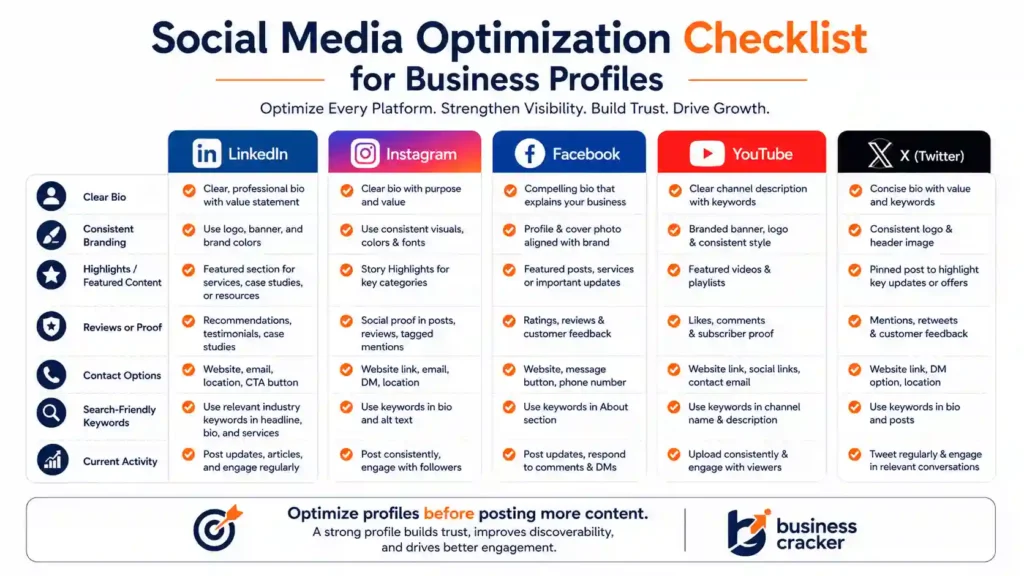
7. Create Platform-Specific Featured Sections
Different platforms have different profile assets.
On LinkedIn, review:
- Banner
- Tagline
- About section
- Featured section
- Services
- Employee links
- Recent posts
- Company specialties
- Website link
On Instagram, review:
- Bio
- Highlights
- Pinned posts
- Story covers
- Link setup
- Contact buttons
- Category
- Reels tab
- Grid quality
On Facebook, review:
- About section
- Services
- Reviews
- Location
- Hours
- Messenger setup
- CTA button
- Page transparency
- Pinned post
On YouTube, review:
- Channel description
- Banner
- Links
- Playlists
- Featured video
- Channel keywords where available
- Thumbnail consistency
A proper social media profile audit should check each platform based on its own behavior, not use one generic checklist for everything.
8. Align Social Branding With the Website
Social branding should match the website.
Check:
- Logo
- Colors
- Typography style
- Image treatment
- Tone of voice
- Service wording
- CTA language
- Offer positioning
- Proof points
- Brand promise
If the website looks professional but social profiles look informal or inconsistent, users may lose confidence. If social posts promise something the website does not support, users may feel misled.
This is especially important for companies using paid ads, SEO, email campaigns, and social media together. The user journey should feel connected.
Business Cracker’s digital marketing services are structured across SEO, link building, SMO, performance marketing, web design, and ORM, which makes cross-channel consistency important for any growth plan.
9. Use Social Search Keywords Carefully
Social platforms are increasingly used for search. Users search for services, product categories, reviews, tutorials, local businesses, and comparisons directly inside social apps.
This is why social media profile optimization should include search-relevant language.
Add keywords naturally in:
- Profile name where appropriate
- Bio
- About section
- Captions
- Video titles
- Playlists
- Highlights
- Alt text where available
- Hashtags
- Pinned posts
- Service descriptions
Do not force keywords into every line. The goal is clarity and discoverability.
Example:
Weak bio:
“Helping brands win online.”
Better bio:
“Social media optimization, SEO, web design, and ORM support for businesses that need stronger online visibility.”
The second version improves clarity and uses searchable language naturally.
10. Review Content Pillars Before Posting More
A business social media checklist should include content direction. Without content pillars, posting becomes random.
Common weak content patterns include:
- Only festival posts
- Only offers
- Only company updates
- Only product photos
- Only generic quotes
- Only trend copying
- Only reshared blog links
- No proof
- No customer education
- No service explanation
A practical content pillar system may include:
- Problem education
- Service explanation
- Mistakes to avoid
- Case studies
- Customer questions
- Before and after examples
- Team expertise
- Testimonials
- Industry updates
- Offer or CTA posts
This gives the audience a reason to follow, save, share, or contact the business.
Sprout Social’s 2025 Index is based on surveys of more than 4,000 consumers and more than 1,200 marketers, and it focuses on how brands can create more memorable social media experiences instead of adding more noise.
The takeaway for businesses is simple. More content is not always better. More relevant content is better.
11. Make the First Nine Posts or Recent Feed Clear
When someone visits a profile, they often scan the most recent posts before deciding whether the business looks credible.
Review your recent feed and ask:
- Can a new user understand what we do?
- Do recent posts match the services we offer?
- Is there proof of real work?
- Are visuals consistent?
- Is the content useful?
- Are CTAs clear?
- Is the feed too promotional?
- Is the feed too generic?
- Does the feed show current activity?
For Instagram, the first nine posts create a strong impression. For LinkedIn, the recent post stream matters. For YouTube, recent videos, thumbnails, and playlists matter. For Facebook, reviews, updates, and service details matter.
Your profile should not look active but unclear.
12. Build Trust Signals Into the Profile
Social media trust signals can influence whether users contact the business.
Add or improve:
- Reviews
- Testimonials
- Case studies
- Client logos were permitted
- Founder or team visibility
- Certifications
- Portfolio posts
- Before and after examples
- Media mentions
- Awards if real and relevant
- Clear contact details
- Response activity
Trust is also linked to reputation. If the business has negative reviews, unanswered comments, poor ratings, or inconsistent brand mentions, profile optimization alone may not be enough. In that case, ORM services can support review management, brand monitoring, and digital credibility.
13. Review Comments, Messages, and Response Behavior
Engagement is not only about getting likes. It is also about how the business responds.
Check:
- Are comments being answered?
- Are DMs monitored?
- Are negative comments handled professionally?
- Are spam comments removed?
- Are questions turned into content ideas?
- Is the response time acceptable?
- Are saved replies too robotic?
- Is the tone consistent with the brand?
A business that posts regularly but does not reply to comments looks inattentive. For service brands, a slow or careless response can cost inquiries.
Good SMO includes engagement readiness, not just publishing.
14. Check Local Business Information
For local businesses, social profiles should support local discovery and trust.
Check:
- Address
- Service area
- Phone number
- Opening hours
- Map links
- Local keywords
- Location tags
- Local proof
- City or area references
- Photos from the real location if relevant
- Review links
- Google Business Profile consistency
A local business should not make users search separately for basic contact information.
If the business serves multiple areas, create content and profile details that make location coverage clear without making the bio unreadable.
15. Review Hashtags and Topic Tags
Hashtags are not a strategy by themselves. They are supporting signals.
Check:
- Are hashtags relevant?
- Are they too broad?
- Are they copied across every post?
- Are branded hashtags used where useful?
- Are local hashtags used for local businesses?
- Are industry tags used naturally?
- Are banned or spammy tags avoided?
- Are hashtags reviewed by the platform?
For many businesses, a small set of relevant hashtags is better than using 25 generic tags.
A cleaner structure may include:
- 2 to 3 industry tags
- 1 to 2 service tags
- 1 local tag if relevant
- 1 branded tag if useful
- 1 topic tag linked to the post
The main content still matters more than the hashtag list.
16. Check Accessibility and Readability
Social media optimization should also include readability and accessibility.
Check:
- Are captions easy to read?
- Are long captions broken into short paragraphs?
- Are images not overloaded with text?
- Is the contrast strong enough?
- Are subtitles added to videos?
- Is alt text used where available?
- Are acronyms explained?
- Are carousel slides readable on mobile?
- Are CTAs visible?
- Are emojis used carefully?
This matters because most users view content on mobile. If a carousel looks good on desktop but is unreadable on a phone, it will underperform.
17. Fix Technical Sharing Elements
Software engineers and website teams should also be part of the SMO checklist when social sharing depends on the website.
Review:
- Open Graph title
- Open Graph description
- Open Graph image
- Twitter or X card tags
- Canonical URL
- Social preview image size
- Favicon
- Page speed
- Mobile layout
- UTM tracking
- Conversion events
- Form tracking
- Broken redirects
- 404s from social links
If a website page is shared on LinkedIn, WhatsApp, Facebook, or X and the preview looks broken, users may not click. This is not only a social media problem. It is also a website implementation issue.
A good social media optimization checklist should include both profile-level and website-level checks.
18. Audit Competitor Profiles Without Copying Them
Competitor analysis helps when it is used correctly.
Review competitors for:
- Profile positioning
- Bio clarity
- Content pillars
- Posting formats
- Engagement quality
- Pinned posts
- Offers
- Review signals
- Visual consistency
- Customer questions
- CTA strategy
Do not copy post ideas blindly. Competitors may have different budgets, audiences, brand awareness, or paid distribution.
Use competitor research to identify gaps. For example:
- Are they explaining services better?
- Are they using stronger proof?
- Are they more consistent visually?
- Are they answering customer questions?
- Are they using video more effectively?
- Are their CTAs clearer?
Then build a profile that fits your own business goals.
19. Connect Social Profiles to Business Goals
A business profile should not exist only to look active.
Define the main goal for each platform:
- Brand awareness
- Lead generation
- Product discovery
- Community building
- Customer support
- Recruitment
- Reputation management
- Event promotion
- Thought leadership
- Local visibility
Then match the profile setup and content to that goal.
Example:
If LinkedIn is used for B2B lead generation, the profile should clearly show services, proof, founder or team expertise, case studies, and a path to contact.
If Instagram is used for local brand visibility, the profile should show location, service area, visual proof, highlights, reviews, and contact buttons.
If YouTube is used for education, playlists, thumbnails, video titles, and descriptions should be optimized around user questions.
20. Track the Metrics That Actually Matter
Do not judge SMO only by followers.
Review:
- Profile visits
- Website clicks
- Link clicks
- Contact button clicks
- DMs
- Comments
- Saves
- Shares
- Reach by content type
- Engagement rate
- Watch time
- Branded searches
- Referral traffic
- Lead source quality
- Assisted conversions
- Review growth
- Response time
Follower growth is useful only if the audience is relevant.
HubSpot’s 2026 marketing statistics also show that marketers continue to prioritize social platforms for ROI and social commerce, with Instagram reported as the most used platform among marketers and the most cited platform for ROI.
For business managers, the better question is not “Did we gain followers?” The better question is “Did this profile help the right people understand and trust the business?”
21. Create a Monthly Social Media Profile Audit Routine
Social profiles should not be optimized once and ignored.
Review monthly:
- Bio
- Link
- CTA
- Pinned posts
- Highlights
- Recent content
- Review status
- Comment quality
- DM response
- Brand consistency
- Platform changes
- Performance metrics
- Competitor movement
Review quarterly:
- Content pillars
- Audience fit
- Platform priority
- Paid and organic connection
- Website tracking
- Reputation risks
- Service messaging
- Creative direction
- Business goals
A recurring social media profile audit helps the business stay current without making rushed changes every week.
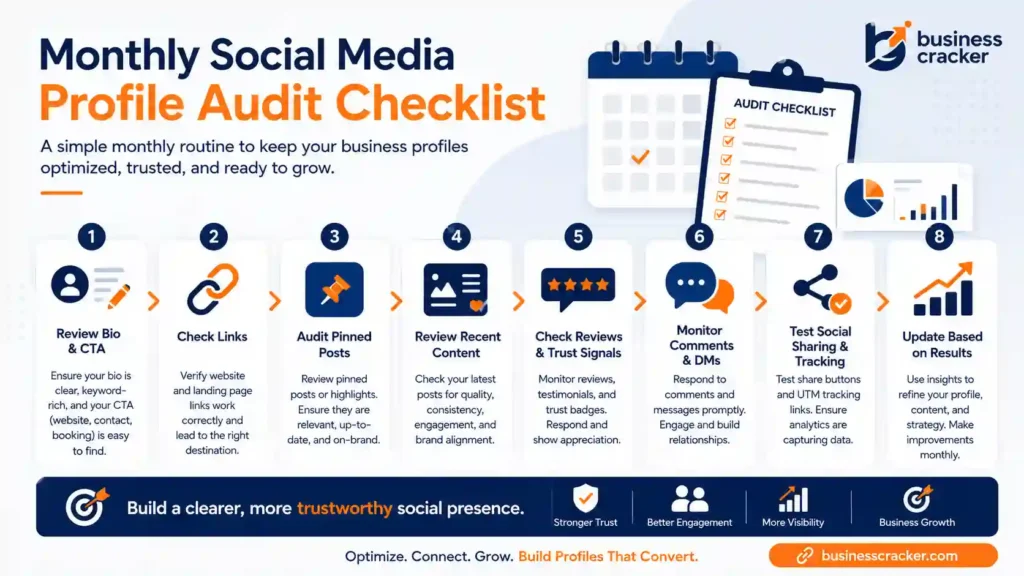
Complete SMO Checklist for Business Profiles
Use this checklist before publishing more content or increasing paid social spend.
Profile Basics
- Business name is consistent across platforms
- Username or handle is easy to search
- Profile image is clear and professional
- Cover image is updated
- Business category is accurate
- Contact details are correct
- Location or service area is clear where relevant
Bio and Messaging
- Bio explains what the business does
- The target audience is clear
- Main services or products are mentioned naturally
- CTA is specific
- Keywords are used without stuffing
- Messaging matches the website
- No vague phrases dominate the profile
Link and CTA
- Profile link works
- Landing page is relevant
- CTA matches the business goal
- UTM tracking is used where needed
- Old campaign links are removed
- Contact path is simple
- Link hub is not overloaded
Branding
- Logo is consistent
- Brand colors are consistent
- Visual style matches the website
- Post templates are readable
- Tone of voice is consistent
- Cover images and highlights look professional
- Brand promise is clear
Content Structure
- Content pillars are defined
- Recent posts explain the business clearly
- Pinned posts are useful
- Educational content is included
- Proof-based content is included
- Service explanation content is included
- CTAs are used naturally
- Content is not only promotional
Social Search
- Relevant keywords appear in the bio and descriptions
- Captions use search-friendly language
- Hashtags are relevant
- Location tags are used where useful
- Video titles are descriptive
- Playlists or highlights are organized
- Alt text is used where available
Engagement and Reputation
- Comments are answered
- DMs are monitored
- Reviews are visible where relevant
- Negative comments are handled professionally
- Spam is cleaned
- Customer questions are tracked
- Reputation risks are reviewed
- ORM support is considered where trust issues exist
Technical Checks
- Social previews display correctly
- Open Graph title and image are set
- Shared links are not broken
- Website pages load properly on mobile
- Tracking works
- Forms work
- Contact buttons work
- Campaign pages match social messaging
Measurement
- Profile visits are reviewed
- Website clicks are tracked
- DMs and inquiries are monitored
- Engagement quality is reviewed
- Top content formats are identified
- Lead quality is checked
- Monthly profile audits are scheduled
- Social performance is connected to business goals
When Should You Use Social Media Optimization Services?
You may need social media optimization services if:
- Your business profiles look inconsistent
- Your posts get low reach and weak engagement
- Your bio does not explain the business clearly
- Your social media does not support website traffic
- Your team posts regularly, but cannot show impact
- Your profiles do not create trust
- Your brand has reputation issues across social platforms
- Your competitors look more credible
- Your paid social traffic does not convert well
- Your team does not have time for regular profile audits
Professional SMO services can help clean up profile foundations, improve content direction, strengthen social media visibility, and connect your profiles with wider digital marketing goals.
How Business Cracker Looks at SMO
Business Cracker treats SMO as part of the wider digital growth system, not as isolated posting work.
A business profile should support:
- Visibility
- Trust
- Search behavior
- Content clarity
- Reputation
- Website traffic
- Paid campaign support
- Lead generation
- Brand consistency
That is why SMO often connects with digital marketing services, website improvements, SEO, paid campaigns, and ORM services. A social profile can create attention, but the full digital presence must support trust and action.
Final Thoughts
A social media optimization checklist is not only for agencies or large brands. It is useful for any business that wants its social profiles to work harder before investing more time in content or ads.
Start with the profile foundation. Fix the bio, branding, link, CTA, pinned posts, highlights, trust signals, social search language, and tracking. Then build content around real audience problems instead of posting only to stay active.
If your business needs a cleaner social media presence, stronger profile optimization, or a practical SMO checklist tailored to your platforms, contact Business Cracker for a focused review of your current setup.