July 13, 2026
Digital PR Link Building: How to Earn Authority Links and Turn Media Coverage Into Business Growth
Most businesses do not struggle because they have no backlinks. They struggle because the links they have are weak, irrelevant, difficult to measure, or disconnected from the pages that generate revenue.
A company may publish guest posts every month and still fail to close the authority gap with competitors. Another company may secure coverage in a respected publication but see no improvement in rankings, traffic, or leads because the campaign was not integrated with its SEO strategy.
Digital PR link building is designed to solve both problems.
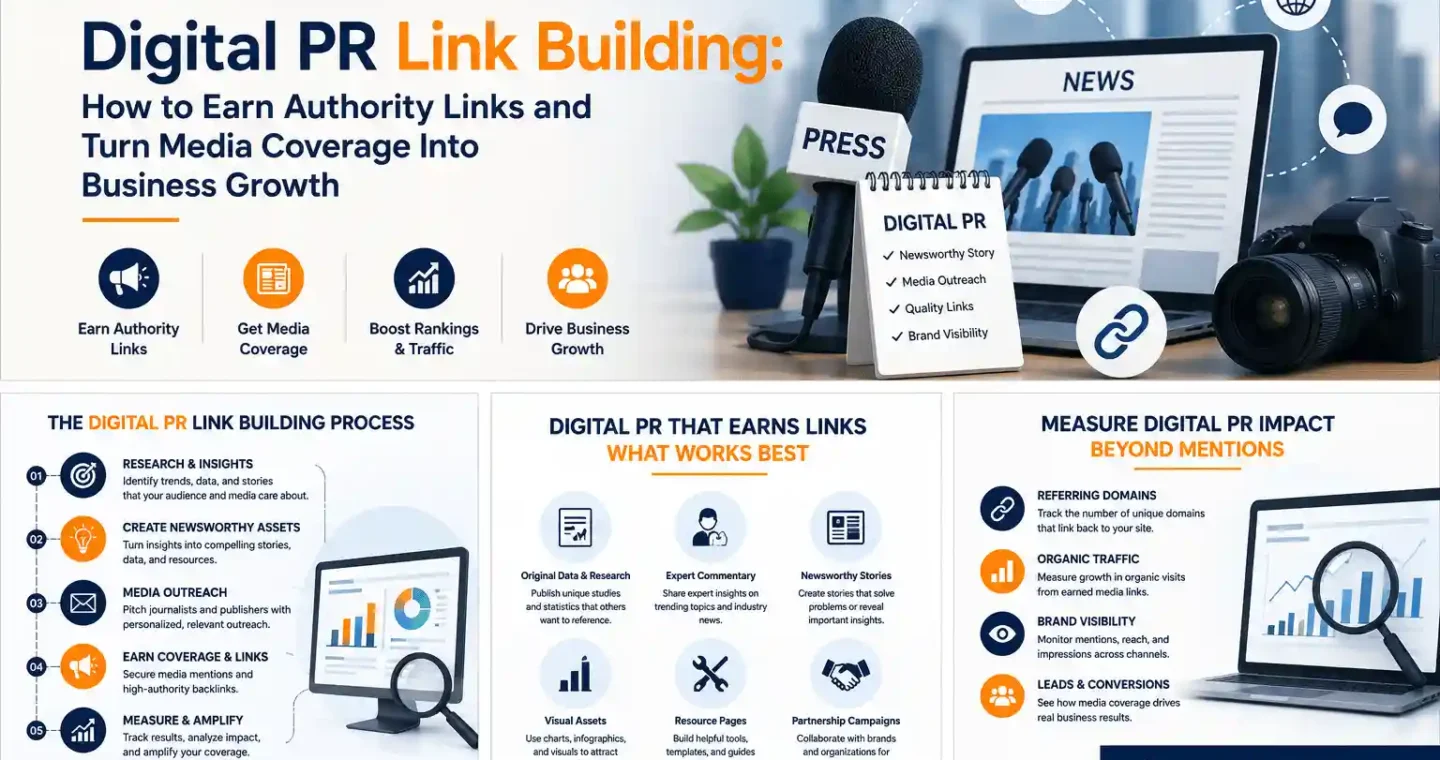
It combines newsworthy content, original research, media outreach, expert positioning, and SEO planning to earn editorial backlinks from publications that businesses often cannot reach through conventional link outreach.
The link is important, but it is not the entire outcome. A well-planned campaign can also increase brand visibility, referral traffic, branded searches, third-party validation, and trust during the buying process.
At Business Cracker, we provide link building services and SEO services that connect backlinks with search visibility and business goals. Our approach is based on a practical principle: a campaign should not be judged only by how many links it earns. It should be judged by whether those links help the right pages attract the right audience and produce measurable growth.
Key Takeaways
- Digital PR link building earns editorial backlinks by giving journalists useful stories, data, expert commentary, or resources.
- It differs from paid placements, guest posts, and link insertions because the publisher retains editorial control.
- Original research works well, but it is not the only option. Public-data studies, reactive commentary, local reports, tools, and expert-led campaigns can also earn coverage.
- High Domain Rating does not automatically mean a backlink is valuable. Relevance, editorial context, audience quality, and business alignment matter.
- Digital PR works best when the campaign asset, target pages, internal links, media outreach, and conversion path are planned together.
- Brand mentions may support visibility across search engines and AI platforms, but backlinks or mentions do not guarantee an AI citation.
- Campaign success should be measured through coverage quality, referring domains, rankings, qualified traffic, leads, and influenced revenue.
What Is Digital PR Link Building?
Digital PR link building is the process of earning backlinks and brand mentions through online media coverage.
A business creates something that is useful to a journalist or publisher, such as:
- Original research
- Proprietary company data
- Survey findings
- Expert commentary
- Industry predictions
- A public-data analysis
- A newsworthy product announcement
- An interactive tool
- A regional report
- A creative campaign
The business then presents the story to relevant journalists, editors, bloggers, industry publications, podcast hosts, or newsletter creators. When a publisher uses the information, it may mention the company and link to the original source.
Google states that links can help it discover pages and understand relevance. It also recommends creating useful resources, tools, tutorials, surveys, and original research that people may naturally reference.
A Simple Example
Imagine a cybersecurity software company that analyzes anonymized data from 20,000 security alerts and discovers that small healthcare organizations experience a sharp increase in phishing attempts during tax season.
The company could:
- Publish the findings on a permanent research page.
- Explain its methodology.
- Create charts that journalists can use.
- Add commentary from a cybersecurity expert.
- Pitch healthcare, technology, small-business, and regional reporters.
- Earn links when those publications cite the research.
- Internally link the report to relevant cybersecurity service or product pages.
The report provides the news. The media coverage builds authority. The internal SEO structure helps that authority support commercial pages.
Why Digital PR Matters for Modern Link Building
Traditional outreach can still produce useful links, but the commercial link market contains a large amount of poor-quality inventory.
A 2026 BuzzStream analysis of nearly 500,000 guest-post sites classified 96.2% as low quality. It also found that 39.6% had no estimated organic traffic, while only 1.37% qualified as high quality or top tier. These classifications are based on third-party SEO metrics, so they do not prove whether every site is useful or harmful. However, the findings show why buying placements based only on DR, DA, or price can waste a significant portion of a marketing budget.
Digital PR creates a different path to links. Instead of starting with a website willing to place a link, it starts with a story worth covering.
That distinction can lead to stronger editorial validation because:
- A journalist chooses whether to use the information.
- The mention appears within a genuine story.
- The link usually points to a source, report, quote, or useful resource.
- The publication has a reason to reference the company beyond SEO.
- The coverage can reach potential customers, partners, employees, and investors.
What Business Problems Can Digital PR Solve?
Digital PR is not only a backlink acquisition tactic. It can address several related growth problems.
Your Competitors Have Stronger Authority
A website may have good content and sound technical SEO but remain below established competitors because those competitors have been cited by news outlets, trade publications, universities, associations, and influential industry websites.
Digital PR can help close that authority gap by pursuing sources that conventional outreach cannot easily access.
Your Existing Links Are Not Moving Rankings
More links do not always create proportionally better results. A campaign may be earning backlinks from websites with little traffic, weak editorial standards, or no topical relationship with the target business.
In that situation, the solution is not necessarily to increase volume. It may be to improve link quality, relevance, target-page strength, and authority distribution.
Our guide to getting high-quality backlinks explains why businesses should evaluate the purpose and context of a backlink rather than count links in isolation.
Your Brand Is Missing From Industry Conversations
A company can rank for several keywords without being recognized as an authority in its market.
Digital PR helps place the brand inside relevant third-party conversations. This can matter when buyers compare vendors, verify expertise, research leadership teams, or look for independent evidence before making a decision.
Your Commercial Pages Cannot Attract Links Naturally
Journalists rarely link directly to a sales page simply because a company wants that page to rank.
A research report, calculator, benchmark, data study, or expert resource provides a more natural citation target. Strategic internal links can then connect the cited asset with relevant service, category, or product pages.
Your Marketing Channels Are Working Separately
Many businesses treat PR, SEO, content, social media, and conversion optimization as unrelated activities.
A digital PR campaign can provide material for all of them:
- SEO gains an authoritative linkable asset.
- PR gains a newsworthy story.
- Social media gains data points, graphics, and commentary.
- Email marketing gains useful research.
- Sales gains third-party proof.
- Paid campaigns gain a stronger landing page or trust asset.
- Leadership gains thought-leadership material.
Digital PR vs. Traditional Link Building
Digital PR and traditional link building both seek to strengthen a website’s authority, but the acquisition process is different.
| Factor | Digital PR | Guest Posting | Link Insertions | Press Release Distribution |
| Primary method | Earned media coverage | Contributed article | Link added to existing content | Distributed announcement |
| Editorial control | Low | Moderate to high | High | High over original release |
| Anchor-text control | Low | Moderate | Moderate to high | High in original copy |
| Typical link target | Research, data, resource or homepage | Blog, service or product page | Existing commercial or informational page | Announcement or homepage |
| Main value | Authority, publicity and trust | Relevance and consistency | Speed and page-level targeting | Announcement distribution |
| Main risk | Unpredictable results | Low-quality publishing sites | Transactional or irrelevant placements | Treating syndicated links as an SEO shortcut |
| Best use | High-authority coverage and brand building | Consistent niche outreach | Filling carefully selected gaps | Communicating genuine company news |
Guest posting and link insertions are not automatically bad. They simply solve different problems.
A balanced strategy may use:
- Digital PR for authority and brand recognition
- Guest posts for consistent, niche-relevant coverage
- Carefully evaluated link insertions for specific page gaps
- Partnerships and resource outreach for industry relevance
- Link reclamation to recover lost or unlinked citations
Our comparison of guest posting vs. niche edits explains where each tactic may fit and what quality risks to check.
What Digital PR Is Not
Digital PR should not be used as a more attractive label for buying backlinks.
It is not:
- Paying a site to insert an exact-match anchor
- Purchasing a guaranteed news link
- Publishing thin press releases only to distribute keyword-rich links
- Sending the same generic email to thousands of journalists
- Creating unsupported statistics for publicity
- Presenting sponsored content as independent editorial coverage
Google’s spam policies identify paid links that pass ranking credit, optimized links in advertorials, and keyword-rich links in distributed press releases as examples of link spam. Paid advertising and sponsorship links are allowed, but Google says they should be qualified with rel=”nofollow” or rel=”sponsored”.
A sustainable campaign earns coverage because the information is useful, accurate, relevant, or timely.
Digital PR vs. Traditional PR
Traditional PR often focuses on print publications, television, radio, events, reputation, and public messaging.
Digital PR expands those activities across:
- Online news publications
- Trade websites
- Digital magazines
- Podcasts
- Newsletters
- Social platforms
- Creator-led media
- Online communities
- Search results
- AI-generated answers
Traditional PR may prioritize reach and reputation. Digital PR also tracks backlinks, referral traffic, search visibility, online mentions, and conversion behavior.
The strongest strategy does not force a choice between the two. A national newspaper interview, an online research hub, a podcast appearance, and a targeted media campaign can support one another.
Do Journalists Still Use PR Pitches?
Yes, but relevance determines whether a pitch has a realistic chance.
Muck Rack’s 2025 State of Journalism report found that 84% of journalists said PR professionals inspire at least some of their stories. However, 47% said they seldom or never receive pitches relevant to their coverage area. The same report found that 66% wanted pitches to show clear relevance to their beat, 62% wanted access to relevant interview sources, and 42% valued original data or research.
This creates both a problem and an opportunity.
Journalists receive too many poor pitches, but they still use relevant, credible pitches to find stories and sources.
Cision’s 2025 State of the Media findings reported that 86% of journalists would immediately reject a pitch that did not align with their beat or audience. It also found that 72% were concerned about factual errors in AI-generated PR content. The business lesson is clear: using AI to produce more outreach is not an advantage when the output is generic, inaccurate, or poorly targeted.
When Should a Business Invest in Digital PR?
Digital PR is a strong option when one or more of these conditions apply:
- Competitors have media links that your website lacks.
- Your industry depends heavily on expertise and trust.
- Your company has proprietary data or experienced specialists.
- Your team can produce useful research or commentary.
- You are competing for high-value commercial keywords.
- Your product or service has a meaningful differentiator.
- You want both search authority and brand visibility.
- Your existing link strategy has reached a quality ceiling.
- Your business can respond quickly to journalist questions.
- You can measure results over several months rather than several days.
When Digital PR May Not Be the First Priority
A business should usually address foundational problems first when:
- Important pages are not indexed.
- The website has serious technical SEO issues.
- The content does not satisfy search intent.
- The offer is unclear or uncompetitive.
- The website has no useful destination for earned traffic.
- The company cannot substantiate its marketing claims.
- Leadership approvals take too long for media deadlines.
- The business expects a guaranteed number of links.
- There is no process for tracking rankings, leads, or referral traffic.
Digital PR can amplify a strong foundation. It cannot permanently compensate for a weak website, unclear positioning, or poor customer experience.
Before investing in media outreach, review your technical foundation with our guide to technical SEO.
The Best Types of Digital PR Campaigns
The right campaign depends on the company’s data, expertise, budget, market, and media opportunity.
Reboot Online’s analysis of digital PR campaigns found that 42.3% of the campaigns it reviewed from 2023 to 2024 were data driven. Surveys represented 19.3%, and mapping campaigns represented 18.2%. This does not mean every company needs an expensive research project, but it shows how frequently data is used to create a defensible news angle.
1. Proprietary Data Campaigns
Proprietary data comes from information the business collects through its product, platform, operations, customers, or internal processes.
Examples include:
- Average project costs by company size
- Software usage patterns by industry
- Cybersecurity threats by region
- Customer support response times
- Ecommerce returns by product category
- Hiring demand by job function
- Marketing conversion rates by channel
Best For
SaaS companies, marketplaces, ecommerce platforms, financial technology companies, agencies, healthcare platforms, logistics businesses, and other organizations with substantial first-party data.
Main Advantage
Competitors cannot easily reproduce the findings.
Main Risk
The data may contain privacy, sampling, bias, or interpretation issues. All information should be anonymized, reviewed, and explained through a clear methodology.
2. Public-Data Studies
A company does not need proprietary data to produce original analysis.
Government databases, regulatory records, public APIs, financial filings, search trends, job listings, property data, and open research can be analyzed to identify a new pattern.
Examples include:
- Best cities for starting a software company
- States with the fastest growth in solar installations
- Industries with the greatest increase in cybersecurity hiring
- Areas where small-business closures are rising
- Regional differences in construction costs
Best For
Small businesses, agencies, local service providers, startups, and companies without a large customer dataset.
Main Advantage
Lower data-collection costs.
Main Risk
The raw data is available to everyone, so the methodology, interpretation, timing, and story angle must add original value.
3. Survey Campaigns
Surveys create new statistics by asking a carefully selected group about behaviors, opinions, challenges, or plans.
Possible audiences include:
- Consumers
- Small-business owners
- IT leaders
- Marketing executives
- Developers
- Human resources professionals
- Homeowners
- Healthcare professionals
Best For
Companies with access to a relevant customer base, professional network, research panel, or qualified survey provider.
Main Advantage
A survey can generate several media angles from one dataset.
Main Risk
Poor sample quality can undermine the entire campaign. Report the sample size, audience definition, collection date, question wording, weighting, and limitations.
4. Reactive PR and Newsjacking
Reactive PR provides expert commentary or relevant data when a news story breaks.
Examples include:
- A major search algorithm update
- A software security vulnerability
- New industry regulation
- A large acquisition
- An economic announcement
- A platform outage
- A major product release
- A sudden change in consumer behavior
Best For
Businesses with credible experts who can provide useful comments quickly.
Main Advantage
Lower asset-development costs and faster opportunities.
Main Risk
The news cycle can close within hours. Slow approvals or generic quotes reduce the chance of coverage.
5. Expert Commentary Campaigns
A business can position its leadership or specialists as reliable media sources without waiting for a major campaign.
Useful expert formats include:
- Predictions
- Technical explanations
- Contrarian opinions supported by evidence
- Industry trend commentary
- Regulatory interpretation
- Buyer guidance
- Risk assessments
- Practical responses to breaking news
Best For
Professional services, software companies, legal services, finance, healthcare, cybersecurity, marketing, real estate, and other expertise-led sectors.
Main Advantage
It builds the reputation of both the individual expert and the company.
Main Risk
Generic thought leadership rarely earns attention. The commentary must be specific, useful, defensible, and quotable.
6. Product-Led PR
Product PR focuses on a genuine company development, such as:
- A new product
- A significant feature
- Expansion into a new market
- An acquisition
- Funding
- A partnership
- A major customer milestone
- A technical breakthrough
- A new accessibility or sustainability initiative
Best For
Companies with real news that affects customers or the wider industry.
Main Advantage
It supports publicity, product discovery, sales enablement, and links at the same time.
Main Risk
A routine feature update may matter to customers but not to journalists. The story needs broader significance.
7. Interactive Tools and Calculators
Useful tools often earn links because they solve a recurring problem.
Examples include:
- ROI calculators
- Pricing estimators
- Security risk assessments
- Salary benchmarks
- Website performance graders
- Marketing budget planners
- Industry comparison tools
- Interactive maps
Best For
Software companies, service businesses, financial firms, agencies, real estate businesses, and data-rich organizations.
Main Advantage
A useful tool can continue earning citations after the launch campaign ends.
Main Risk
Development costs may be significant, and the tool must remain accurate and functional.
8. Local and Regional Digital PR
National coverage is not the only valuable outcome.
A local business can create:
- City-level price studies
- Regional consumer surveys
- Neighborhood trend reports
- Local hiring data
- Local environmental analysis
- State-by-state rankings
- Community impact reports
Best For
Law firms, healthcare providers, real estate companies, home-service businesses, educational institutions, local software providers, and regional professional services.
Main Advantage
Local relevance can create qualified traffic and stronger market recognition.
Main Risk
The story must provide genuine community value rather than act as disguised local advertising.
How to Choose the Right Campaign
Use the following campaign selection matrix.
| Business Situation | Recommended Campaign |
| SaaS company with large usage dataset | Proprietary data report |
| Startup with experienced founders but little data | Expert commentary and reactive PR |
| Local service business | Regional data or consumer survey |
| Ecommerce brand | Consumer behavior survey or product-led PR |
| B2B service company | Industry benchmark or expert report |
| Company with a limited budget | Public-data analysis and reactive PR |
| Business launching a major feature | Product-led PR supported by original data |
| Brand seeking recurring coverage | Quarterly index or annual benchmark |
| Business with development resources | Interactive calculator or tool |
| Regulated or technical organization | Expert-led report with transparent methodology |
The Business Cracker News-to-Revenue Framework
A digital PR campaign should not end when a publication links to the website.
We use a seven-stage framework to connect media activity with SEO and commercial value.
Stage 1: Define the Business Outcome
Choose the primary outcome before choosing the campaign idea.
Possible objectives include:
- Increase authority for a competitive topic
- Improve rankings for a commercial keyword cluster
- Build awareness in a new market
- Generate qualified referral traffic
- Support a product launch
- Establish an expert as an industry source
- Increase branded search demand
- Earn third-party proof for sales conversations
A campaign can support several outcomes, but one should determine the strategy.
Stage 2: Audit the SEO Foundation
Review:
- Target-page quality
- Search intent
- Technical health
- existing backlinks
- internal links
- competitor coverage
- keyword positions
- conversion tracking
- brand positioning
A media campaign should not send authority and visitors to a weak, slow, outdated, or confusing website.
Stage 3: Develop and Validate the Story
Before investing in research or design, test whether the idea can produce a credible headline.
A useful story should answer:
- What is new?
- Why does it matter now?
- Who is affected?
- What evidence supports it?
- Which journalists already cover the subject?
- How does the business have a legitimate connection to it?
- Can the finding be explained in one sentence?
- Can the story produce several angles?
Stage 4: Build the Linkable Asset
The asset should act as the primary source.
It may include:
- A clear headline
- Executive summary
- Key findings
- Charts
- Methodology
- Data limitations
- Expert interpretation
- Downloadable images
- Contact information
- Related internal resources
- Date published and updated
- Author and reviewer information
Stage 5: Build a Qualified Media List
Do not start with the largest possible list.
Start with journalists who:
- Cover the exact topic
- Have published related stories recently
- Use data or experts in their work
- Write for an audience relevant to the campaign
- Have a realistic reason to care about the findings
Stage 6: Pitch and Support the Story
The pitch should make the journalist’s job easier.
Offer:
- The strongest finding
- Why it matters now
- A direct link to the source
- Interview access
- Additional data cuts
- Regional breakdowns
- High-resolution visuals
- Methodology details
- Quick responses to questions
Stage 7: Convert Coverage Into Growth
After coverage appears:
- Record linked and unlinked mentions.
- Reclaim appropriate unlinked citations.
- Add useful internal links.
- Track target-page rankings.
- Share coverage through owned channels.
- Equip sales teams with third-party proof.
- Monitor referral conversions.
- Update the asset when new data becomes available.
- Maintain the journalist relationship.
This final stage is where PR activity becomes an ongoing business asset.
How to Run a Digital PR Link Building Campaign
Step 1: Set a Specific Goal
“Get high-authority backlinks” is not a complete goal.
A better goal is:
Earn relevant editorial coverage that strengthens our cybersecurity topic cluster, improves visibility for three commercial pages, and introduces the brand to IT decision-makers.
Define:
- Primary business objective
- Target audience
- Core topic
- Target pages
- Priority markets
- Campaign timeline
- Success metrics
- Budget
- Approval owners
Step 2: Analyze Search and Media Competitors
Your search competitors may be different from your business competitors.
Identify the domains ranking for your important topics and investigate:
- Which publications link to them?
- What stories produced those links?
- Which company experts are quoted?
- Do competitors publish recurring reports?
- Which topics receive repeated coverage?
- Which journalists cover several competitors?
- Where are competitors mentioned without links?
- Which content assets attract the strongest links?
The goal is not to copy a competitor’s study. It is to find proven media demand and develop a stronger or more current angle.
Step 3: Score Campaign Ideas Before Production
Use a simple five-point scale.
| Factor | Question |
| News value | Is there a clear story rather than only information? |
| Novelty | Does the campaign reveal something new? |
| Timeliness | Is there a reason to publish the story now? |
| Evidence | Can every important claim be supported? |
| Audience impact | Does the finding affect a recognizable group? |
| Brand fit | Does the company have a legitimate reason to discuss it? |
| Media demand | Are journalists already covering this topic? |
| Visual potential | Can the findings become clear graphics? |
| Link potential | Is there a useful source page to cite? |
| Commercial connection | Can the coverage support meaningful business goals? |
Do not launch ideas that score poorly on evidence, media demand, or brand fit, even when the concept sounds creative.
Step 4: Collect and Validate the Data
For Proprietary Data
Check:
- Consent and privacy requirements
- Anonymization
- Duplicate records
- Missing values
- Time period
- Geographic coverage
- Product or customer bias
- Outliers
- Sample size
- Definitions
- Reproducibility
For Surveys
Document:
- Who was surveyed
- Number of respondents
- Recruitment method
- Collection dates
- Exact question wording
- Response options
- Weighting
- Margin of error, where applicable
- Limitations
For Public Data
Record:
- Original source
- Download or access date
- Filters used
- Cleaning method
- Calculations
- Excluded records
- Geographic definitions
- Ranking methodology
Data should be reviewed before the campaign headline is finalized. The conclusion must follow the evidence, not the other way around.
Step 5: Create a Journalist-Friendly Landing Page
A campaign page should answer a journalist’s main questions quickly.
Above the Fold
Include:
- Clear finding
- One-sentence summary
- Publication date
- Strong visual
- Link to methodology
- Media contact
Main Report
Include:
- Key findings
- Supporting charts
- Context
- Expert interpretation
- Data breakdowns
- Limitations
- Related resources
Media Resources
Include:
- Downloadable charts
- Image credits
- Spokesperson bio
- Headshot
- Company description
- Contact information
- Source citation guidance
Do not gate the core report behind a lead form. Journalists often work under tight deadlines and may move to another source when access is difficult.
Step 6: Build a Media List Based on Relevance
Segment contacts by:
- Topic or beat
- Publication type
- Geographic market
- Audience
- Previous coverage
- Authority
- Relationship stage
- Priority level
Tier 1
National publications, major business outlets, recognized technology websites, and top industry publications.
Tier 2
Trade publications, specialist websites, professional associations, sector newsletters, and regional business outlets.
Tier 3
Niche blogs, local publications, podcasts, creator newsletters, and community media.
Tier 2 coverage can be more valuable than Tier 1 coverage when it reaches qualified buyers and closely matches the company’s expertise.
Step 7: Write a Strong Pitch
A good pitch should answer four questions immediately:
- What happened?
- Why should this journalist care?
- Why does it matter now?
- What evidence or access are you offering?
Sample Data Campaign Pitch
Subject
New data: 41% of small firms delayed security updates
Hi [Name],
Your recent coverage of cybersecurity risk for small businesses focused on the cost of ransomware recovery.
We analyzed anonymized security alerts from 8,400 small-business accounts and found that 41% delayed a critical software update for more than 30 days. Healthcare and professional service companies had the longest delays.
The full findings and methodology are available here: [research link].
We can also provide:
- Industry-level data
- Regional findings
- An interview with our cybersecurity lead
- Publication-ready charts
Would this be useful for an upcoming story?
Best,
[Name]
Sample Reactive PR Pitch
Subject
Expert comment: What the new privacy rule means for SaaS teams
Hi [Name],
The new privacy rule announced today will affect how SaaS companies collect and retain customer analytics data.
According to [Expert Name], [Title]:
“[Two or three concise sentences containing a specific and useful interpretation.]”
[Expert Name] is available today for follow-up questions about compliance timelines, product analytics, and data-retention policies.
Best,
[Name]
Sample Follow-Up
Hi [Name],
Following up in case the data is useful for your upcoming coverage.
One additional finding: companies with fewer than 50 employees took nearly twice as long to apply critical updates as larger organizations.
The report and charts are here: [link].
Thanks,
[Name]
A follow-up should add value. Repeating “just checking in” without new information rarely improves the pitch.
Step 8: Manage Journalist Responses Professionally
When a journalist responds:
- Reply quickly.
- Answer the actual question.
- Confirm deadlines.
- Provide source files where appropriate.
- Avoid unsupported claims.
- Keep quotes concise.
- Make experts available.
- Do not demand specific anchor text.
- Do not attempt to control the article.
- Correct factual misunderstandings respectfully.
- Thank the journalist after publication.
Editorial independence is one of the reasons earned links are valuable.
Step 9: Reclaim Relevant Unlinked Mentions
A publication may use the company’s data without linking to the report.
Before requesting a link, confirm that:
- The company is clearly mentioned.
- The original report would help readers verify the information.
- The publication allows source links.
- The request is editorially appropriate.
A suitable message is:
Thank you for referencing our research. We noticed the article mentions the findings but does not include the original methodology. Would you consider linking the study page so readers can review the data source?
The purpose should be reader access and source verification, not anchor-text manipulation.
Step 10: Maintain the Relationship
After publication:
- Thank the journalist.
- Share the article.
- Avoid immediately sending another unrelated pitch.
- Record topics and preferences.
- Offer future data when relevant.
- Respond when the journalist needs expertise.
- Keep contact details current.
Cision’s 2025 findings reported that 85% of journalists considered a simple email introduction, even without an immediate pitch, the best way to begin building a relationship.
How to Connect Digital PR With SEO
A common digital PR mistake is earning good links to an isolated report that has no relationship with the rest of the website.
Choose the Right Link Destination
The destination should be:
- Permanent
- Indexable
- Fast
- Mobile friendly
- Useful without a login
- Supported by evidence
- Easy to cite
- Connected to related pages
Avoid frequently changing the URL. An annual report can be updated on a stable hub, with archived editions available when necessary.
Use Strategic Internal Links
The PR asset should link naturally to:
- Supporting guides
- Relevant service pages
- Product categories
- Methodology pages
- Case studies
- Expert profiles
For example, a Business Cracker study about backlink quality could link to our:
- Link building services
- White hat link building guide
- Toxic backlinks guide
- Guide to choosing a link building agency
Internal links help users explore related information and help search engines understand the relationship between pages. Google recommends descriptive anchor text that helps both users and search systems understand the linked content.
Do Not Force Commercial Anchors
Journalists commonly use:
- Brand names
- Report titles
- Study names
- Naked URLs
- Source descriptions
- Expert names
- Phrases such as “according to new research”
These natural anchors are normal.
Demanding an anchor such as “best enterprise software development company” can damage the relationship and make the placement look manipulative.
Improve the Target Pages
A strong backlink will not fix a weak page.
Review:
- Search intent
- Topical completeness
- Original value
- Page structure
- Conversion path
- Technical performance
- Internal links
- Trust signals
- Author information
- Freshness
Link acquisition and on-page SEO should be managed as one system.
Does Digital PR Help With AI Visibility?
Digital PR may help a brand become more visible across AI-generated answers because it creates third-party mentions, expert citations, and editorial references.
However, this should not be reduced to “get backlinks and ChatGPT will recommend you.”
Ahrefs’ 2025 analysis of 75,000 brands found that branded web mentions had a stronger correlation with visibility across ChatGPT, Google AI Mode, and AI Overviews than conventional link-volume metrics. Branded web mention correlations ranged from approximately 0.66 to 0.71, while backlink count showed a much weaker relationship. The study is correlational, so it does not prove that mentions directly cause AI visibility.
The practical conclusion is not that backlinks are irrelevant. It is that brand visibility across AI systems appears to depend on a broader pattern of recognition.
Digital PR can contribute to that pattern through:
- Consistent brand mentions
- Expert quotes
- Named research
- Branded anchor text
- Podcast and video appearances
- Coverage across different publications
- Clear association between the brand and its topic
- Accurate third-party descriptions
Read our guide to optimizing for AI-powered search for a broader explanation of AI visibility, answer engine optimization, and brand signals.
How to Measure Digital PR Performance
Link count alone is not enough.
Use four measurement levels.
1. Outreach Metrics
Track:
- Contacts researched
- Pitches delivered
- Delivery failures
- Open rate, with privacy limitations in mind
- Replies
- Positive responses
- Requests for interviews
- Requests for additional data
- Follow-up performance
- Relationship growth
These metrics help diagnose outreach execution, but they do not prove business value.
2. Coverage and Link Metrics
Track:
- Total coverage
- Linked coverage
- Unlinked coverage
- Unique referring domains
- Publication relevance
- Editorial context
- Link destination
- Follow, nofollow, sponsored, or syndicated status
- Anchor type
- Geographic relevance
- Estimated audience
- Link retention
Reboot Online’s analysis of more than 6,200 digital PR backlinks earned in 2024 classified 48% as follow links, 33% as syndicated links, and 19% as nofollow links. The distribution shows why a campaign should not be evaluated only by the number of follow links. Nofollow coverage, syndicated reach, referral traffic, and brand visibility may still create business value.
3. SEO Metrics
Track before and after the campaign:
- Rankings for target keywords
- Non-branded impressions
- Organic clicks
- Target-page traffic
- Referring-domain growth
- Topic-cluster visibility
- Internal-link performance
- Indexed pages
- Branded searches
- Competitor visibility
Avoid attributing every ranking change to PR. Content updates, technical changes, competitors, seasonality, and ranking-system changes may also affect performance.
4. Business Metrics
Track:
- Qualified referral traffic
- Engaged sessions
- Demo requests
- Form submissions
- Calls
- Trial registrations
- Newsletter subscriptions
- Assisted conversions
- Sales opportunities
- Influenced pipeline
- Customer acquisition cost
- Gross profit
- Conversion-rate changes
Digital PR ROI Formula
A practical formula is:
Digital PR ROI = (Influenced Gross Profit – Campaign Cost) ÷ Campaign Cost × 100
Example
A campaign costs $12,000.
Over the following six months:
- Eight qualified leads interact with the campaign or coverage.
- Two become customers.
- Each customer produces $9,000 in gross profit.
Influenced gross profit is $18,000.
ROI = ($18,000 – $12,000) ÷ $12,000 × 100 = 50%
This calculation should be presented with attribution limitations. Digital PR is frequently an assisted channel. A customer may read media coverage, search the brand later, visit several pages, and convert through another channel.
How Long Does Digital PR Take?
Digital PR does not operate on one universal timeline.
A realistic campaign may progress as follows.
Weeks 1 to 3
- Define objectives
- Analyze competitors
- Develop campaign ideas
- Validate data availability
- Confirm methodology
Weeks 3 to 8
- Collect and clean data
- Write the report
- Create visuals
- Build the landing page
- Prepare experts
- Research journalists
Weeks 8 to 12
- Conduct pre-outreach
- Launch the campaign
- Send follow-ups
- Support journalists
- Track early coverage
Months 3 to 6
- Monitor link discovery
- Track rankings
- Measure referral traffic
- Reclaim unlinked mentions
- Repurpose findings
- Strengthen internal links
Month 6 and Beyond
- Refresh the asset
- Compare performance with the baseline
- Plan the next edition
- Maintain media relationships
- Track assisted revenue
- Evaluate topic-level authority
Reactive PR may earn coverage within hours. A substantial original research campaign may take several months to plan, launch, and evaluate.
How Much Does Digital PR Cost?
The cost depends on the campaign model.
Important cost components include:
- Strategy
- Data acquisition
- Survey panel
- Research
- Data cleaning
- Statistical review
- Writing
- Design
- Web development
- Interactive tools
- Media database access
- Contact research
- Outreach
- Expert time
- Legal or compliance review
- Monitoring
- Reporting
Lean Campaign
A lean campaign may use:
- Public data
- A focused industry angle
- Basic charts
- A targeted media list
- One primary landing page
- Manual outreach
This model suits smaller businesses with limited data and a clearly defined market.
Standard Campaign
A standard campaign may include:
- A professional survey or proprietary dataset
- Dedicated research and writing
- Custom visuals
- Multiple media segments
- Pre-outreach
- Several pitch angles
- Full campaign reporting
Advanced Campaign
An advanced campaign may include:
- Large sample research
- Multiple countries or states
- Interactive assets
- Data scientists
- Legal review
- Several spokespeople
- National media targeting
- Paid amplification
- Ongoing media monitoring
The correct budgeting question is not “How much should one link cost?”
It is:
What does it cost to create a credible campaign that can earn coverage, strengthen authority, reach the right audience, and support measurable business growth?
Common Digital PR Mistakes
Creating Content Without a Story
A long report is not automatically newsworthy.
Fix it by identifying the strongest headline before producing the full asset.
Choosing a Topic With No Brand Connection
Random viral coverage may generate attention without relevant authority or qualified demand.
Fix it by connecting the idea to a topic the company has a legitimate reason to own.
Using Weak or Misleading Data
An impressive headline cannot compensate for an unreliable methodology.
Fix it through transparent sourcing, quality checks, expert review, and honest limitations.
Pitching Based on Publication Authority Alone
A large publication is not valuable when the journalist, audience, and topic are irrelevant.
Fix it by prioritizing beat alignment and audience fit.
Sending Generic Mass Emails
High-volume outreach can damage sender reputation and media relationships.
Fix it through segmentation, article-level research, and relevant pitches.
Demanding a Backlink
A journalist is not required to link because a company supplied information.
Fix it by providing a clear primary source that genuinely helps readers verify or explore the story.
Treating Every Nofollow Link as a Failure
A nofollow link may still produce referral traffic, awareness, secondary coverage, and brand validation.
Fix it by measuring the complete result.
Measuring Only DR or DA
DR and DA are third-party estimates, not Google metrics.
Fix it by evaluating relevance, traffic, editorial context, reputation, link placement, and commercial impact.
Ignoring the Target Page
Media links will not create their full value when the destination is thin or disconnected from business goals.
Fix it by planning content quality, internal links, and conversion paths before launch.
Publishing Research Once and Abandoning It
Old data gradually loses media value.
Fix it by refreshing successful reports on a quarterly, annual, or otherwise appropriate schedule.
Digital PR Troubleshooting Guide
| Symptom | Likely Problem | Recommended Action |
| Low email open rate | Weak subject line or poor contact data | Verify contacts and test a clearer headline |
| High open rate but no replies | Weak relevance or story value | Improve beat alignment and lead with the strongest finding |
| Positive replies but no coverage | Insufficient evidence or delayed responses | Provide methodology, sources, visuals, and faster support |
| Coverage without links | Source page is unclear or publication policy limits links | Provide a useful source URL and reclaim only appropriate mentions |
| High link count from weak sites | Poor targeting or syndication-heavy results | Raise publication standards and review original sources |
| Strong publications but no ranking improvement | Weak target page or poor internal linking | Improve content, technical SEO, and authority distribution |
| Ranking improvement but no leads | Wrong keyword or audience | Reassess search intent and conversion path |
| High referral traffic but low engagement | Coverage and landing-page message do not align | Create a more relevant destination |
| One successful campaign followed by weak results | Idea fatigue or media saturation | Refresh the format, data, or audience angle |
| Brand mentions but no AI visibility | Insufficient topic consistency or broader brand signals | Build sustained third-party recognition across formats |
A Practical 90-Day Digital PR Plan
Days 1 to 30: Research and Validation
- Define the business objective.
- Select target topics and pages.
- Audit competitors’ editorial backlinks.
- Review existing company data and expertise.
- Generate campaign ideas.
- Score each idea.
- Validate media demand.
- Confirm data and compliance requirements.
- Select the campaign.
Days 31 to 60: Asset and Media Preparation
- Gather and clean data.
- Write the report.
- Create charts and media assets.
- Build the landing page.
- Add methodology and limitations.
- Prepare spokesperson comments.
- Build the media list.
- Segment contacts by beat and priority.
- Conduct selective pre-outreach.
Days 61 to 90: Launch and Optimization
- Publish the asset.
- Pitch priority contacts.
- Launch broader targeted outreach.
- Follow up with additional findings.
- Respond to journalist questions.
- Track linked and unlinked coverage.
- Reclaim appropriate mentions.
- Strengthen internal links.
- Measure early traffic and ranking movement.
- Document lessons for the next campaign.
In-House Digital PR vs. Hiring an Agency
Build an In-House Team When
- You plan to run campaigns frequently.
- Your company has significant proprietary data.
- Leadership wants direct control over messaging.
- Experts are readily available.
- The company can invest in PR, research, content, design, and outreach skills.
- The brand operates in a complex or regulated market requiring deep internal knowledge.
Hire an Agency When
- Your team lacks media research and outreach capacity.
- You need faster access to campaign processes.
- Internal staff cannot manage research, content, design, and journalist communication.
- You need an external view of your news potential.
- Link building, SEO, and digital PR need to be coordinated.
- The business wants to test the channel before building a full internal team.
Use a Hybrid Model When
- Internal experts provide data and technical knowledge.
- The agency develops campaigns and manages outreach.
- The SEO team improves target pages and internal links.
- Leadership approves messaging and spokesperson access.
- Both teams share measurement and reporting.
How to Evaluate a Digital PR or Link Building Agency
Ask prospective providers:
- How do you develop and validate campaign ideas?
- Can you show complete campaigns rather than isolated publication logos?
- Do you report linked and unlinked coverage separately?
- How do you evaluate topical relevance?
- Who owns the research and creative assets?
- How do you verify survey and data quality?
- Do you use paid placements?
- Are sponsored links properly qualified?
- What happens when a campaign does not earn coverage?
- How do you connect PR assets with target-page SEO?
- Do you report leads and revenue where tracking allows?
- How do you handle nofollow and syndicated coverage?
- Do you guarantee a fixed number of links?
- How do you protect client and customer data?
- Can you explain your journalist targeting process?
Be cautious when an agency:
- Guarantees links from named news publications
- Sells coverage only by DR
- Hides source websites
- Uses exact-match anchor targets
- Reports syndicated copies as independent wins
- Cannot explain its methodology
- Creates unsupported statistics
- Treats every media mention as an SEO success
Our guide on choosing a link building agency provides a more detailed vendor evaluation framework.
Frequently Asked Questions About Digital PR Link Building
Is Digital PR the Same as Link Building?
No. Link building is the broader practice of acquiring backlinks. Digital PR is one method within that broader discipline.Digital PR uses newsworthy stories, research, experts, and media relationships to earn editorial coverage. Other link-building methods include guest posting, resource outreach, broken-link building, partnerships, and link reclamation.
Is Digital PR Better Than Guest Posting?
Neither tactic is universally better.Digital PR is usually better for earning editorial coverage, building brand recognition, and reaching publications that do not accept guest posts.Guest posting may be better when a business needs a more consistent cadence, niche relevance, contributed expertise, and greater control over the content.A mature strategy can use both.
Are Press Release Backlinks Good for SEO?
A press release can help communicate genuine news and make information accessible to journalists. However, businesses should not distribute press releases primarily to create keyword-rich links.Google identifies optimized links in widely distributed press releases as a potential form of link spam. Promotional links should be appropriately qualified.The main value of a press release is the news and the media discovery it can support. Independent editorial coverage created from that announcement is usually more valuable than syndicated copies of the release.
Does Digital PR Help With Online Reputation?
Yes, when coverage is accurate, relevant, and credible.Positive editorial mentions can influence how customers, partners, employees, and investors perceive a company. Digital PR should be coordinated with review management, customer experience, executive communication, and broader reputation strategy.
Can Digital PR Help a New Website?
Yes, but the website needs a credible foundation.
A new website should have.
Clear positioning
Useful content
Strong technical SEO
Trustworthy author and company information
Relevant service or product pages
Analytics and conversion tracking
A legitimate linkable asset
Digital PR should support the foundation rather than replace it
Build Links That Support Real Business Growth
Digital PR link building works because it gives publishers a genuine reason to reference a business.
The strongest campaigns do not begin with the question, “How can we get a link?”
They begin with better questions:
- What information does our market need?
- What can we reveal that others cannot?
- Which story would help a journalist’s audience?
- Where does our company have credible expertise?
- How can earned coverage support rankings, trust, and revenue?
A successful campaign connects research, storytelling, journalist targeting, SEO, internal linking, and measurement. That connection is what turns a media mention into a long-term business asset.
At Business Cracker, our link building services focus on relevance, editorial quality, strategic outreach, and long-term organic growth. We also connect link acquisition with SEO strategy so that earned authority supports the pages and topics that matter to your business.
Contact Business Cracker to discuss a practical link building and digital PR strategy based on your market, website, competitors, and growth goals.