June 7, 2026
What Is Link Building in Digital Marketing? Beginner’s Guide for Business Owners
Small business owners hear the same advice again and again: “You need backlinks to rank higher.”
That advice is not wrong, but it is incomplete.
Backlinks can support SEO, authority, referral traffic, and brand visibility. But link building in digital marketing is not about collecting random links from any website that agrees to mention you. It is about earning relevant references from other websites so search engines and potential customers can better understand that your business is credible, useful, and worth discovering.
For beginners, this topic often becomes confusing because link building sits between SEO, content marketing, PR, partnerships, outreach, and reputation. Some people call it off page SEO. Some call it digital PR. Some call it authority building. Some sell it as a backlink package.
The goal of this guide is to explain link building clearly, without turning it into a technical SEO lecture.
The Problem This Article Solves
Business owners, startup marketers, and beginners often know that backlinks matter, but they do not fully understand why they matter or how link building supports rankings, authority, and referral traffic.
This confusion appears often in SEO communities. In one Reddit discussion, a user asked how link building is actually done in practice and questioned whether the industry had moved from cheap spam links to expensive paid placements on better-looking websites. The replies reflected a common concern: business owners do not just want “more links.” They want to know what a safe and useful link actually looks like.
That is the real problem. Beginners are not only asking, “What is link building?” They are asking:
- Why do links matter?
- Which links are useful?
- Which links are risky?
- How does link building connect with SEO?
- Can backlinks bring customers directly?
- Should a small business hire someone for this?
- How do you avoid wasting money?
This guide answers those questions from a business point of view.
Desired Reader Outcome
After reading this guide, you should be able to:
- Understand what link building means in digital marketing
- Know how backlinks support SEO and referral traffic
- Understand the difference between good and bad links
- See how link building fits into off page SEO
- Know which link building methods are safer for beginners
- Decide whether your business needs professional link building services
- Ask better questions before hiring an SEO or link building provider
What Is Link Building in Digital Marketing?
Link building in digital marketing is the process of getting other websites to link back to your website.
A backlink is a clickable link from another website to your website.
Example:
If a local business blog writes an article about reliable website design companies and links to your web design service page, that is a backlink.
If an industry publication quotes your founder and links to your company website, that is a backlink.
If a partner company lists your business on its partner page with a link to your site, that is also a backlink.
In simple terms, backlinks work like references. They show that another website found your page useful, relevant, or worth mentioning.
Why Are Backlinks Important?
Backlinks matter for three main reasons:
- They help search engines discover pages
- They can support rankings and authority
- They can send referral traffic from other websites
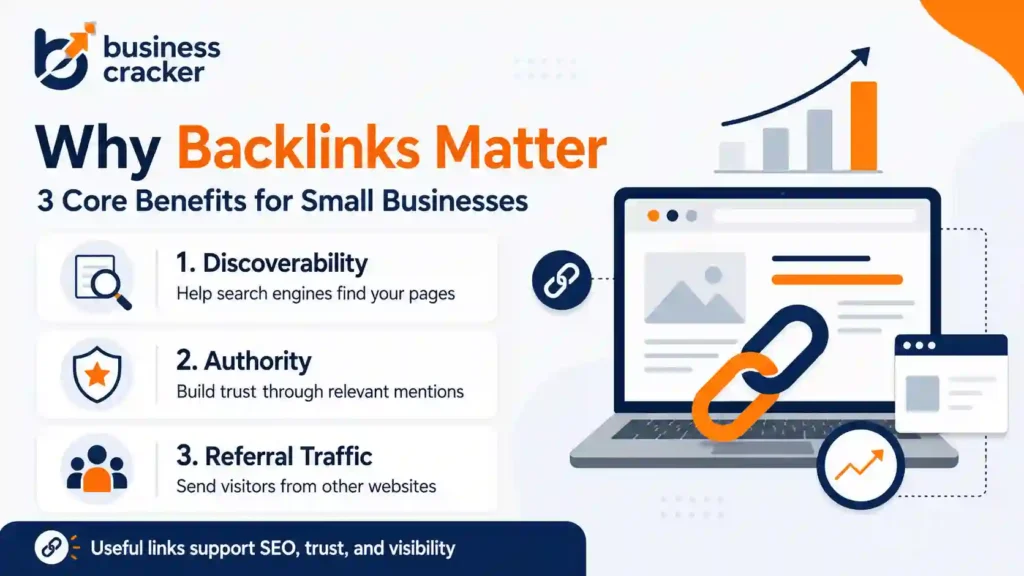
Google’s SEO Starter Guide explains that Google primarily finds pages through links from pages it has already crawled. The guide also says that PageRank uses links as a signal, while making clear that Google Search uses many different ranking signals, not links alone.
That point is important for beginners. Links are useful, but they are not magic. A backlink can help a strong page perform better. It usually cannot save a weak page with thin content, poor search intent, slow speed, confusing structure, or no business value.
How Link Building Supports SEO
SEO is the process of improving a website so it can perform better in organic search. Link building is one part of SEO, usually placed under off page SEO.
A complete SEO strategy usually includes:
- Technical SEO
- Keyword research
- On page optimization
- Content creation
- Internal linking
- Local SEO where relevant
- Off page SEO
- Link building
- Reporting and performance tracking
Link building supports SEO by helping search engines and users discover that your website has authority in a subject area.
For example, if a business has a detailed guide about choosing CRM software and several respected SaaS blogs link to it, that can help search engines understand that the guide is useful in that topic area.
But if the same CRM page gets links from unrelated sites about gambling, coupons, or random guest post farms, those links may be low value or risky.
What is off-page SEO?
Off page SEO refers to actions taken outside your website that can influence your search visibility, authority, and trust.
This can include:
- Backlinks
- Brand mentions
- Digital PR
- Guest posting
- Local citations
- Reviews
- Social visibility
- Podcast mentions
- Partner listings
- Industry directories
- Community mentions
Link building is one of the most discussed parts of off page SEO because backlinks are measurable and have historically played a major role in search.
However, off page SEO is not only about links. A business can also build authority through strong brand mentions, expert content, local reputation, review quality, and industry presence.
Why Link Building Matters for Business Owners
For business owners, link building matters because it can support visibility in places where potential customers are already searching.
1. It Can Help Important Pages Rank Better
A business website may have service pages, location pages, product pages, or blog articles that deserve to rank but do not have enough authority.
Good backlinks can help these pages compete.
For example:
- A web design company may build links to its website design service page.
- A local accountant may earn links from local business directories and local publications.
- A SaaS startup may earn links from software comparison blogs, integration partners, and industry guides.
- An e-commerce brand may earn links from gift guides, product reviews, and niche publishers.
The goal is not to build links to every page. The goal is to support pages that already have search demand, business value, and useful content.
2. It Can Bring Referral Traffic
Not every valuable link is only about rankings.
A relevant link from the right website can send visitors directly.
For example:
- A wedding photographer listed on a local venue page can receive referral leads.
- A B2B software company mentioned in a comparison guide can receive demo requests.
- A restaurant featured in a local food blog can receive bookings.
- A consultant quoted in an industry article can receive qualified inquiries.
This is why digital marketing link building should not be judged only by SEO metrics. A link can also create visibility, trust, and traffic from the linking website itself.
3. It Can Build Brand Authority
When your business is mentioned by relevant websites, industry blogs, associations, local organizations, podcasts, and media sites, your brand looks more credible.
This matters because buyers rarely trust one signal.
They may check:
- Your website
- Google reviews
- Social profiles
- Industry mentions
- Blog references
- Case studies
- LinkedIn presence
- Third-party articles
A backlink from a relevant website can support that trust path.
4. It Can Help New Websites Build Visibility
New websites often struggle because search engines have limited signals about them.
A new business may publish good content, but still struggle to rank because stronger competitors already have established authority.
Link building can help new websites create signals outside their own domain.
For beginners, the best starting point is not aggressive backlink building. It is building real links from real relationships, useful content, directories, local organizations, partners, and industry sites.
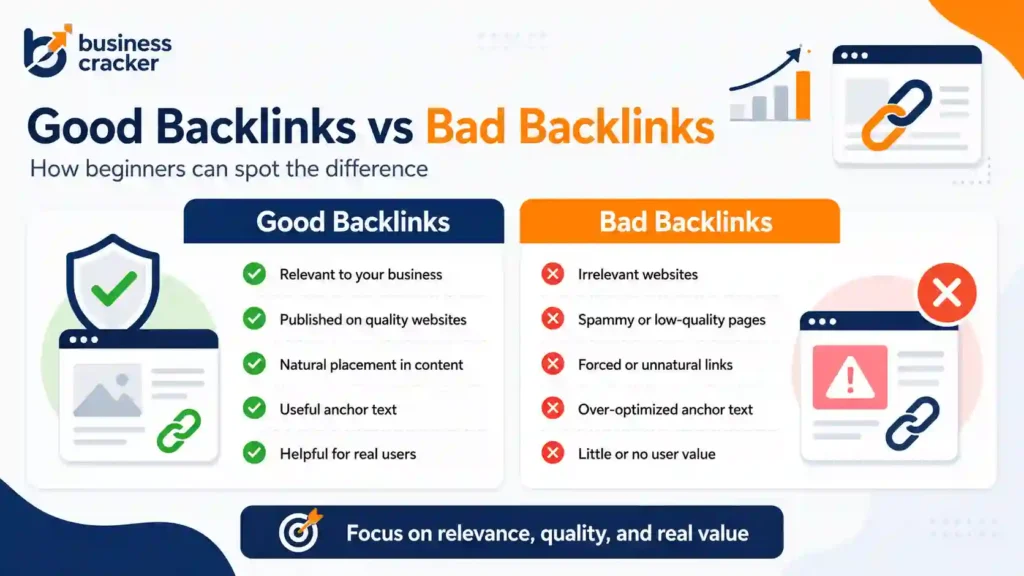
What Makes a Good Backlink?
Not every backlink has the same value.
A good backlink usually has these qualities.
1. Relevance
The linking website should make sense for your business.
If you run a dental clinic, a backlink from a local healthcare website, city directory, patient education article, or local publication is more relevant than a random link from a general blog with no connection to your industry.
Relevance can come from:
- Industry
- Topic
- Location
- Audience
- Partnership
- Service category
- Content relationship
2. Website Quality
A good linking website should look real and useful.
Check:
- Does the site publish helpful content?
- Does it have real traffic?
- Does it have a clear audience?
- Does it have an editorial standard?
- Does it avoid spammy topics?
- Does it link to relevant websites?
- Does it look maintained?
- Does it have real authors or business information?
A backlink from a website that exists only to sell links is usually not a good asset.
3. Natural Placement
A good backlink should appear naturally in the content.
For example, a link inside a helpful article, resource page, case study, partner page, or interview usually looks more natural than a keyword-stuffed link in a random paragraph.
A weak link may appear in content that has nothing to do with your business.
4. Useful Anchor Text
Anchor text is the clickable text used in a link.
Example:
“Read this guide on link building in digital marketing.”
In that sentence, “link building in digital marketing” is the anchor text.
Good anchor text should be natural. It can include:
- Brand name
- Page title
- Partial keyword
- URL
- Descriptive phrase
- Generic phrase when appropriate
Avoid repeating the same exact keyword in every backlink. That can look unnatural.
5. Real User Value
A good link should help the reader.
Ask:
- Would a real reader find this link useful?
- Does the link support the topic?
- Does the linked page answer the next question?
- Is the placement helpful or forced?
If the answer is no, the link may not be worth pursuing.
What Makes a Bad Backlink?
Bad backlinks can waste budget and sometimes create SEO risk.
Avoid links from:
- Spam sites
- Private blog networks
- Auto-generated pages
- Irrelevant directories
- Comment spam
- Forum profile spam
- Hacked websites
- Link farms
- Sites that publish unrelated guest posts daily
- Pages filled with outbound links to random industries
- Paid links that are not properly qualified
- Exact-match anchor text packages
Google’s spam policies list buying or selling links for ranking purposes, excessive link exchanges, automated link creation, low-quality directory links, and keyword-rich links in low-quality guest posts as examples of link spam.
Google also explains that paid or sponsored links should be marked with proper attributes such as rel=”sponsored” or rel=”nofollow”.
For business owners, the takeaway is simple. Do not buy links blindly. Understand where the link is coming from, why it is relevant, and whether it creates business or SEO value.
Common Link Building Methods for Beginners
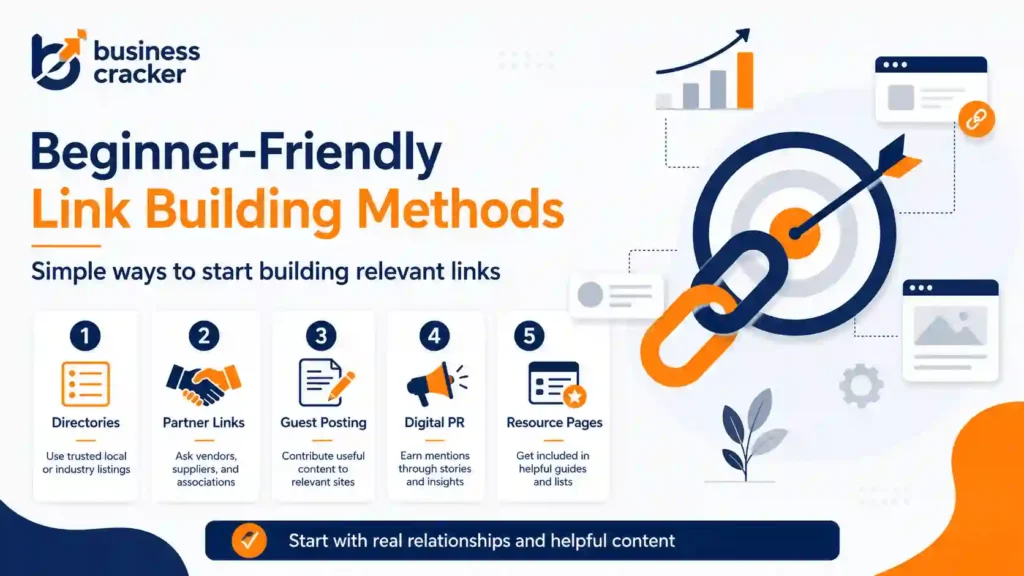
1. Business Directory Listings
Directories can be useful when they are relevant and legitimate.
Examples:
- Local business directories
- Industry directories
- Chamber of commerce listings
- Professional association profiles
- Startup directories
- Supplier directories
- Marketplace profiles
Avoid low-quality directory blasts that create hundreds of irrelevant links.
2. Partner Links
Many businesses already have link opportunities through real relationships.
Check:
- Vendors
- Suppliers
- Technology partners
- Associations
- Event partners
- Franchise pages
- Reseller pages
- Sponsorship pages
- Certification providers
A partner link is often easier and safer because there is already a real business relationship.
3. Guest Posting
Guest posting means writing content for another website and including a relevant link.
It can work when:
- The website is relevant
- The topic helps the audience
- The content is original
- The link is natural
- The publisher has editorial standards
It becomes weak when the article is written only to place a backlink.
4. Digital PR
Digital PR involves earning mentions through newsworthy stories, expert comments, research, data, product updates, or industry insights.
Examples:
- Founder commentary
- Original surveys
- Local business stories
- Industry reports
- Expert quotes
- Product data
- Trend commentary
Digital PR is often stronger for brand authority than basic guest posting.
5. Resource Page Links
Some websites maintain pages that list helpful tools, guides, businesses, or resources.
If your page is genuinely useful, you can request inclusion.
Useful assets may include:
- Guides
- Checklists
- Calculators
- Templates
- Research pages
- Free tools
- Local resources
6. Broken Link Building
Broken link building means finding broken links on other websites and suggesting your page as a replacement.
This works when your content closely matches the broken resource.
It requires patience, but it is a clean method when done properly.
7. Unlinked Brand Mentions
Sometimes websites mention your business but do not link to your website.
You can contact the publisher and request that they add a link. This works best when the mention is already positive and relevant.
8. Local Link Building
For small businesses, local links are often more useful than random national links.
Local link sources may include:
- Local newspapers
- City blogs
- Community organizations
- Local sponsorships
- Local event pages
- Schools or charities
- Business associations
- Local vendor pages
- Local podcast appearances
Local relevance can be powerful for small businesses.
How Link Building Fits Into Digital Marketing
Link building should not operate alone.
It connects with other digital marketing activities.
Link Building and SEO
Link building supports search visibility, but it works best when the website has strong SEO basics.
Before building links, check:
- Are the important pages indexed?
- Is the website technically healthy?
- Are service pages clear?
- Is content useful?
- Is internal linking strong?
- Do pages match search intent?
- Are title tags and meta descriptions optimized?
- Is the website fast and mobile-friendly?
If the foundation is weak, start with SEO services before scaling link building.
Link Building and Content Marketing
Content gives people something worth linking to.
A business can attract better links when it publishes:
- Practical guides
- Original research
- Industry data
- Comparison pages
- Case studies
- Opinion pieces
- Tools
- Templates
- Checklists
- Local resources
If a business only has a homepage and a few thin service pages, link building becomes harder.
Link Building and PR
PR helps businesses earn attention. Link building turns some of that attention into measurable website authority and referral traffic.
Examples:
- A founder interview with a link to the website
- A local media story with a link to the business
- A data report cited by industry blogs
- A product launch mentioned in relevant publications
Link Building and Social Media
Social shares are not the same as backlinks, but social media can help distribute content.
If a useful guide gets shared by the right people, it may reach bloggers, journalists, partners, or website owners who later link to it.
This is why link building often works better when connected with broader digital marketing services, not handled as a separate task.
Why Many Businesses Get Link Building Wrong
Mistake 1: Buying Cheap Backlink Packages
Cheap link packages often look attractive because they promise quick delivery.
The problem is quality.
A package offering hundreds of links usually includes low-value sources such as weak directories, profile links, comment spam, or irrelevant websites. These links rarely support meaningful business growth.
Mistake 2: Looking Only at DA or DR
Domain Authority and Domain Rating are third-party metrics. They can help with filtering, but they are not the full picture.
A website can have a strong score and still be irrelevant, spammy, or poor for your business.
Review the actual website, not only the metric.
Mistake 3: Building Links to the Wrong Pages
Many businesses build links only to the homepage.
Sometimes that makes sense, but not always.
You may need links to:
- Service pages
- Location pages
- Product pages
- Blog guides
- Research pages
- Case studies
- Tools
- Comparison pages
Choose pages based on business value and ranking potential.
Mistake 4: Using Over-Optimized Anchor Text
Repeating the same keyword in every backlink is risky and unnatural.
A safer anchor mix includes:
- Brand anchors
- URL anchors
- Partial match anchors
- Page title anchors
- Natural phrase anchors
Mistake 5: Ignoring Referral Value
A backlink from a relevant small website can sometimes bring better business value than a link from a large but unrelated site.
Ask:
- Can this link send real potential customers?
- Is the audience relevant?
- Does the mention improve trust?
- Would we want this link even if SEO did not exist?
That question helps avoid poor link decisions.
How to Start Link Building as a Beginner
Step 1: Fix Your Website First
Before asking for links, make sure your website is worth linking to.
Check:
- Clear homepage
- Useful service pages
- Strong contact page
- Fast loading pages
- Mobile friendly design
- Helpful content
- Real business information
- Testimonials or proof
- Clear calls to action
A weak website makes link building harder.
Step 2: Identify Your Most Important Pages
Choose pages that matter for the business.
Examples:
- Main service page
- Top product category
- Local service page
- Best educational guide
- Comparison page
- Case study
- Lead generation page
Do not build links randomly.
Step 3: Study Competitors
Check which websites link to competitors.
Look for:
- Industry directories
- Guest post sites
- Local publications
- Partner pages
- Resource pages
- Review sites
- Podcasts
- Associations
- Blogs
Do not copy every competitor link. Use competitor research to find patterns.
Step 4: Build Easy Real-World Links First
Start with links that come from real relationships.
Examples:
- Supplier page
- Partner page
- Local chamber listing
- Association profile
- Event sponsorship page
- Local directory
- Business profile
- Customer case study
- Podcast appearance
- Community page
These are often safer and more relevant for beginners.
Step 5: Create Linkable Content
Publish content that gives people a reason to link.
Examples:
- “Cost of Website Design for Small Businesses”
- “Local SEO Checklist for Service Businesses”
- “Industry Benchmark Report”
- “Small Business Marketing Budget Template”
- “Beginner Guide to SEO for Local Businesses”
- “Comparison of Marketing Channels for Startups”
Linkable content should solve a real problem, not just target a keyword.
Step 6: Do Targeted Outreach
Outreach should be specific.
Do not send generic emails to hundreds of websites.
A good outreach email explains:
- Why you are contacting them
- Why your page is relevant
- How it helps their audience
- Where it could fit
- Why the suggestion is useful
Short, specific outreach usually works better than long promotional emails.
Step 7: Track Results
Track:
- New referring domains
- Link quality
- Anchor text
- Target page
- Ranking movement
- Organic traffic
- Referral traffic
- Leads
- Lost links
- Competitor movement
Link building should be measured, not guessed.
How Long Does Link Building Take?
Link building is not instant.
A new link may take time to be crawled, indexed, and reflected in search performance. Google’s SEO Starter Guide also notes that SEO changes can take time, sometimes weeks or months, to show impact.
For a small business, early link building may show value through:
- Better referral traffic
- More brand mentions
- Better local visibility
- Improved keyword movement
- Stronger authority over time
- More trust from third-party references
Expect gradual progress rather than overnight ranking jumps.
How Many Backlinks Does a Small Business Need?
There is no fixed number.
It depends on:
- Industry competition
- Location
- Website age
- Current authority
- Competitor links
- Target keywords
- Content quality
- Technical SEO health
- Business goals
A local service business in a small city may need fewer high-quality local links. A national SaaS company competing for difficult keywords may need a much stronger authority-building campaign.
The better question is not “How many backlinks do we need?”
The better question is:
“Which pages need authority, and which relevant websites can link to them naturally?”
Link Building and AI Search in 2026
Search is changing because users now get information from Google results, AI Overviews, ChatGPT, Reddit, YouTube, social platforms, and niche communities.
Ahrefs’ 2026 SEO statistics report notes that organic click-through rates on queries with Google AI Overviews dropped sharply from June 2024 to September 2025, based on Seer Interactive data. It also reports that 96.6 percent of Google search clicks go to first-page results.
This does not make link building less important. It changes how businesses should think about visibility.
Links, brand mentions, citations, and third-party references can all help a business appear more credible across search and discovery environments. A backlink from a relevant industry source is not only an SEO signal. It can also place your brand where buyers and AI systems may find it.
In 2026, link building should support broader authority, not just keyword rankings.
Should You Hire a Link Building Agency?
A business should consider professional link building support when:
- Competitors have stronger backlink profiles
- Important pages are not ranking
- The business has no outreach system
- The team does not know how to evaluate link quality
- Existing backlinks are weak or irrelevant
- The company wants safer off page SEO
- Content exists but lacks authority
- The business needs a custom link building strategy
Professional link building services can help with backlink audits, competitor research, prospecting, outreach, placement review, anchor text planning, and reporting.
But choose carefully. A link building agency should explain its process clearly. If it only sells link counts, be cautious.
Questions to Ask Before Hiring a Link Building Provider
Ask these questions:
- How do you choose websites for link building?
- Do you check relevance manually?
- Do you review traffic and content quality?
- What link types do you use?
- Do you use guest posting, digital PR, niche edits, or partner outreach?
- How do you choose anchor text?
- Do you build links to service pages or only blogs?
- How do you report results?
- Do you track link retention?
- Do you follow Google’s link spam policies?
- Do you avoid automated or bulk backlink methods?
- Can you show a sample report?
- How will this support our business goals?
Good providers will answer these directly.
What Business Cracker Recommends
For beginners, link building should start with strategy, not shortcuts.
The right process looks like this:
- Fix the website foundation.
- Identify important business pages.
- Review competitors.
- Build real local, industry, and partner links.
- Create content worth linking to.
- Use careful outreach.
- Avoid spammy link tactics.
- Track ranking, traffic, referral visits, and leads.
Business Cracker supports businesses with SEO services, link building services, and broader digital marketing services that connect off page SEO with website quality, content strategy, and measurable growth.
Final Thoughts
Link building in digital marketing is the process of earning relevant backlinks that help users and search engines discover your business. For small business owners and beginners, the goal is not to chase hundreds of backlinks. The goal is to build the right links from the right websites to the right pages.
Good link building supports rankings, authority, referral traffic, and brand trust. Bad link building creates noise and risk.
Start with your website, your best pages, your real relationships, and your audience’s questions. Then build links that make sense for your business, not just links that look good in a report.
If your business needs a safer, clearer, and more measurable link building strategy, contact Business Cracker to discuss how link building can support your SEO and digital growth goals.