
May 10, 2026
What Is Performance Marketing and How Does It Work?
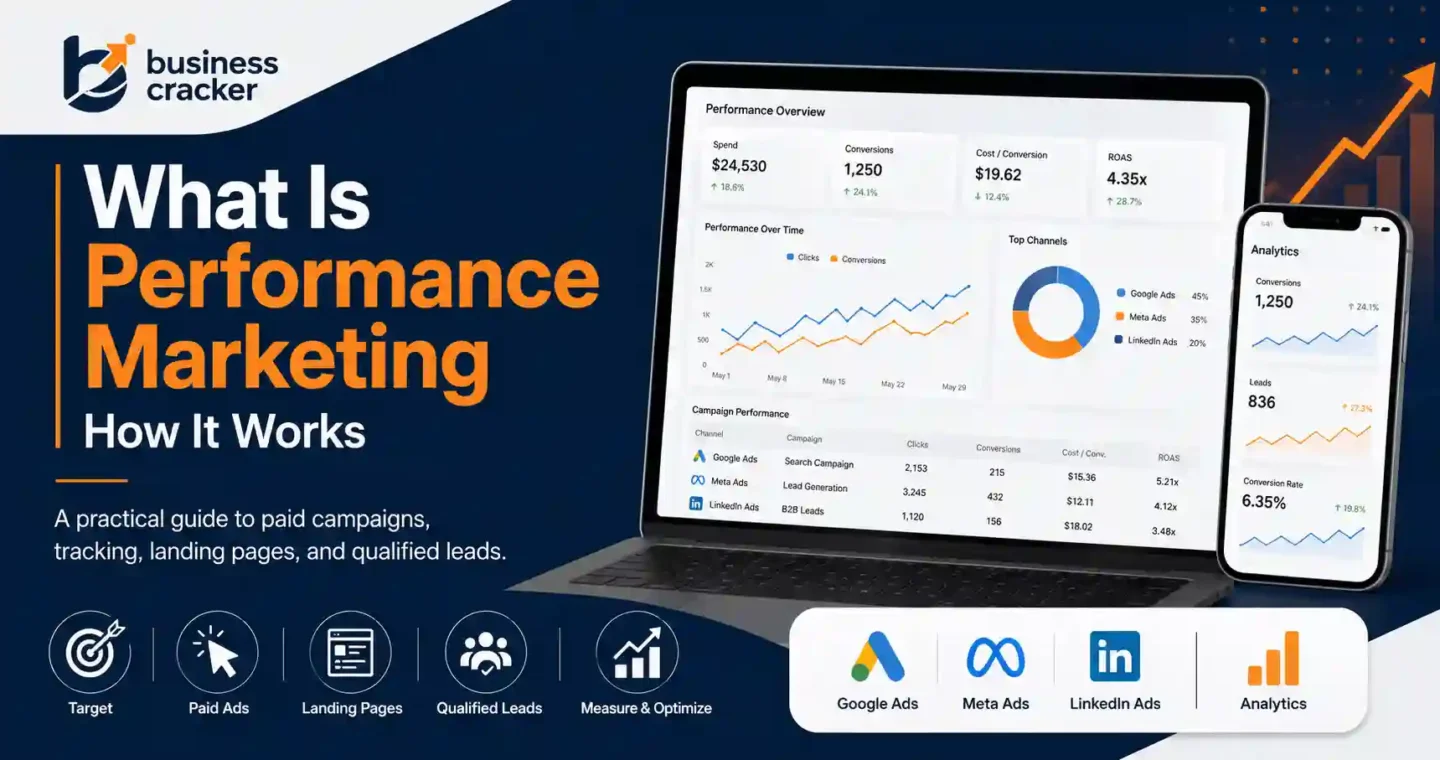
Performance marketing is a digital advertising approach where campaigns are planned, measured, and optimized around specific business actions. These actions can include leads, purchases, calls, demo requests, app installs, signups, qualified inquiries, or booked appointments.
The idea sounds simple: spend money where results can be measured. In practice, performance marketing is often harder than that. Many businesses run Google Ads, Meta Ads, LinkedIn Ads, or remarketing campaigns and still struggle to understand what is actually working.
The common problems are clear. Marketers complain about rising costs, weak lead quality, poor attribution, broken tracking, unclear campaign structure, and platforms optimizing for form fills instead of real buyers. In recent paid media discussions, advertisers raised concerns about changing platform performance, low-quality leads from Meta campaigns, and difficulty sending meaningful lead quality signals back to ad platforms. These are not small technical issues. They affect budget, sales pipeline, and confidence in paid marketing.
Performance marketing works only when campaigns, tracking, landing pages, lead quality, and business goals are connected. If one part is weak, the whole system becomes unreliable.
The Problem This Article Solves
Many businesses think performance marketing means running ads and checking cost per lead.
That is too narrow.
A campaign can have a low cost per lead and still fail if the leads are not qualified. A campaign can have many conversions and still be misleading if tracking is broken. A campaign can get clicks and still waste budget if the landing page does not explain the offer clearly.
This article explains what performance marketing is, how it works, which channels are commonly used, what metrics matter, and how businesses can avoid common paid campaign mistakes.
Desired Reader Outcome
After reading this article, you should be able to:
- Understand what performance marketing means
- Know how performance campaigns are structured
- Identify the difference between clicks, conversions, and qualified outcomes
- Understand how Google Ads support and Meta Ads support fit into a paid strategy
- Know why landing pages and tracking matter
- Decide when your business may need performance marketing services
What Is Performance Marketing?
Performance marketing is a digital marketing model focused on measurable outcomes.
Instead of measuring only impressions, reach, or brand visibility, performance marketing asks a direct question:
What business action did the campaign produce?
That action may be:
- A sale
- A lead form submission
- A phone call
- A WhatsApp inquiry
- A booked consultation
- A demo request
- A newsletter signup
- An app install
- A product trial
- A qualified lead
- A repeat purchase
Performance marketing can include paid search, paid social, display advertising, affiliate campaigns, remarketing, shopping ads, video ads, and sponsored placements. What makes it performance-focused is not the channel. It is the measurement discipline.
A campaign should have a defined objective, a target audience, a clear offer, a tracking setup, conversion data, optimization process, and reporting that connects spend to outcomes.
Why Performance Marketing Matters Now
Digital advertising is still growing, but growth does not automatically mean better results for every advertiser.
IAB and PwC’s full-year 2025 Internet Advertising Revenue Report said U.S. internet advertising revenue reached $294.6 billion in 2025, up 13.9 percent year over year. IAB described the market as moving toward performance-driven and AI-powered growth.
That growth creates more competition. More businesses are bidding for attention across search, social, video, commerce, and creator-led channels. As competition increases, weak campaigns become more expensive to run.
Performance marketing matters because businesses need clearer answers:
- Which channel is producing qualified leads?
- Which campaign is wasting spend?
- Which keyword or audience is creating revenue?
- Which landing page is blocking conversions?
- Which ads attract serious buyers?
- Which conversions are real and which are low quality?
- Which budget should be scaled?
Without that clarity, paid marketing becomes guesswork.
How Performance Marketing Works
Performance marketing usually works through a structured process.
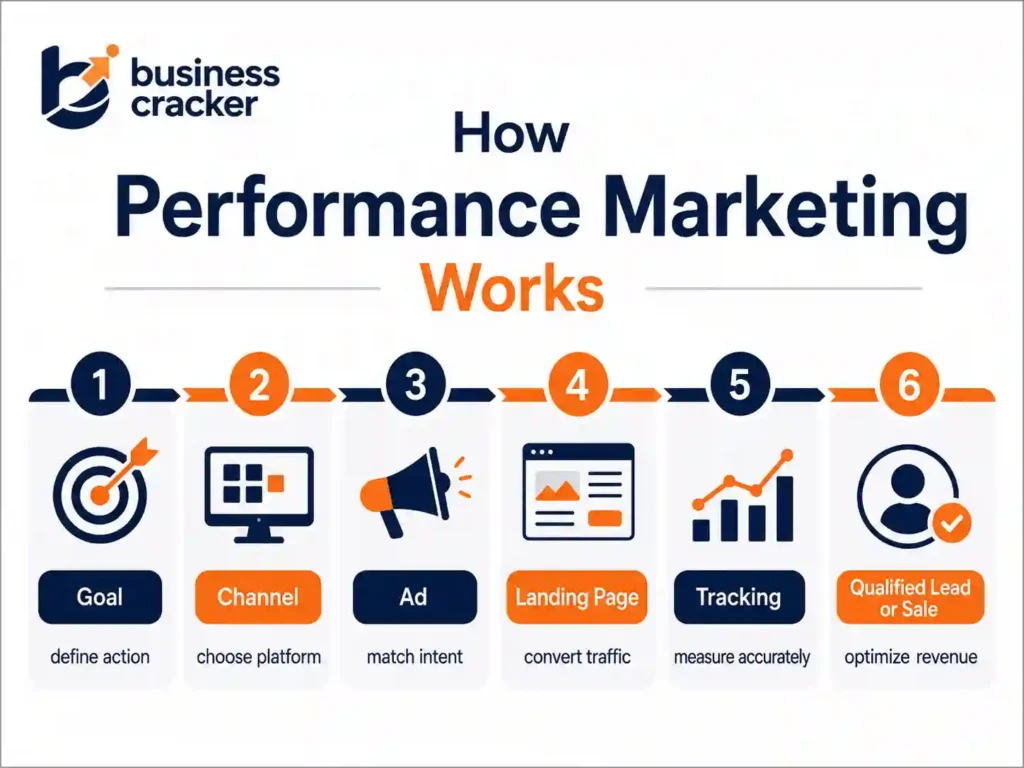
1. Define the Campaign Goal
The first step is deciding what the campaign should achieve.
Common goals include:
- Generate leads
- Increase e-commerce sales
- Drive consultation requests
- Promote a specific service
- Increase app installs
- Improve remarketing conversions
- Grow webinar registrations
- Capture demo requests
- Reduce cost per acquisition
- Improve lead quality
The goal should be specific.
Weak goal:
“Get more traffic.”
Better goal:
“Generate qualified leads for website design services from business owners searching for website redesign support.”
The second goal gives the campaign a clear direction.
2. Choose the Right Channel
Performance marketing channels are not equal. Each one has a different role.
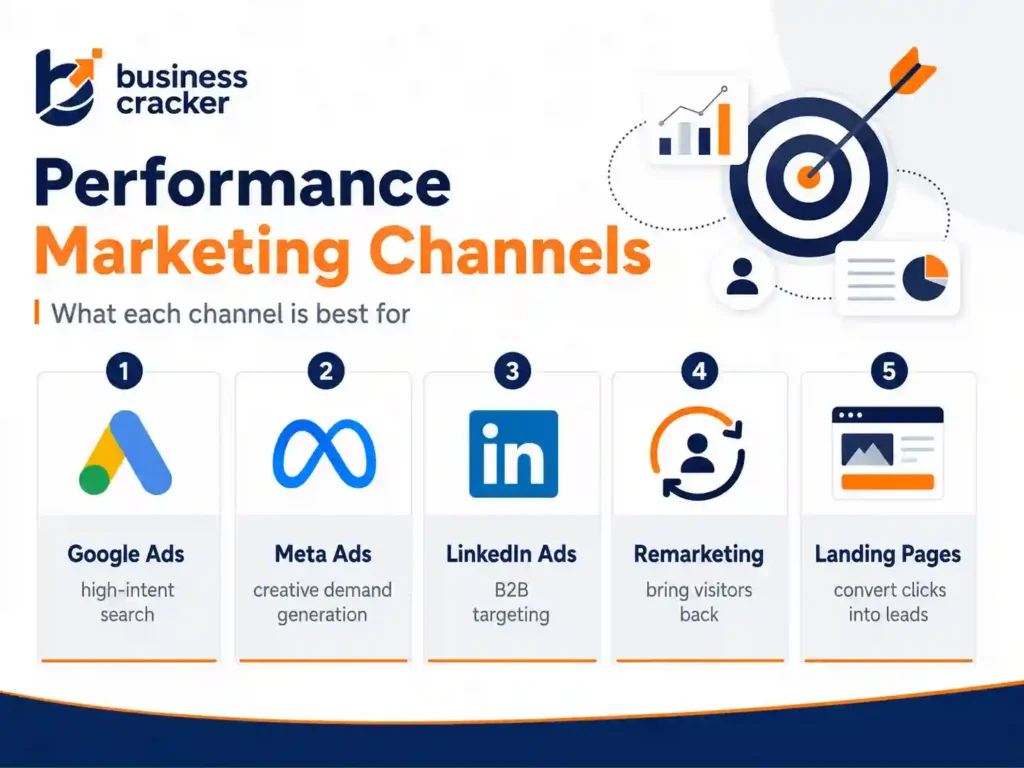
Google Ads
Google Ads works well when users already have intent. They may be searching for a product, service, solution, or provider.
Google Ads can be useful for:
- Search campaigns
- Shopping campaigns
- Performance Max
- Remarketing
- Local service promotion
- High intent service keywords
- Competitor comparison queries
Google Ads support is useful when a business needs help with keyword selection, conversion tracking, campaign structure, search terms, bidding, and landing page alignment.
Meta Ads
Meta Ads, including Facebook and Instagram, are often stronger for demand generation, retargeting, creative testing, lead generation, and visual offers.
Meta Ads can be useful for:
- Lead generation
- Retargeting
- Brand awareness with measurable actions
- E-commerce promotions
- Offer testing
- Local service campaigns
- Creative-led campaigns
Meta’s Conversions API helps businesses send marketing data directly to Meta, which can improve measurement and attribution across the customer journey. Meta states that the Conversions API can help improve ad performance and measurement when used properly.
LinkedIn Ads
LinkedIn Ads can work for B2B businesses, especially when job title, company size, industry, or professional role matters. It is often more expensive, so the offer and audience must be clear.
Remarketing
Remarketing targets users who have already interacted with your website or brand. It often works better when the original traffic quality is strong.
Landing Page and Website Campaigns
Some performance campaigns fail not because of the ad platform, but because the landing page is weak. This is where website design services can support performance marketing by improving page clarity, trust, speed, and conversion flow.
3. Build the Audience or Keyword Strategy
Audience selection depends on the platform.
For Google Ads, the focus may be:
- Keywords
- Search intent
- Match types
- Negative keywords
- Location
- Device
- Search terms
- Landing page relevance
For Meta Ads, the focus may be:
- Creative testing
- First-party data
- Retargeting audiences
- Lookalike audiences
- Interest signals
- Lead form quality
- Placement performance
For B2B campaigns, audience quality matters more than raw reach.
A campaign targeting the wrong users may still produce clicks, but the sales team will not see qualified opportunities.
4. Create the Offer
The offer is what the user responds to.
Examples:
- Free consultation
- Website audit
- Landing page review
- Product discount
- Demo request
- Trial signup
- Quote request
- Webinar registration
- Downloadable guide
- Strategy call
A weak offer creates weak performance.
For example, “Contact us” may work for high-intent search users, but cold social traffic may need a more specific reason to respond.
A stronger offer may be:
“Request a paid campaign landing page review.”
That tells the user exactly what they get.
5. Create Ads That Match the Intent
Ad copy and creative should match the audience’s stage.
For search campaigns, the ad should match what the user is looking for.
For social campaigns, the ad should quickly frame the problem and offer.
For remarketing, the ad should remind users why they should return.
Strong ads usually include:
- Clear problem
- Relevant offer
- Specific benefit
- Proof where possible
- Clear CTA
- Message matches the landing page
Weak ads often rely on vague claims such as:
- Grow your business
- Get more leads
- Improve your marketing
- Best digital marketing agency
These may sound familiar, but they do not help users decide.
6. Build a Landing Page That Converts
Performance marketing depends heavily on the landing page.
A paid campaign landing page should include:
- Clear headline
- Message match with the ad
- One primary CTA
- Short and useful copy
- Trust signals
- Mobile-friendly layout
- Fast loading speed
- Simple form
- Proper tracking
- Clear next step
If a campaign gets clicks but no leads, review the landing page before blaming the platform.
A business running paid ads should not send every campaign to the homepage. A homepage is usually too broad. A dedicated landing page gives the user a clearer path.
This is why performance marketing often works best when paid campaigns, landing pages, and digital marketing services are planned together.
7. Set Up Conversion Tracking
Conversion tracking is the foundation of performance marketing.
Google Ads explains that a conversion action is a specific customer activity valuable to a business, and conversion measurement helps advertisers understand the actions customers take after interacting with ads.
Important conversion actions may include:
- Form submissions
- Purchases
- Phone calls
- WhatsApp clicks
- Demo requests
- Quote requests
- Button clicks
- Booking confirmations
- Newsletter signups
- Qualified lead updates
- Offline sales imports
The mistake is tracking every action as equal.
A contact form submission from a serious buyer should not be treated the same as a low-intent click on a button. A qualified consultation request should not be treated the same as a spam form fill.
Performance marketing needs clean conversion data.
8. Optimize Campaigns Based on Real Data
Once campaigns are live, optimization begins.
Optimization may include:
- Pausing weak keywords
- Adding negative keywords
- Testing ad copy
- Adjusting bids
- Reviewing search terms
- Testing audiences
- Improving landing pages
- Removing poor placements
- Testing new creatives
- Reviewing lead quality
- Improving conversion tracking
- Adjusting budget allocation
Paid campaign optimization is not about changing everything daily. It is about making controlled decisions based on enough data.
If you change too many variables at once, you cannot understand what caused the improvement or decline.
9. Measure Lead Quality, Not Only Lead Volume
This is one of the biggest performance marketing problems.
A campaign may look successful in the ad platform because it generated many leads. But if sales rejects those leads, the campaign is not really successful.
Common lead quality problems include:
- Fake inquiries
- Job seekers filling forms
- Low-budget users
- Wrong location leads
- Students or vendors instead of buyers
- Unresponsive leads
- People who do not understand the offer
- Leads generated from misleading ad copy
- Leads from broad targeting
- Instant form leads with weak intent
Meta advertisers regularly discuss this issue, especially with lead forms and message campaigns. Some report that shorter forms increase volume but reduce quality, while adding qualifying questions raises cost per lead.
The solution is not always “get cheaper leads.” The solution is to improve quality signals.
Ways to improve lead quality:
- Add qualifying questions
- Improve offer clarity
- Exclude wrong locations
- Use better negative keywords
- Send offline conversion data where possible
- Review sales feedback weekly
- Separate raw leads from qualified leads
- Use landing pages instead of weak lead forms when needed
- Align ad copy with real buyer intent
Performance marketing should be judged by business value, not only platform conversions.
Performance Marketing vs Digital Marketing
Digital marketing is the broader category. It includes SEO, content, social media, email, web design, paid ads, online reputation, and more.
Performance marketing is a more measurable branch of digital marketing. It focuses on campaigns where outcomes are tracked and optimized.
For example:
- SEO can support long-term visibility
- Web design can improve conversion rates
- Content can support trust and education
- Paid ads can generate faster traffic
- Performance marketing connects spend to measurable outcomes
Business Cracker offers both broader digital marketing planning and performance-focused campaign support. The right mix depends on the business goal.
Performance Marketing vs SEO
Performance marketing and SEO are different but connected.
SEO focuses on organic visibility. It usually takes longer, but it can reduce long-term dependency on paid traffic when done properly.
Performance marketing can produce faster data because campaigns can start driving traffic quickly. But it requires budget, tracking, testing, and landing page quality.
A business should not always choose one over the other.
Use SEO services when:
- You want long-term organic visibility
- Your service pages need search visibility
- Your site has indexing or technical issues
- You want to reduce paid dependency over time
- Your content needs keyword and intent structure
Use performance marketing when:
- You need faster traffic
- You have a clear offer
- You can track conversions
- You have a landing page ready
- You want to test demand quickly
- You have budget for campaign learning
Use both when:
- SEO is building long-term demand
- Paid campaigns are capturing short-term demand
- Landing pages support both search and ads
- Tracking gives visibility into leads and sales
Performance Marketing Channels
Paid Search
Paid search captures users who are actively searching.
Examples:
- Google Search Ads
- Microsoft Ads
- Brand campaigns
- Non-brand service campaigns
- Competitor campaigns
- High-intent keyword campaigns
Paid search works well when the keyword has commercial intent.
Paid Social
Paid social is useful when the business needs to create demand, test creative, retarget users, or reach specific audiences.
Examples:
- Meta Ads
- LinkedIn Ads
- TikTok Ads
- Pinterest Ads
- Reddit Ads
Paid social often depends more on creative, audience quality, and offer clarity.
Display and Remarketing
Display and remarketing can support visibility and return traffic, but they should be managed carefully. Poor placements and weak audiences can waste budget.
Shopping and E-commerce Ads
For e-commerce businesses, shopping campaigns and catalog-based campaigns can work well when the feed, pricing, product pages, and tracking are accurate.
Affiliate and Partner Campaigns
Affiliate performance marketing is based on partners driving actions such as sales or leads. It needs strong tracking and quality control.
Key Performance Marketing Metrics
The right metrics depend on the campaign goal.
Impressions
Impressions show how often ads were shown. They are useful for reach, but they do not prove performance.
Clicks
Clicks show interest, but clicks alone do not mean business value.
CTR
Click-through rate shows how often people click after seeing the ad. A high CTR can show message relevance, but it does not guarantee lead quality.
CPC
Cost per click shows how much each click costs. A low CPC is not always good if the traffic is weak.
Conversion Rate
Conversion rate shows how many visitors take the desired action. It depends on traffic quality, offer, landing page, and trust.
CPL
Cost per lead shows how much you pay for each lead. It is useful, but incomplete if lead quality is not reviewed.
CPA
Cost per acquisition shows the cost of acquiring a customer or meaningful conversion.
ROAS
Return on ad spend is common in e-commerce. It compares revenue to ad spend.
CAC
Customer acquisition cost includes broader costs of acquiring a customer. It is more useful for business-level decisions.
Lead Quality
Lead quality measures whether the lead is worth sales follow-up. This is critical for service businesses.
Pipeline or Revenue
For B2B and high-ticket services, campaign performance should eventually connect to pipeline or revenue, not only lead count.
Common Performance Marketing Problems
Problem 1: Broken Tracking
If tracking is wrong, campaign decisions are wrong.
Broken tracking may happen because of:
- Missing conversion tags
- Duplicate conversions
- Wrong thank you page setup
- Cookie consent issues
- Cross-domain tracking problems
- Form submissions not tracked
- Phone calls not tracked
- Offline sales not imported
- CRM not connected
- Testing not completed after launch
Fix this before judging campaign performance.
Problem 2: Optimizing for the Wrong Conversion
If the platform is told that every form fill is success, it will optimize for more form fills.
That may not mean better customers.
Use better conversion actions where possible, such as qualified leads, booked calls, purchases, or CRM-stage updates.
Problem 3: Weak Landing Pages
Many campaigns fail after the click.
Landing page issues include:
- Poor message match
- Slow loading
- Weak CTA
- No proof
- Confusing form
- Too much navigation
- No mobile optimization
- Unclear offer
Fix the page before increasing budget.
Problem 4: Poor Lead Quality
Low-quality leads can make a campaign look successful in the platform but useless to sales.
Fix this by improving targeting, ad copy, form questions, landing page clarity, and offline feedback.
Problem 5: No Clear Budget Learning Period
Campaigns need enough data to learn.
Stopping campaigns too early or changing them too often can prevent stable learning. At the same time, letting weak campaigns run without review wastes money.
Set a test budget, timeline, and success criteria before launch.
Problem 6: Treating Every Channel the Same
Google Ads, Meta Ads, LinkedIn Ads, and remarketing do not work the same way.
Each channel needs different creatives, targeting, landing pages, and reporting expectations.
Problem 7: Reporting Only Platform Metrics
Platform metrics are useful, but they do not tell the full story.
A proper report should connect:
- Spend
- Clicks
- Conversions
- Cost per lead
- Lead quality
- Sales feedback
- Landing page performance
- Next actions
How to Build a Performance Marketing Strategy
Step 1: Audit the Current Funnel
Before launching campaigns, review:
- Website speed
- Landing pages
- Forms
- Tracking setup
- Analytics
- Service pages
- Offer clarity
- Sales process
- Current traffic sources
- Past campaign data
Do not run paid campaigns into a weak funnel without knowing the risk.
Step 2: Define the Main Conversion
Choose the main action.
Examples:
- Book a consultation
- Submit a lead form
- Request a quote
- Purchase a product
- Start a trial
- Call the business
- Download a guide
Avoid tracking too many primary conversions.
Step 3: Match Channel to Intent
Use paid search for high-intent demand.
Use paid social for awareness, retargeting, and offer testing.
Use LinkedIn for B2B audience targeting.
Use remarketing to bring back interested users.
Use SEO to build long-term visibility alongside paid efforts.
Step 4: Build the Landing Page
The landing page should match:
- Campaign goal
- Audience
- Offer
- Ad message
- Device behavior
- CTA
- Tracking plan
A campaign should not launch until the landing page is ready.
Step 5: Set Tracking and QA
Before launch, test:
- Form submissions
- Call tracking
- Button clicks
- Conversion tags
- Thank you page
- CRM flow
- UTM parameters
- Campaign naming
- Analytics reports
Do not assume tracking works. Test it.
Step 6: Launch With a Controlled Budget
Start with a test budget that can produce useful data.
Avoid spreading a small budget across too many campaigns. It is better to test fewer campaigns properly than to underfund many campaigns.
Step 7: Review Early Signals
Early review should check:
- Search terms
- Audience quality
- Landing page engagement
- Form submissions
- Cost per conversion
- Lead details
- Tracking accuracy
- Budget pacing
Do not optimize based on one day of data unless something is clearly broken.
Step 8: Improve and Scale
Scale only when the campaign shows quality.
Good scaling signals include:
- Stable conversion tracking
- Qualified leads
- Acceptable CPL or CPA
- Positive sales feedback
- Strong landing page performance
- Clear winning keywords or audiences
- Budget headroom
Scaling weak campaigns only increases waste.
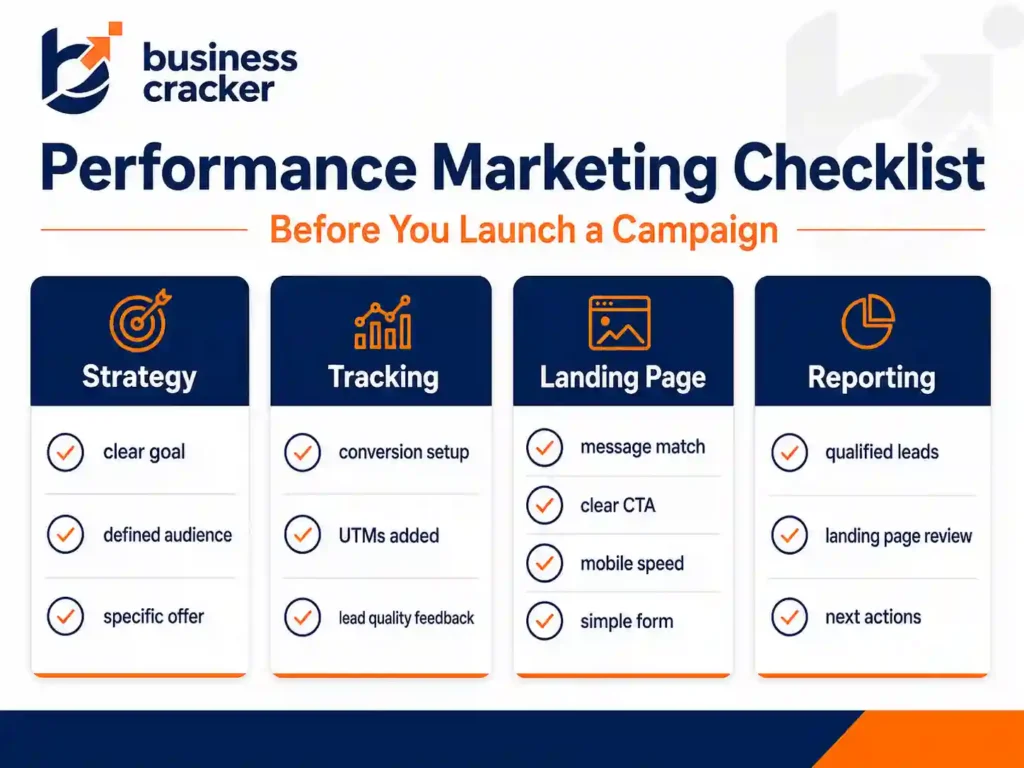
Performance Marketing Checklist
Use this checklist before launching a campaign.
Strategy
- Is the campaign goal clear?
- Is the audience defined?
- Is the offer specific?
- Is the channel suitable?
- Is the budget realistic?
- Is the success metric agreed?
Tracking
- Are conversions set up?
- Are duplicate conversions avoided?
- Are phone calls tracked?
- Are forms tested?
- Are UTMs added?
- Is CRM or lead quality feedback available?
- Are primary and secondary conversions separated?
Landing Page
- Does the page match the ad?
- Is the CTA clear?
- Is the page fast on mobile?
- Is the form simple?
- Are trust signals visible?
- Is the offer easy to understand?
Campaign Setup
- Are keywords or audiences relevant?
- Are exclusions added?
- Are the locations correct?
- Are ad creatives aligned?
- Are budgets controlled?
- Are naming conventions clean?
Reporting
- Will reporting show lead quality?
- Will sales feedback be included?
- Will landing page performance be reviewed?
- Will next actions be documented?
- Will budget changes be explained?
When Should a Business Use Performance Marketing Services?
A business should consider performance marketing support when:
- Paid ads are spending money without clear results
- Tracking is incomplete or unreliable
- Campaigns generate leads, but sales reject them
- Google Ads or Meta Ads performance is unstable
- Landing pages are not converting
- Cost per lead is rising
- Campaigns are hard to interpret
- The business needs a controlled testing plan
- Reporting does not explain what to do next
Good performance marketing services should not only manage ads. They should review the full path from click to lead or sale.
That includes:
- Campaign setup
- Tracking
- Landing pages
- Audience strategy
- Budget control
- Creative testing
- Conversion review
- Lead quality feedback
- Reporting
- Optimization
How Business Cracker Looks at Performance Marketing
Business Cracker treats performance marketing as a measurable growth system, not only paid ads management.
That means campaigns should connect:
- Business goals
- Channel selection
- Audience intent
- Ad copy
- Landing page design
- Conversion tracking
- Lead quality
- Budget decisions
- Reporting
A campaign is not successful because it generated clicks. It is successful when it helps the business attract the right audience and produce measurable outcomes.
Final Thoughts
Performance marketing is not just buying traffic. It is the process of connecting paid campaigns to measurable business actions.
A good campaign needs the right channel, a clear offer, strong landing page, reliable tracking, lead quality review, and disciplined optimization. Without these, ad platforms may show conversions while the business sees weak results.
If your campaigns are spending budget but not producing enough qualified leads, contact Business Cracker for a practical review of your campaign setup, landing page, tracking, and paid growth plan.
Frequently Asked Questions
What is performance marketing?
Performance marketing is a digital advertising approach focused on measurable actions such as leads, sales, calls, signups, app installs, or booked consultations. The goal is to track campaign spend against business outcomes.
How does performance marketing work?
Performance marketing works by setting a clear goal, choosing the right channel, creating ads, sending users to a relevant landing page, tracking conversions, and optimizing campaigns based on performance data.
Is performance marketing the same as paid ads?
Not exactly. Paid ads are one part of performance marketing. Performance marketing also includes conversion tracking, landing page optimization, lead quality review, budget decisions, and reporting tied to measurable outcomes.
Which channels are used in performance marketing?
Common channels include Google Ads, Meta Ads, LinkedIn Ads, Microsoft Ads, display ads, remarketing, shopping ads, affiliate campaigns, and video ads. The right channel depends on the business goal and audience intent.
Why are my paid campaigns getting leads but no customers?
This usually happens when campaigns optimize for lead volume instead of lead quality. Causes may include broad targeting, weak form qualification, unclear ad copy, poor landing page message, spam leads, or missing sales feedback in campaign optimization.
Do small businesses need performance marketing?
Small businesses can use performance marketing when they have a clear offer, a defined audience, proper tracking, and a landing page that can convert. If those basics are missing, fix them before increasing ad spend.
