June 21, 2026
White Hat Link Building: Safe Ways to Build Authority Without Penalties
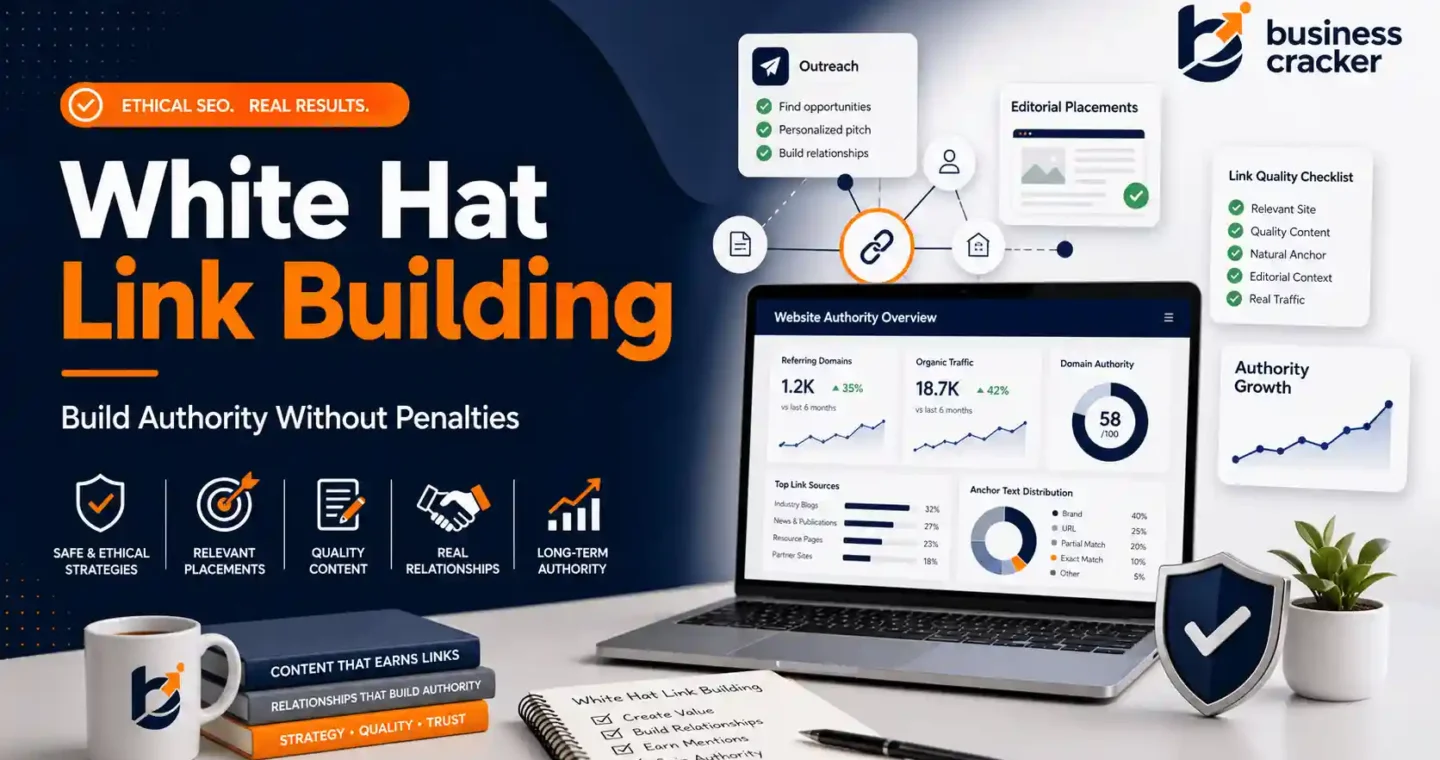
White hat link building is not about finding a cleaner name for buying backlinks.
It means building links in a way that can survive manual review, algorithm updates, client scrutiny, and your own quality standards six months later.
That distinction matters because business owners, SEO managers, and marketing agencies are under pressure from both sides. They know backlinks can support authority and rankings, but they also see spammy vendors selling “safe” links, guest post lists full of irrelevant sites, and warnings about Google penalties.
The fear is valid.
In current SEO communities, people are asking whether automatic link building tools are safe, how to identify link farms, whether spammy backlinks can hurt newer sites, and how to judge paid guest posts from vendors. One Reddit user looking for “safe white-hat link building” tools specifically asked about automation, guest post opportunities, digital PR, and automatic submissions. Another discussion asked how to tell when a website becomes a link farm. A separate thread on paid guest posts showed the core buyer problem clearly: people want to know whether a backlink is actually worth buying or whether it creates risk.
That is the real issue. Readers do not just want backlinks. They want high-quality backlinks without spam, wasted budget, irrelevant placements, or avoidable risk.
The Problem This Article Solves
Business owners, SEO managers, and agencies want backlinks, but they are worried about:
- Spammy link vendors
- Google penalties
- Low-quality guest posts
- Irrelevant websites
- Link farms
- Exact-match anchor abuse
- Paid placements with no disclosure
- Backlink reports that look good but do nothing
- Losing rankings after algorithm updates
- Damaging client or brand trust
This article explains what white hat link building actually means, which methods are safer, which tactics to avoid, and how to build authority without relying on shortcuts.
Desired Reader Outcome
After reading this guide, you should be able to:
- Understand what white hat link building means in practice
- Know the difference between ethical link building and risky link schemes
- Build safer backlinks through outreach, content, PR, and relationships
- Evaluate guest post opportunities before paying or pitching
- Spot low-quality sites and link farms
- Create a link building process that supports SEO services
- Know when to use professional link building services
- Make better decisions before hiring vendors or agencies
What Is White Hat Link Building?
White hat link building is the process of earning backlinks through ethical, relevant, and user-first methods.
A white hat backlink usually comes from:
- Relevant content
- Real editorial context
- Useful resources
- Genuine relationships
- Digital PR
- Expert commentary
- Business partnerships
- Local or industry citations
- Helpful guest contributions
- Link-worthy assets
The key point is intent.
A white hat link should make sense for the reader, not just for search engines.
If a link exists only because someone paid to place exact-match anchor text on a random website, that is not white hat link building. Even if the vendor calls it “manual outreach” or “high authority placement,” the quality depends on the actual website, page, context, and reason for the link.
White Hat Link Building vs Black Hat Link Building
The difference is not only about whether money changes hands. The difference is how the link is created, why it exists, and whether it manipulates search rankings without real editorial value.
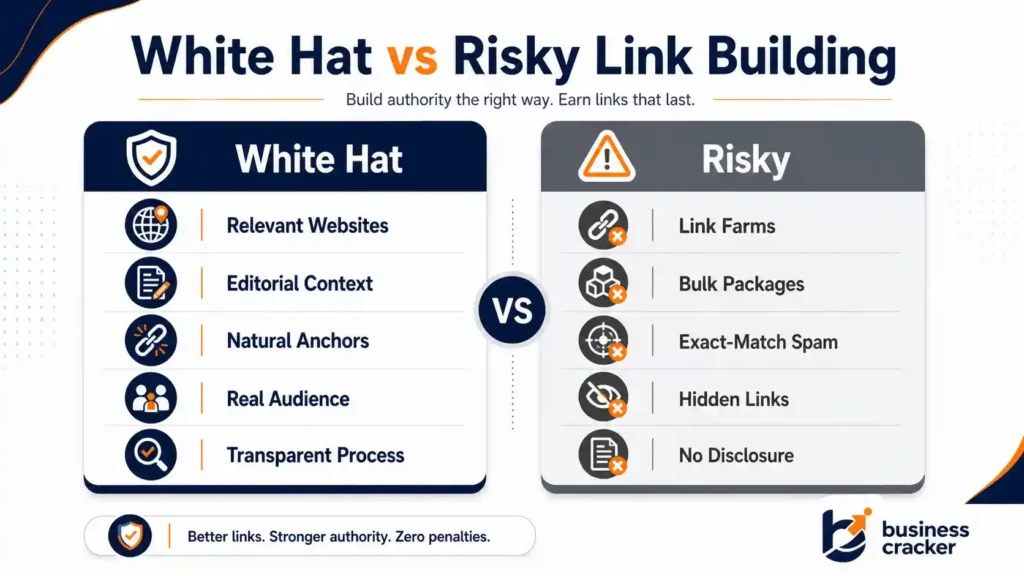
| Area | White Hat Link Building | Risky or Black Hat Link Building |
| Intent | Help users and earn relevant references | Manipulate rankings |
| Website quality | Relevant, trusted, real audience | Thin, spammy, link farm, fake news site |
| Content | Useful and editorially reviewed | Low quality, duplicate, AI-spun, generic |
| Anchor text | Natural and varied | Exact-match heavy |
| Placement | Contextual and useful | Forced or hidden |
| Scale | Controlled and quality-focused | Bulk links at speed |
| Transparency | Clear about paid or sponsored links | Hides paid link arrangements |
| Reporting | Explains relevance, context, and outcomes | Reports only DA, DR, and URL count |
| Risk | Lower risk | Higher risk |
Google’s spam policies explain that spam includes tactics intended to deceive users or manipulate search systems. The same page also states that sites violating spam policies may rank lower or be removed from search results.
That is why the safest link building strategy is not “build links that Google cannot detect.” It is “build links that are worth having even if reviewed manually.”
Can White Hat Link Building Guarantee No Penalties?
No honest SEO should promise that.
White hat link building reduces risk, but it cannot guarantee that no rankings will ever drop, no algorithm update will ever affect a site, or no third-party spam links will ever appear.
Google’s manual actions documentation explains that a manual action happens when a human reviewer determines that pages on a site are not compliant with Google’s spam policies. Most manual actions affect attempts to manipulate Google’s search index.
The practical goal is to build a backlink profile that looks natural, relevant, and defensible.
A safe link building program should make you comfortable answering this question:
“Would we still want this link if Google did not exist?”
If the answer is yes, the link is usually closer to white hat.
Why White Hat Link Building Matters More in 2026
The link market is crowded, expensive, and full of weak inventory.
A recent BuzzStream guest post cost study found that the average vendor price for a guest post was $461, while only 1.37 percent of guest post sites in its dataset qualified as High Quality or Top Tier. The same study also reported that 39.6 percent of sites had zero average monthly organic traffic.
That data confirms what many SEO managers already see in outreach inboxes. A lot of guest post inventory is not worth paying for.
Another BuzzStream link building statistics report found that link building interest remains high, but teams are still struggling with strategy, quality, and measurement.
So the challenge in 2026 is not simply “get backlinks.”
The challenge is:
- Which links are worth earning?
- Which placements are safe enough to approve?
- Which websites are relevant?
- Which links can support rankings, referral traffic, or brand trust?
- Which tactics will still look clean after the next spam update?
What Makes a Backlink White Hat?
A backlink is more likely to be white hat when it passes these checks.
1. The Website Is Relevant
Relevance is the first filter.
A good backlink should come from a website connected to your:
- Industry
- Audience
- Location
- Service category
- Product category
- Business relationship
- Expertise area
- Content topic
For example, a marketing agency getting a backlink from a marketing publication, business blog, SaaS partner, SEO resource page, or local business association makes sense.
A marketing agency getting a backlink from a random casino, coupon, crypto, or unrelated lifestyle site does not make sense.
Relevance is stronger than fake authority.
2. The Page Has Real Context
A white hat link should sit inside the content where it naturally helps the reader.
Good placements include:
- Editorial articles
- Expert quotes
- Resource pages
- Case studies
- Research citations
- Partner pages
- Local business pages
- Industry guides
- Podcast show notes
- Interview pages
Weak placements include:
- Footer links
- Sidebar links
- Spam comments
- Forum profile links
- Thin guest posts
- Auto-generated pages
- Hidden links
- Random listicles with no editorial value
A link should not feel inserted. It should feel earned.
3. The Anchor Text Is Natural
Anchor text is the clickable text of a link.
White hat SEO does not mean avoiding keywords completely. It means using anchor text in a way that looks natural.
A safe anchor mix includes:
- Brand name
- URL
- Page title
- Partial keyword
- Natural phrase
- Generic phrase when appropriate
- Author or company mention
Risky anchor patterns include:
- Repeating the same exact keyword across many links
- Using commercial anchors too often
- Building many links to one money page too quickly
- Forcing keywords into unnatural sentences
- Using anchors that do not match the page context
For example, linking with “Business Cracker” or “link building services” can both be natural depending on context. Repeating “best white hat link building agency” everywhere is not natural.
4. The Website Has Real Quality Signals
Before approving a link, check the website manually.
Look for:
- Real organic traffic
- Clear niche or editorial focus
- Quality content
- Real authors or business identity
- Useful categories
- Recent updates
- Internal linking
- No obvious spam topics
- No random outbound links to unrelated industries
- No public “write for us and pay” footprint on every page
- No sudden traffic crash if you have access to SEO tools
Do not trust DA or DR alone. These are third-party metrics. They can help with filtering, but they do not prove quality.
5. The Link Helps the Reader
This is the simplest test.
Ask:
- Would a real reader click this link?
- Does the link support the article?
- Does the linked page answer the next question?
- Is the placement useful without SEO?
- Would the publisher naturally include this reference?
If the link has no user value, it is probably not a strong white hat link.
Safe White Hat Link Building Methods That Still Work
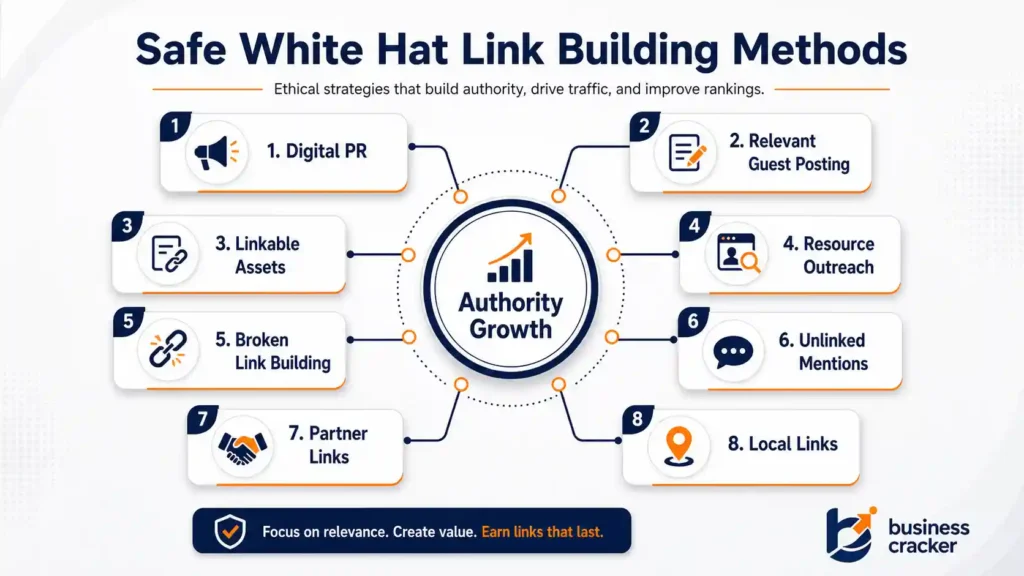
1. Digital PR
Digital PR is one of the cleanest ways to earn high-quality backlinks because the link is tied to a story, data point, expert quote, or useful campaign.
Good digital PR assets include:
- Original surveys
- Industry data
- Local market reports
- Expert commentary
- Founder insights
- Product data
- Trend analysis
- Research summaries
- Visual reports
- Public interest stories
- Useful tools or calculators
Example:
A marketing agency could publish a report on small business SEO budgets. A cybersecurity company could release data on phishing attacks. A local real estate company could analyze home price trends by city.
The asset gives journalists and bloggers something to reference.
Digital PR is not easy. It requires research, a strong angle, clean data, and good outreach. But it is more defensible than buying placements on low-quality guest post sites.
2. Relevant Guest Posting
Guest posting can be white hat when it is done for audience value, expertise, and relevance.
It becomes risky when it is done only to place keyword-rich backlinks at scale.
A safe guest post should meet these standards:
- The website is relevant to your niche
- The topic fits the publisher’s audience
- The article is original
- The content is useful
- The link is natural
- The anchor text is not forced
- The site has editorial standards
- The site is not publishing random guest posts from every industry
- The placement would still be valuable for brand visibility or referral traffic
Google’s qualify outbound links guidance explains when to use sponsored, ugc, and nofollow attributes. If a link is paid or sponsored, the relationship should be handled properly.
That does not make guest posting useless. It means guest posting should be treated as brand building and expert contribution, not a bulk link tactic.
3. Content Link Building
Content link building means creating assets that other websites have a reason to cite.
Strong linkable assets include:
- Original statistics
- Research reports
- Templates
- Checklists
- Calculators
- Free tools
- Industry glossaries
- Comparison guides
- Data visualizations
- Case studies
- Long-form educational guides
- Local resource pages
The mistake many businesses make is publishing basic blog posts and expecting links.
Most standard blog posts do not attract backlinks because they repeat what already exists.
A linkable asset needs one of these qualities:
- Data others can cite
- A tool others can use
- A checklist others can recommend
- A visual others can reference
- A clear answer to a difficult question
- A better version of an outdated resource
For example, Business Cracker could create a backlink quality checklist to support its link building services page. That type of asset could be useful for SEO managers and agencies evaluating link opportunities.
4. Resource Page Outreach
Resource page outreach still works when your page is genuinely useful.
Many websites maintain resource pages for:
- Tools
- Guides
- Local businesses
- Associations
- Industry education
- Templates
- Nonprofit resources
- Startup resources
- Marketing resources
This tactic fails when marketers pitch weak or irrelevant pages.
A strong resource page pitch should explain:
- Why your page fits the list
- What problem it solves
- Who it helps
- Why it adds value
- Where it could fit on the page
Do not ask for a backlink first. Show why the resource deserves inclusion.
5. Broken Link Building
Broken link building is ethical because it helps another website fix a dead link.
The process is simple:
- Find a relevant page with a broken external link.
- Check what the old resource covered.
- Create or identify a better replacement.
- Contact the website owner or editor.
- Mention the broken link.
- Suggest your resource only if it closely matches the old page.
This method works best when the replacement page is genuinely useful.
Do not pitch your homepage as a replacement for every broken link. That is not helpful.
6. Unlinked Brand Mentions
If another website mentions your brand, founder, product, event, or report without linking, you can request a link.
This is one of the safest link building methods because the mention already exists.
Look for mentions of:
- Company name
- Founder name
- Product name
- Report title
- Event name
- Case study
- Podcast appearance
- Expert quote
- Campaign name
Then ask politely if they can add a link for reader context.
This works because the link completes the existing reference.
7. Partner and Vendor Links
Many businesses already have legitimate link opportunities through existing relationships.
Check:
- Suppliers
- Vendors
- Software partners
- Certification providers
- Associations
- Sponsorships
- Event partners
- Franchise networks
- Distributors
- Integration partners
- Client case studies
These links are often safe because they reflect real business relationships.
For example, a SaaS company can earn links from integration partners. A local business can earn links from chambers and associations. An agency can earn links from partner tools or client case studies.
Do not overlook the links you have already earned offline.
8. Local Link Building
Local link building is especially useful for small businesses and service companies.
Good local link sources include:
- Local newspapers
- City blogs
- Chambers of commerce
- Local directories
- Community organizations
- Local event pages
- Sponsorship pages
- Local podcasts
- Schools
- Charities
- Business associations
- Local supplier pages
Local links do not need huge domain metrics to be useful. They need local relevance and trust.
For local SEO, a link from a respected community website may be more useful than a random national blog.
9. Expert Commentary
Expert commentary helps businesses earn mentions and links by sharing useful insight with writers, journalists, and industry publishers.
Good expert commentary is:
- Short
- Specific
- Based on experience
- Non-promotional
- Easy to quote
- Relevant to the article topic
Bad expert commentary sounds like a sales pitch.
This method works well for:
- Founders
- Consultants
- SEO managers
- SaaS teams
- Agencies
- Local experts
- Legal, finance, health, and B2B specialists
If you have practical experience, use it.
10. Case Study Link Building
Case studies can earn links when they include real lessons and data.
A strong case study explains:
- The problem
- The starting point
- The strategy
- What changed
- What was measured
- The outcome
- What others can learn
Case studies can attract links from clients, partners, industry blogs, SaaS tools, and educational resources.
The more specific the case study, the easier it is for others to reference.
What Is Not White Hat Link Building?
Be careful with tactics like:
- Private blog networks
- Bulk directory submissions
- Comment spam
- Forum profile links
- Automated link submissions
- Hacked links
- Hidden links
- Exact-match anchor packages
- Paid dofollow links without disclosure
- Guest post farms
- Link exchanges at scale
- Low quality niche edits
- AI-generated guest posts on irrelevant sites
- Fake news websites
- Domains created only to sell links
Some of these tactics may still produce links. That does not mean they are safe or useful.
White hat link building is not about what you can get away with. It is about building links that make sense.
How to Identify a Link Farm
A link farm is a website or network that exists mainly to place links for SEO purposes.
Signs of a link farm include:
- Articles on unrelated topics
- Many outbound links to commercial websites
- No clear editorial focus
- Thin articles
- No real author expertise
- Generic stock images
- Strange category mix
- Low or declining organic traffic
- Public guest post pricing
- Exact-match anchor links everywhere
- Same layout across many sites
- Articles that read like link containers
- Links to gambling, CBD, crypto, loans, adult, or other unrelated topics
A website does not become high quality because it has a strong metric.
Check the actual pages.
How to Evaluate a Guest Post Site
Before approving a guest post, ask:
- Is the site relevant to our industry?
- Does it have real organic traffic?
- Does it rank for relevant topics?
- Are the articles useful?
- Does the site publish too many guest posts?
- Are outbound links relevant?
- Are authors credible?
- Is the site indexed?
- Does the page have internal links?
- Would this site send referral traffic?
- Would we want our brand mentioned here?
- Does the placement require proper link attributes?
If you would not show the site to a client, stakeholder, or customer, do not build the link.
How to Build a Safe Link Building Process
A safe link building system needs quality control at every stage.
Step 1: Audit the Current Backlink Profile
Before building new links, review existing links.
Check:
- Referring domains
- Link growth pattern
- Anchor text distribution
- Toxic or suspicious links
- Lost links
- Links to commercial pages
- Links to blog pages
- Sitewide links
- Spammy domains
- Competitor comparison
If your backlink profile already has aggressive anchors or risky links, do not add more of the same.
Step 2: Choose Target Pages Carefully
Not every page needs backlinks.
Prioritize pages that have:
- Business value
- Search demand
- Good content
- Clear intent match
- Strong conversion path
- Internal links
- Technical stability
- Ranking potential
Target pages may include:
- Service pages
- Product pages
- Category pages
- Location pages
- Case studies
- Linkable assets
- Guides
- Tools
- Research pages
For example, if your goal is to improve organic visibility, link building should connect with your wider SEO services strategy. If your goal is authority building, your link building services page and supporting content may need stronger off-page signals.
Step 3: Set Link Quality Rules
Define what you will accept and reject.
Your rules may include:
- Minimum topical relevance
- No link farms
- No hacked sites
- No hidden links
- No spam categories
- No sites with zero quality control
- No forced exact-match anchors
- No irrelevant guest posts
- No sites with suspicious outbound link patterns
- No paid links without proper handling
Write these rules before outreach starts.
Step 4: Build Prospect Lists Manually
Tools can help, but they should not make the final decision.
Use tools to find:
- Competitor links
- Resource pages
- Broken links
- Brand mentions
- Industry blogs
- Local sites
- Journalists
- Podcast hosts
- Associations
- Partner pages
Then manually review each opportunity.
Automation can support research. It should not approve links.
Step 5: Use Natural Outreach
White hat outreach should be specific and useful.
A weak outreach email says:
“Hi, I want to publish a guest post on your site.”
A better email says:
“I noticed your guide on local SEO resources includes tools for small businesses. We created a backlink quality checklist that helps business owners avoid spammy link vendors. It may be useful for your readers.”
The second email gives a reason.
Good outreach explains:
- Why you are contacting them
- Why your resource fits
- What value it adds
- Why their audience may care
- What you are asking for
Keep it short. Editors do not need a long pitch.
Step 6: Review Every Placement
Before approving a live link, check:
- Page topic
- Link context
- Anchor text
- Link attribute
- Placement visibility
- Article quality
- Outbound links
- Indexation
- Publisher relevance
- Whether the link looks natural
Do not approve links only because the agency delivered them.
Step 7: Track Results Beyond Link Count
A white hat link building report should include:
- Live URL
- Target URL
- Anchor text
- Link type
- Link attribute
- Placement date
- Website relevance
- Page relevance
- Traffic estimate
- Indexation status
- Outreach status
- Link retention
- Ranking movement
- Organic traffic movement
- Referral traffic
- Leads or assisted conversions where available
If reporting only shows URLs and DA, it is incomplete.
What About Disavowing Spammy Links?
Do not rush to disavow every odd backlink.
Google’s disavow links documentation says the tool is advanced and should be used with caution. Google recommends using it mainly when there is a manual action for unnatural links, or when you believe one is likely because of paid links or other link schemes.
For most businesses, the better first step is:
- Stop risky link building
- Remove links you control
- Avoid repeating the same patterns
- Build stronger, relevant links over time
- Use disavow only when the situation justifies it
If you are unsure, get a proper backlink audit before uploading a disavow file.
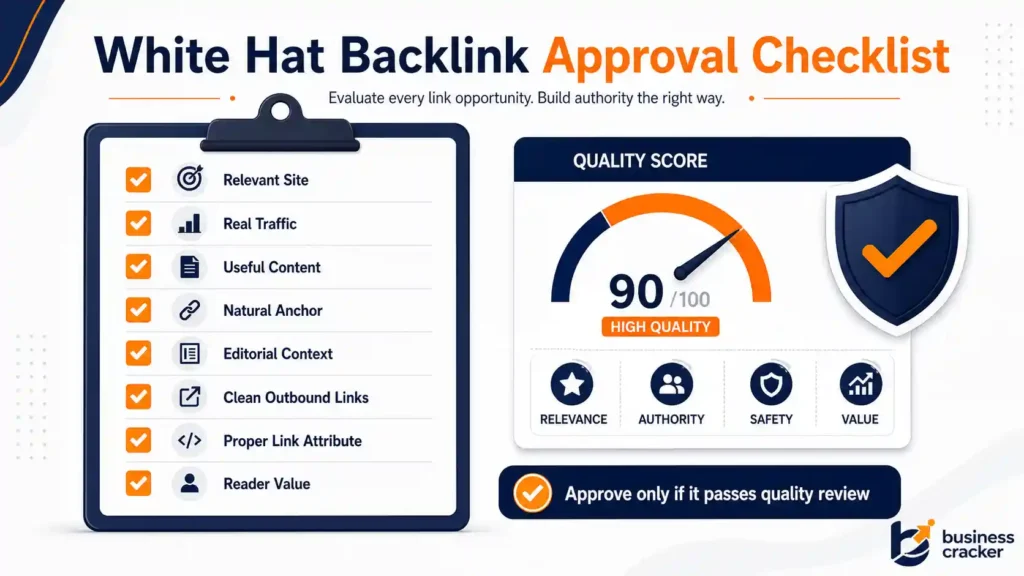
White Hat Link Building Checklist
Use this before approving any link.
- Is the linking site relevant?
- Does the page topic fit our business?
- Is the content useful?
- Is the link placed naturally?
- Is the anchor text safe?
- Does the site have real traffic?
- Is the page likely to be indexed?
- Are outbound links clean?
- Is the site free from obvious spam topics?
- Is the link useful for readers?
- Is the relationship transparent?
- Are paid or sponsored links handled properly?
- Would we be comfortable showing this link publicly?
- Does the link support a real SEO or business goal?
If the link fails several of these checks, reject it.
How White Hat Link Building Fits Into SEO
White hat link building works best when the rest of SEO is already solid.
Before scaling link building, check:
- Technical SEO
- Crawlability
- Indexation
- Page speed
- Content quality
- Search intent
- Internal linking
- Service page clarity
- Conversion path
- Analytics tracking
Backlinks can support authority, but they cannot fix weak content, poor technical SEO, or unclear business pages.
That is why Business Cracker connects link building with SEO services and broader digital marketing services. Link building should support the full growth system, not sit alone in a spreadsheet.
When Should You Hire a Link Building Agency?
Consider professional help if:
- You do not know how to evaluate backlinks
- Your competitors have stronger authority
- You need manual outreach
- You do not have time to build prospect lists
- You want safer guest posting or digital PR
- Your internal team lacks link building experience
- You need reporting and link quality control
- You want to avoid spammy vendors
A good agency should explain its process, quality rules, outreach method, anchor text approach, and reporting.
Business Cracker’s link building services are designed for businesses that want relevant, measurable, and safer authority building instead of bulk backlink packages.
Final Thoughts
White hat link building is not slow because it is outdated. It is slower because it requires judgment.
It takes more work to build high-quality backlinks from relevant websites than to buy a list of placements. But the result is cleaner, safer, and more useful for long-term SEO.
The safest links usually come from real value:
- Useful content
- Expert insight
- Digital PR
- Relevant guest contributions
- Local trust
- Partnerships
- Strong resources
- Real editorial context
Avoid shortcuts that depend on spam, hidden links, bulk guest posts, or fake authority.
If your business wants to build authority without relying on risky backlink tactics, contact Business Cracker to discuss a safer white hat link building strategy for your website.