May 14, 2026
SEO vs Paid Ads: Which Is Better for Business Growth?
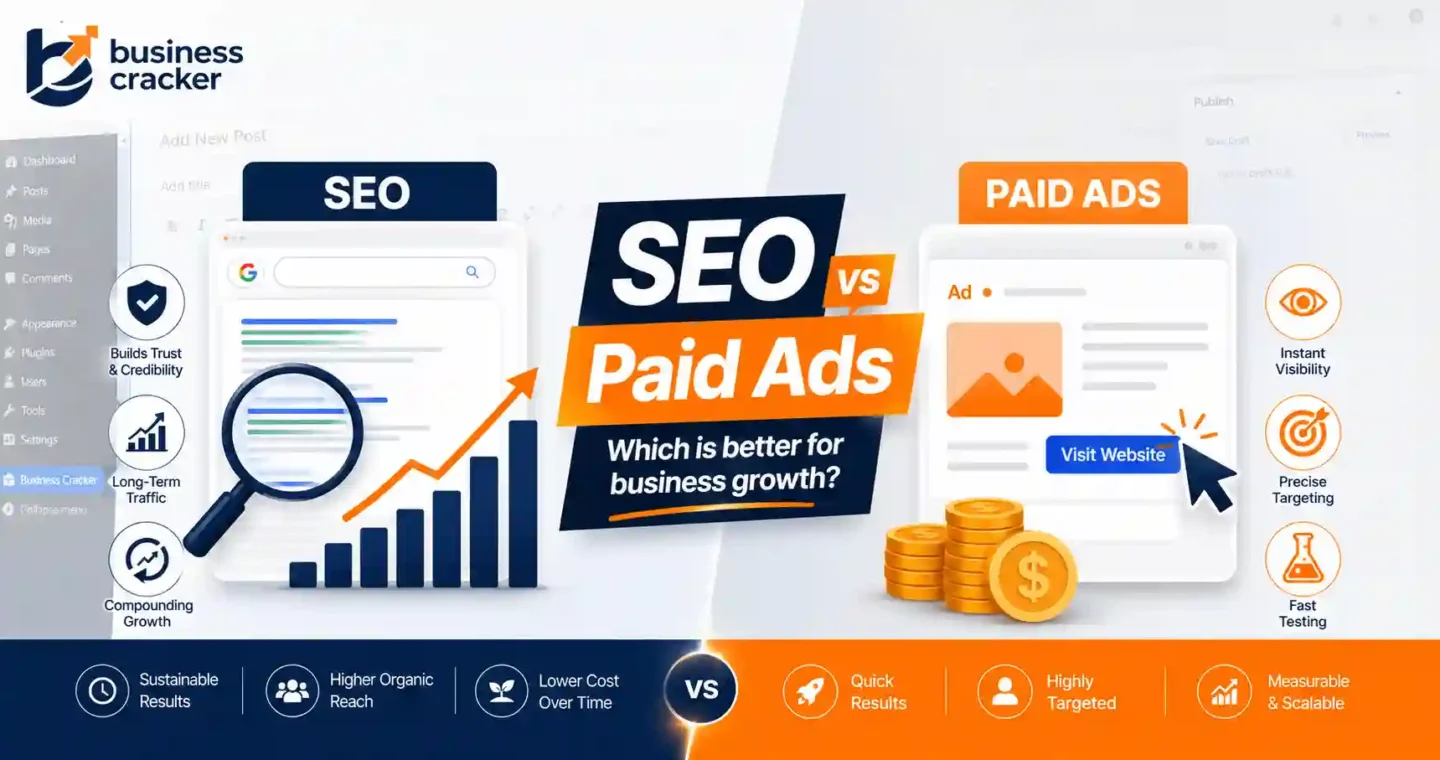
SEO vs paid ads is not a question with one fixed answer. It depends on the business model, timeline, budget, market competition, website quality, offer, and how soon the business needs leads.
For many businesses, the real issue is not choosing one channel forever. It is knowing when SEO should lead, when paid ads should lead, and how both can work together without wasting budget.
Current marketing discussions show the pressure clearly. Businesses are trying to split budgets between SEO, paid ads, and newer search behaviors. Some say ads are the only channel giving immediate results, while SEO is slower but steadier. Others worry that ad costs keep rising, organic traffic is changing, and attribution is becoming harder to trust. One recent growth discussion framed the issue well: ads produced quick wins, SEO was slower but steady, and the budget question became harder because each channel plays a different role.
This article breaks down SEO and paid ads from a practical business point of view.
Quick Answer
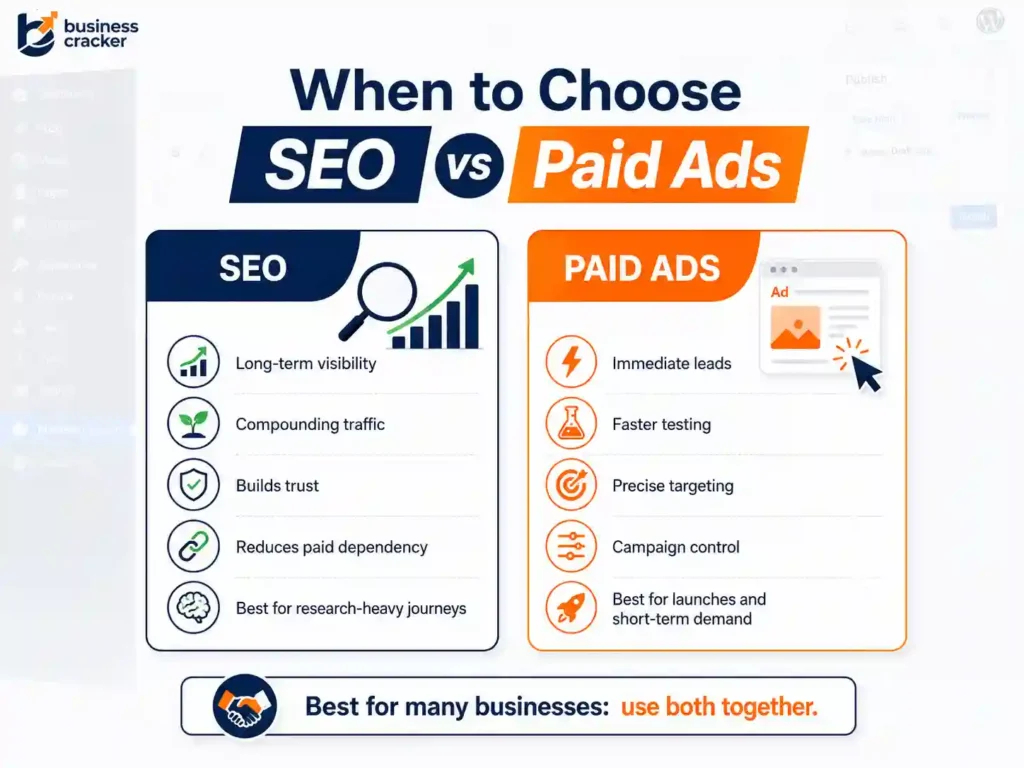
SEO is usually better for long-term visibility, trust, compounding traffic, and reducing dependency on paid traffic over time.
Paid ads are usually better for immediate visibility, faster testing, campaign control, and short-term lead generation.
For most businesses, the strongest growth strategy is not SEO or paid ads alone. It is using SEO to build long-term demand while using paid ads to test offers, capture high-intent traffic, and support the short-term pipeline.
What Is SEO?
SEO, or search engine optimization, is the process of improving a website so search engines can understand it and users can find it through organic search.
Google’s SEO Starter Guide explains SEO as helping search engines understand your content and helping users decide whether to visit your site through search results. Google also notes that some changes can take a few hours, while others can take several months to show impact.
SEO usually includes:
- Technical SEO
- On-page SEO
- Keyword research
- Content strategy
- Internal linking
- Website structure
- Page speed
- Local SEO
- Link building
- Search intent optimization
- Content updates
- Search Console analysis
SEO is not free. It requires time, skill, content, technical work, and often link building. But unlike paid ads, organic visibility can continue to produce traffic even when you are not paying for every click.
For businesses that need stronger organic visibility, SEO services can help with technical fixes, content planning, on-page optimization, and ranking-focused website improvements.
What Are Paid Ads?
Paid ads are campaigns where a business pays platforms to show ads to specific audiences or searchers.
Common paid channels include:
- Google Ads
- Meta Ads
- LinkedIn Ads
- Microsoft Ads
- Display ads
- YouTube ads
- Shopping ads
- Remarketing campaigns
Paid ads can appear in search results, social feeds, websites, apps, videos, and other placements. The main advantage is control. You can choose the audience, location, keyword, budget, creative, landing page, and campaign goal.
Paid ads are usually used for:
- Lead generation
- E-commerce sales
- Product launches
- Consultation requests
- Local service inquiries
- Remarketing
- Offer testing
- Seasonal campaigns
- Demand capture
The weakness is dependency. When the budget stops, traffic usually stops.
For businesses that need better tracking, campaign structure, paid campaign optimization, or Google Ads and Meta Ads support, performance marketing services can help connect ad spend with measurable outcomes.
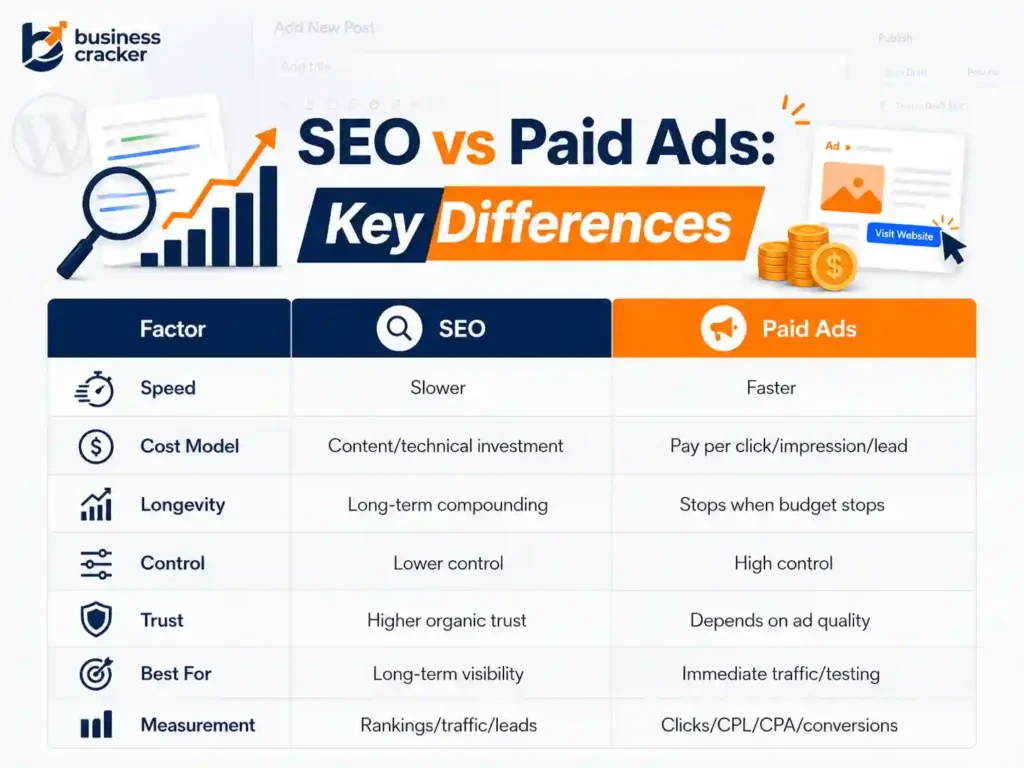
SEO vs Paid Ads: Key Differences
| Factor | SEO | Paid Ads |
| Speed | Slower to show results | Faster visibility |
| Cost model | Investment in content, technical work, and authority | Pay per click, impression, lead, or action |
| Longevity | Can compound over time | Usually stops when budget stops |
| Control | Less control over exact ranking timing | High control over targeting and budget |
| Trust | Often stronger because organic results feel earned | Depends on ad quality, brand, and offer |
| Testing speed | Slower | Faster |
| Best for | Long-term visibility and authority | Immediate traffic and demand capture |
| Risk | Slow returns if execution is weak | Fast budget waste if targeting or landing pages are poor |
| Measurement | Search Console, rankings, traffic, leads | Platform data, tracking, conversions, CPL, CPA |
| Main dependency | Content, technical setup, authority | Budget, tracking, offer, landing page |
Why Businesses Compare SEO and Paid Ads
Most businesses compare SEO and paid ads because both can generate traffic and leads, but they behave differently.
SEO feels slow because it takes time to build topical relevance, improve pages, earn authority, and get search engines to trust the site.
Paid ads feel faster because traffic can start soon after launch. But paid traffic can become expensive if campaigns are not managed well.
WordStream’s 2025 Google Ads Benchmarks reported that the average Google Ads conversion rate across industries was 7.52 percent, while LocaliQ reported the average 2025 search advertising CPC across industries at $5.26 and average CTR at 6.66 percent. These numbers are useful as benchmarks, but actual performance varies heavily by industry, offer, competition, and landing page quality.
That is why the better question is not “Which channel is cheaper?”
The better question is:
Which channel is better for this business goal, at this stage, with this budget and this website?
When SEO Is Better for Business Growth
SEO is usually better when the business needs long-term visibility and wants to reduce paid dependency over time.
1. When Search Demand Already Exists
SEO works well when people are already searching for your products, services, problems, or comparisons.
Examples:
- SEO services
- website design company
- digital marketing agency
- best CRM for small businesses
- local accountant near me
- technical SEO checklist
- Google Ads agency
If search demand exists, SEO can help your website appear when buyers are actively researching.
Paid ads can also capture this demand, but SEO can build a more durable presence if the content and website are strong.
2. When the Buying Journey Is Research Heavy
Some buyers do not convert after one click. They compare options, read guides, check service pages, review case studies, and return later.
SEO works well for research-heavy journeys because it can support multiple stages:
- Awareness: What is the problem?
- Consideration: Which solution works?
- Comparison: SEO vs paid ads, agency vs freelancer, platform A vs platform B
- Decision: Service page, case study, contact page
This is why SEO is valuable for B2B, professional services, education, software, healthcare, finance, home services, and high-ticket purchases.
3. When Trust Matters
Organic visibility can support trust because users often see organic rankings as earned visibility.
That does not mean SEO automatically creates trust. A ranking page still needs useful content, proof, clear service information, and a good user experience.
But for many businesses, appearing in organic search across multiple related topics creates familiarity.
A user may first read a blog, later check a service page, then compare providers, then contact the business.
4. When the Business Wants Compounding Value
SEO can compound.
A strong page can keep bringing traffic long after it is published, especially if it is maintained and supported with internal links and updates.
Paid ads do not usually compound the same way. If every lead depends on new ad spend, the business has less long-term stability.
That does not make paid ads bad. It means SEO and paid ads solve different problems.
5. When Paid Ads Are Too Expensive
In some industries, paid clicks are expensive. Legal, finance, insurance, SaaS, B2B services, healthcare, and competitive local services can all have high CPCs.
If paid acquisition costs are too high, SEO can become a better long-term investment.
But this only works if the business is willing to invest consistently. SEO is not a one-month fix.
When Paid Ads Are Better for Business Growth
Paid ads are better when the business needs speed, controlled testing, or immediate visibility.
1. When You Need Leads Quickly
SEO takes time. Paid ads can generate traffic much faster.
If a business needs leads this month, paid campaigns may be more practical.
Examples:
- A new service launch
- A seasonal offer
- An event registration campaign
- A limited-time promotion
- A new location launch
- A startup testing demand
- A business with no organic visibility yet
Paid ads help test the market before waiting months for organic rankings.
2. When You Need to Test Offers
Paid ads are useful for testing:
- Headlines
- Offers
- Landing pages
- Audience segments
- Geographic markets
- Pricing angles
- CTAs
- Service positioning
SEO is slower for this kind of testing because organic traffic takes time to build.
Paid ads can show faster signals. If an offer performs well in paid campaigns, it may also inform future SEO content and service page copy.
3. When Search Results Are Too Competitive
Some organic keywords are difficult to rank for.
For example, a new website may struggle to rank quickly for:
- digital marketing agency
- SEO agency
- best CRM software
- personal injury lawyer
- ecommerce platform
Paid ads can help a business appear for competitive queries while SEO builds slowly in the background.
4. When You Need Precise Targeting
Paid ads allow more targeting control.
Depending on the platform, you can control:
- Location
- Device
- Audience
- Keywords
- Time of day
- Demographics
- Remarketing lists
- Company type
- Job roles
- Interests
- Budget pacing
SEO cannot provide the same immediate targeting control.
5. When You Have a Strong Landing Page and Tracking
Paid ads work best when tracking and landing pages are ready.
Google Ads explains that conversion tracking helps advertisers understand which ads drive valuable customer actions, such as purchases, quote requests, phone calls, sign-ups, and other actions.
If tracking is weak, paid ads become hard to judge.
If landing pages are weak, paid ads become expensive.
If both are strong, paid campaigns can provide fast and useful learning.
When SEO Performs Poorly
SEO can fail when the website foundation is weak.
Common SEO problems include:
- Thin service pages
- Poor technical SEO
- Weak internal links
- Slow pages
- No keyword mapping
- Duplicate content
- Poor search intent match
- No authority or backlinks
- No content updates
- No clear topical strategy
- Pages not indexed properly
A business should not expect SEO results just because blogs are published. SEO needs structure, relevance, and consistency.
When Paid Ads Perform Poorly
Paid ads can fail quickly when the campaign setup or landing page is weak.
Common paid ad problems include:
- Broad targeting
- Wrong keywords
- No negative keywords
- Poor conversion tracking
- Weak landing page
- Slow mobile experience
- Unclear offer
- Low trust
- Bad form design
- Poor lead quality
- Optimizing for the wrong conversion
- No sales feedback loop
Google says Quality Score can help identify areas for improvement across ads, keywords, and landing pages, and should be treated as a diagnostic tool rather than a score to optimize blindly. It also identifies landing page experience as how relevant and useful the page is to people who click the ad.
If paid ads are getting clicks but not conversions, the issue may not be the ad platform. It may be the landing page, offer, tracking, or lead quality.
SEO vs Paid Ads by Business Stage
New Business
A new business often needs visibility fast.
Recommended approach:
- Use paid ads for immediate demand capture
- Build SEO foundations at the same time
- Create core service pages
- Publish educational content
- Set up tracking properly
- Avoid relying only on ads
Paid ads can test which services and messages get attention. SEO can build long-term visibility from the start.
Growing Business
A growing business usually needs both.
Recommended approach:
- Use SEO to build authority and reduce long-term cost per lead
- Use paid ads for priority services and market testing
- Improve landing pages
- Track qualified leads
- Build comparison content
- Use Search Console and ad data together
At this stage, the main mistake is running SEO and paid ads in separate silos.
Established Business
An established business should use both channels strategically.
Recommended approach:
- Use SEO for brand authority and category coverage
- Use paid ads for high-value campaigns, retargeting, and offer testing
- Use paid search to cover gaps where organic rankings are weak
- Use organic data to improve ad keyword targeting
- Use paid campaign data to improve SEO pages
For mature businesses, the goal is not to choose one channel. The goal is budget efficiency across channels.
SEO vs Paid Ads by Goal
Goal: Fast Leads
Paid ads are usually better.
If the business needs to make inquiries quickly, paid campaigns can be launched faster than SEO can rank.
But this only works if the landing page and tracking are ready.
Goal: Long-Term Traffic
SEO is usually better.
If the business wants steady organic visibility over months and years, SEO is the better long-term channel.
Goal: Testing a New Service
Paid ads are usually better first.
Paid campaigns can test demand before the business invests heavily in long-form content or SEO pages.
Goal: Reducing Lead Cost Over Time
SEO is usually better.
Paid ads may keep producing leads, but each click has a cost. SEO can reduce dependency on paid channels if the site earns stable organic traffic.
Goal: Launching a Time-Sensitive Offer
Paid ads are usually better.
SEO is usually too slow for urgent campaigns.
Goal: Building Trust
SEO often has an advantage.
Useful organic content, service pages, case studies, and comparison pages can help users evaluate the business before contacting.
Goal: Scaling Proven Demand
Use both.
Paid ads can scale what already works. SEO can build long-term coverage around the same topics.
Why SEO and Paid Ads Work Better Together
The strongest businesses rarely treat SEO and paid ads as enemies.
They use each channel for what it does best.
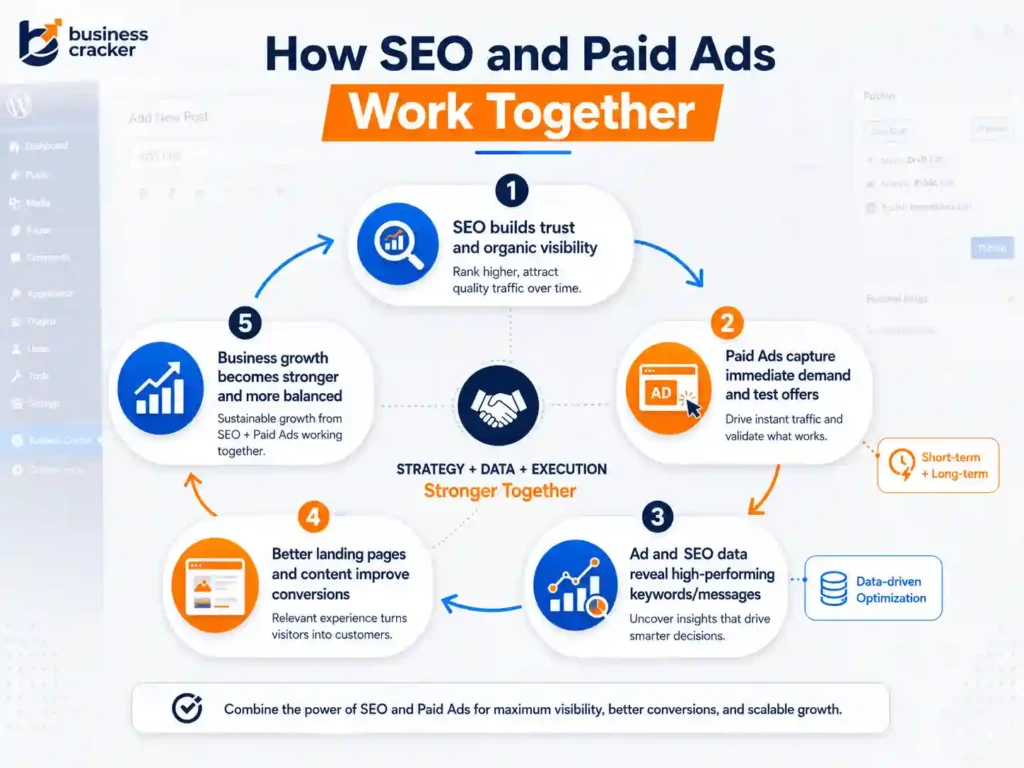
Paid Ads Can Inform SEO
Paid campaigns can show:
- Which keywords convert
- Which offers attract leads
- Which locations perform
- Which landing page messages work
- Which questions users ask
- Which audience segments respond
That data can improve SEO content, service pages, meta titles, and CTAs.
SEO Can Improve Paid Ads
SEO can improve paid performance by strengthening:
- Landing page quality
- Content clarity
- Page speed
- Service page depth
- Trust signals
- Internal linking
- Keyword understanding
- Conversion path
A better website often helps paid traffic convert more efficiently.
Organic and Paid Visibility Can Support Each Other
When users see a brand in both paid and organic results, it can increase familiarity.
For high-intent searches, appearing in both areas can support trust and a click opportunity.
This does not mean every keyword needs both. It means the business should evaluate where paid and organic visibility overlap profitably.
How to Decide Budget Split Between SEO and Paid Ads
There is no universal budget split.
Use these factors.
Timeline
If you need leads now, allocate more to paid ads.
If you can invest for long-term growth, allocate more to SEO.
Current Website Quality
If your website is weak, fix SEO and landing pages before scaling ads.
Search Demand
If people already search for your service, both SEO and paid search can work.
If demand is low, paid social, content, and awareness campaigns may be needed.
Competition
If SEO competition is high, paid ads can create visibility while organic work builds.
If paid clicks are too expensive, SEO may become more attractive.
Budget Size
Small budgets should not be spread too thin.
It may be better to focus on one or two high-intent paid campaigns while building SEO foundations gradually.
Sales Cycle
Longer sales cycles usually benefit from SEO content, retargeting, comparison pages, and trust-building assets.
Shorter sales cycles may work well with direct paid campaigns.
Tracking Maturity
If tracking is weak, do not scale paid ads aggressively.
Fix conversion tracking first.
Practical Budget Examples If You Need Leads in 30 Days
Prioritize paid ads, but do not ignore SEO.
Suggested focus:
- 70 percent paid ads
- 30 percent SEO and landing page improvements
Use paid ads for immediate traffic. Use SEO work to improve pages and reduce future dependency.
If You Want Long-Term Growth
Prioritize SEO while keeping paid campaigns controlled.
Suggested focus:
- 60 percent SEO
- 40 percent paid ads
Use SEO for content, service pages, technical improvements, and authority. Use paid ads for testing and priority campaigns.
If Your Website Is Weak
Prioritize website and SEO foundations first.
Suggested focus:
- Fix service pages
- Improve website speed
- Add conversion tracking
- Create key content
- Then run paid campaigns
Sending paid traffic to a weak website usually wastes budget.
If You Already Have Organic Traffic
Use paid ads to support pages and offers that are not yet ranking.
Suggested focus:
- Use SEO to maintain and expand visibility
- Use paid ads for high-value gaps
- Use remarketing for users who visited organic pages
This is often a strong growth model.
What Business Managers Should Ask Before Choosing
Before deciding between SEO and paid ads, ask:
- How fast do we need leads?
- What is our monthly marketing budget?
- Is our website ready to convert traffic?
- Do we have proper tracking?
- Which services are most profitable?
- Do people already search for what we offer?
- What does a qualified lead look like?
- Can our team follow up quickly?
- How competitive is the market?
- Are we trying to test demand or build authority?
These questions are more useful than asking which channel is better in general.
What Marketers Should Watch
Marketers should avoid reporting only surface-level metrics.
For SEO, do not stop at:
- Traffic
- Rankings
- Blog count
- Impressions
Also track:
- Qualified organic leads
- Service page traffic
- Assisted conversions
- Query growth
- Page-level conversion paths
- Indexed pages
- CTR improvements
For paid ads, do not stop at:
- Clicks
- CTR
- CPC
- Leads
Also track:
- Qualified leads
- Cost per qualified lead
- Sales feedback
- Landing page conversion rate
- Search terms
- Budget waste
- Conversion accuracy
Both channels need business context.
What Software Engineers Should Watch
Software engineers and developers play an important role in both SEO and paid performance.
For SEO, they should check:
- Crawlability
- Indexability
- Canonicals
- Redirects
- Page speed
- Structured data
- URL changes
- Mobile rendering
- Internal link implementation
For paid ads, they should check:
- Conversion tracking
- Form events
- Thank you pages
- UTM handling
- Page speed
- Tag loading
- Consent setup
- CRM integration
- Landing page stability
Marketing fails when implementation is treated as an afterthought.
Common Mistakes in SEO vs Paid Ads Decisions
Mistake 1: Expecting SEO to Work Like Ads
SEO is not instant. It needs time, consistency, and page quality.
Mistake 2: Expecting Ads to Fix a Weak Website
Paid ads can send traffic, but they cannot force users to trust a poor landing page.
Mistake 3: Cutting SEO Because Ads Are Faster
Ads may solve short-term demand, but relying only on ads can create long-term dependency.
Mistake 4: Running Ads Without Tracking
If conversions are not tracked properly, performance data becomes unreliable.
Mistake 5: Publishing SEO Content Without Conversion Paths
A blog that gets traffic but never links to services may not support business growth.
Mistake 6: Comparing Channels Only by Cost Per Lead
Lead quality matters. A cheaper lead is not better if it does not convert into business.
Mistake 7: Treating SEO and Paid Teams Separately
SEO and paid teams should share keyword, landing page, and conversion data.
The Best Strategy for Most Businesses
For most businesses, the best approach is:
- Build SEO foundations
- Use paid ads for fast learning and demand capture
- Improve landing pages
- Track qualified leads
- Use paid data to improve SEO
- Use SEO pages to improve paid conversion
- Rebalance budget based on actual results
This is how SEO and paid ads become a growth system instead of two separate activities.
Business Cracker looks at this through connected digital marketing services across SEO, performance marketing, website design, and conversion planning.
Final Thoughts
SEO vs paid ads is not a winner-takes-all decision. SEO builds long-term visibility and trust. Paid ads create faster traffic and controlled testing. Both can support business growth when they are planned around the same goals.
The right choice depends on timing, budget, search demand, website quality, tracking, and lead quality. If your business needs immediate inquiries, paid ads may lead. If your business wants durable visibility, SEO should not be delayed. If you want stronger growth, use both with clear measurement.
If you are unsure whether your business should invest in SEO, paid ads, or both, contact Business Cracker for a practical review of your website, campaigns, tracking, and growth priorities.
FAQs
Is SEO better than paid ads?
SEO is better for long-term visibility, trust, and compounding traffic. Paid ads are better for immediate visibility, faster testing, and short-term lead generation. The better choice depends on your timeline, budget, website quality, and business goal.
Are paid ads faster than SEO?
Yes. Paid ads can start sending traffic soon after launch, while SEO usually takes longer because search engines need time to crawl, index, evaluate, and rank pages. However, paid ads stop when the budget stops.
Should a small business invest in SEO or paid ads first?
If the business needs leads quickly and has a strong landing page, paid ads may come first. If the website is weak or the business wants long-term organic visibility, SEO should start early. Many small businesses need a small paid campaign plus SEO foundations.
Can SEO reduce paid ad costs?
SEO can reduce dependency on paid ads over time by bringing organic traffic to service pages, blog posts, and comparison content. It may not directly reduce CPC, but it can lower the need to pay for every visitor.
Why are my paid ads getting clicks but no leads?
Common reasons include poor landing page experience, weak message match, unclear CTA, slow mobile speed, broad targeting, wrong keywords, low trust, broken tracking, or an offer that does not match user intent.
Can SEO and paid ads work together?
Yes. Paid ads can test keywords, offers, and landing pages quickly. SEO can use that data to improve content and service pages. SEO can also build long-term visibility while paid ads support immediate campaigns.