April 28, 2026
How to Choose the Right Digital Marketing Agency for Your Business?
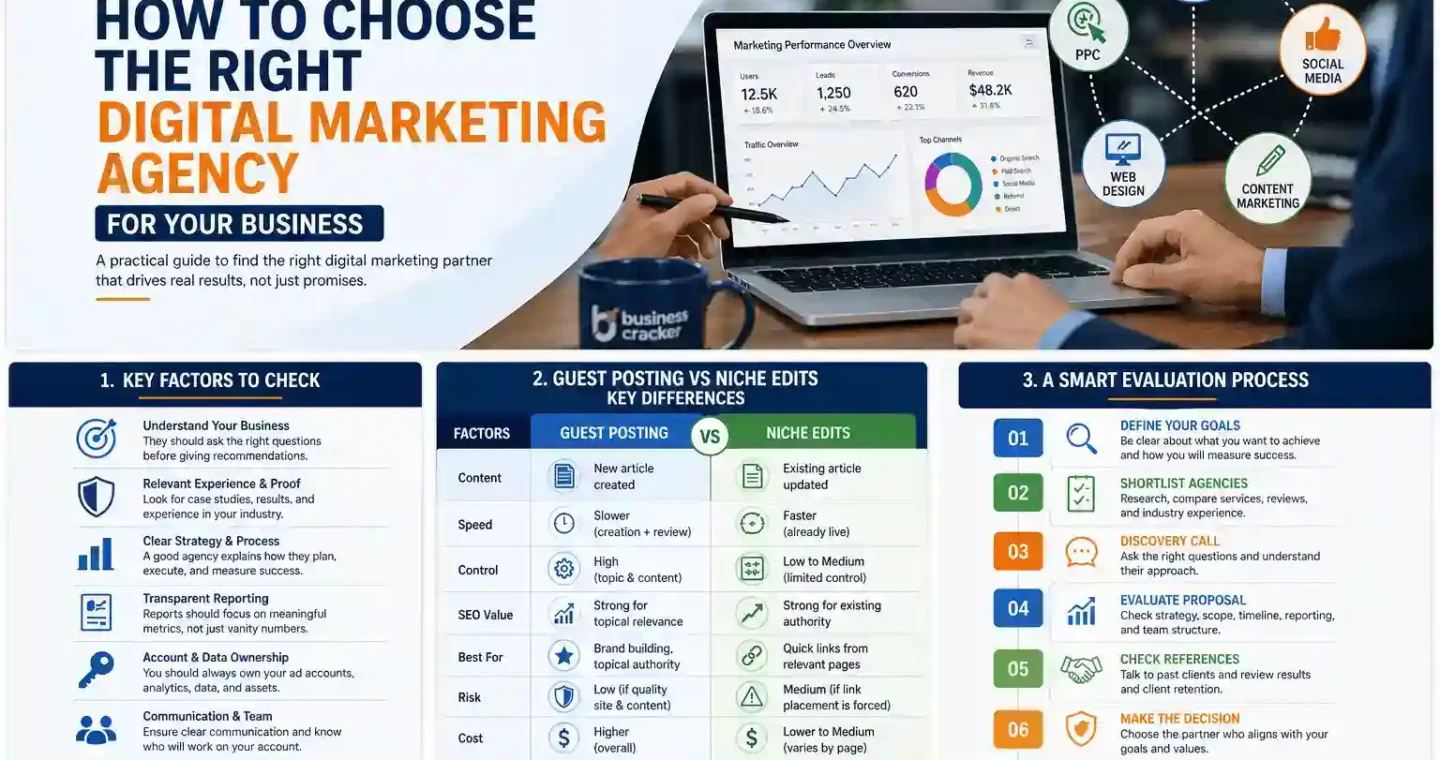
Choosing a digital marketing agency is not a small vendor decision. It affects how your website is positioned, how paid budgets are spent, how leads are measured, and how your business shows up across search, social, and conversion channels.
The hard part is not finding an agency. The hard part is filtering the good ones from agencies that sell activity as progress. Many businesses still complain about vague reports, poor lead quality, inflated metrics, unclear ownership of ad accounts, and monthly work that looks busy but does not move revenue. Recent community discussions show recurring concerns around agencies charging for basic social posts, focusing on cheap leads instead of qualified leads, holding ad accounts hostage, and using jargon to hide weak execution.
This guide explains how to choose a digital marketing agency with a practical evaluation process. The goal is not to pick the agency with the best pitch. The goal is to choose a partner that understands your business, can explain the work clearly, and can connect marketing activity to commercial outcomes.
The Problem This Article Solves
Most businesses start agency selection from the wrong place. They ask:
- How much do you charge?
- How many posts will you create?
- How many backlinks will you build?
- How fast can you rank us?
- How many leads can you generate?
These questions are not useless, but they are incomplete.
A better agency selection process starts with business fit, channel fit, proof, process, reporting, account access, and how the agency defines success.
The wrong agency can waste time and budget, even if it looks active every month. The right agency can help you prioritize the channels that matter, improve website visibility, make paid campaigns more accountable, and build a cleaner digital growth system.
Desired Reader Outcome
After reading this article, you should be able to:
- Know what to check before hiring a digital marketing agency
- Identify common red flags in agency pitches
- Understand which services your business actually needs
- Ask better questions during agency discovery calls
- Compare agencies beyond pricing and portfolio screenshots
- Decide whether a full-service agency, SEO agency, paid ads specialist, or online marketing company is the right fit
What Does a Digital Marketing Agency Do?
A digital marketing agency helps businesses improve online visibility, attract the right audience, and convert that audience into leads, sales, or measurable business outcomes.
A good agency may support areas such as:
- SEO
- Content strategy
- Paid search
- Paid social
- Website design
- Landing page optimization
- Conversion tracking
- Social media optimization
- Online reputation management
- Analytics and reporting
- Link building
- Campaign strategy
Business Cracker, for example, offers practical digital marketing services across SEO, link building, performance marketing, web design, SMO, and ORM.
But not every business needs every service immediately. The right agency should help you prioritize, not push every available service into the first proposal.
Why Choosing the Right Agency Matters More in 2026
Digital marketing has become more competitive, more technical, and more expensive to manage badly.
Clutch’s State of Digital Marketing 2025 report says digital marketing continues to expand as businesses adapt to AI, privacy changes, platform consolidation, and mobile-first behavior. The same report notes that global digital marketing was valued at $410.66 billion in 2024 and is projected to surpass $1.1 trillion by 2033. It also states that mobile channels captured 66 percent of all digital marketing spend in 2024.
That means businesses are not only competing with local competitors. They are competing in crowded search results, paid platforms, social feeds, review platforms, and AI-influenced discovery paths.
The wrong agency can turn that complexity into confusion. The right agency makes decisions clearer.
Step 1: Define the Business Goal Before Looking for an Agency
Do not start by asking for a service package. Start by defining the business problem.
Clutch also recommends defining your marketing goals first, then setting a budget, researching potential partners, interviewing shortlisted agencies, and narrowing the selection before hiring.
Common goals include:
- Increase qualified leads
- Improve organic visibility
- Reduce wasted ad spend
- Improve website conversion rate
- Build brand trust
- Improve local search presence
- Generate e-commerce sales
- Improve reputation and reviews
- Build a stronger content and SEO foundation
Clutch’s agency selection guidance also recommends that businesses determine goals before hiring a digital marketing company, because different businesses need different support based on campaign type, audience, and growth stage.
A clear goal helps you avoid vague proposals.
Weak goal:
“We need digital marketing.”
Better goal:
“We need to increase qualified website leads from organic search and paid campaigns over the next six months, while improving tracking and landing page conversion.”
That second goal gives an agency something real to respond to.
Step 2: Decide Which Services You Actually Need
Not every business needs a full-service agency from day one.
A new website may need SEO foundations and web design improvements before paid campaigns. A business already getting traffic may need conversion rate improvements. A company spending heavily on ads may need performance marketing and tracking cleanup. A service business with weak visibility may need SEO and content first.
Review your current situation.
Choose SEO if:
- Your website has low organic visibility
- Important pages are not ranking
- You rely too much on paid ads
- Your service pages are thin
- Your content lacks keyword direction
- Your website has indexing or technical issues
In that case, review SEO services first.
Choose performance marketing if:
- You want faster campaign testing
- You already have landing pages
- You have a defined offer
- You can track leads or sales properly
- You need Google Ads or Meta Ads support
- You want better budget control
In that case, review performance marketing services.
Choose web design if:
- Your website looks outdated
- Visitors are not converting
- Pages are hard to use on mobile
- Your landing pages are weak
- The site structure is confusing
- Your design does not support trust
In that case, review web design services.
Choose a broader service plan if:
- You need SEO, paid media, design, and conversion support together
- Your internal team needs execution support
- You want one team to manage multiple channels
- You need a structured growth plan
In that case, review the full digital marketing services page.
Step 3: Check Whether the Agency Understands Your Business Model
A good agency should ask specific questions before giving a recommendation.
They should ask about:
- Your target customers
- Sales cycle
- Average order value or deal size
- Main services or products
- Current marketing channels
- Website performance
- Lead quality
- Conversion process
- Sales follow-up
- Budget
- Competitors
- Geographic focus
- Internal team capacity
If an agency gives a full proposal before understanding these areas, be careful.
A B2B consulting business does not need the same strategy as a local clothing store. A healthcare company does not need the same campaign structure as an e-commerce brand. A startup does not need the same reporting model as an established service company.
Business fit matters.
Step 4: Review Their Own Website Critically
An agency’s own website is not perfect proof of skill, but it is useful evidence.
Check:
- Is the message clear?
- Are services explained properly?
- Is the website fast and usable?
- Is the design trustworthy?
- Are there real pages for core services?
- Are there case studies or proof points?
- Is the contact path clear?
- Does the content sound practical or generic?
- Does the agency explain how it works?
If an SEO agency has no clear service pages, no useful content, and a weak website structure, ask why.
If an online marketing company promises conversion improvements but its own site has poor CTAs, unclear layout, or no trust signals, that is also a concern.
Step 5: Ask for Proof, Not Just Claims
Do not ask only, “Can you show results?”
Ask for proof that connects work to business outcomes.
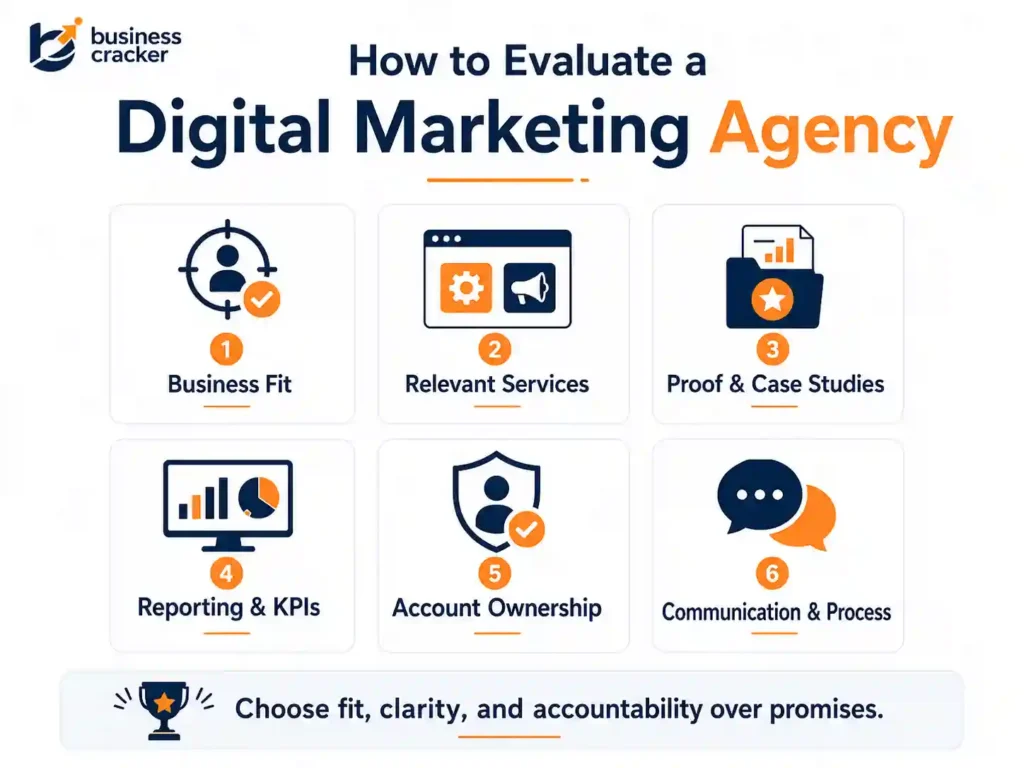
Useful proof may include:
- Case studies
- Before and after traffic data
- Ranking improvements
- Lead quality improvements
- Campaign performance reports
- Landing page improvements
- Conversion tracking examples
- Client retention examples
- Content examples
- Link building samples
- Website design examples
Do not expect every agency to share private client revenue data. But they should be able to explain the problem, work done, and outcome clearly.
Weak proof:
“We helped many clients grow.”
Better proof:
“The client had weak service page visibility. We improved the technical structure, rewrote core pages, added internal links, and built relevant backlinks. Organic impressions increased, and leads from organic pages became more consistent.”
Step 6: Understand Their Reporting Process
Reporting is where many agency relationships fail.
A report should not only show activity. It should explain what changed, what worked, what did not work, and what should happen next.
For SEO, reporting may include:
- Organic traffic
- Search Console impressions
- Clicks
- CTR
- Ranking movement
- Indexed pages
- Top landing pages
- Technical issues
- Content updates
- Backlinks earned
- Conversion data
For paid campaigns, reporting may include:
- Spend
- Clicks
- CPC
- Conversions
- Cost per lead
- Lead quality
- Conversion rate
- Search terms
- Audience performance
- Budget waste
- Landing page insights
For website projects, reporting may include:
- Page speed
- Mobile usability
- CTA performance
- Form submissions
- User journey issues
- Page-level recommendations
A strong agency should explain metrics in business language. A weak agency hides behind dashboards.
Step 7: Make Lead Quality Part of the KPI
This is one of the biggest problems in paid marketing and lead generation.
An agency can generate many leads while still hurting the business if those leads are of low quality. In recent marketing discussions, practitioners warned that agencies may optimize for cheap leads and report success even when the sales team receives poor-quality inquiries. The practical recommendation was to connect KPIs to revenue or sales qualified leads, not only form fills or cost per lead.
Ask the agency:
- How do you define a qualified lead?
- How will we track lead source?
- How will we separate spam from real inquiries?
- How will sales feedback be included?
- Will reporting include lead quality?
- How often will we review conversion data?
If the agency refuses to discuss lead quality, that is a red flag.
Step 8: Confirm Account and Data Ownership
Your business should own its key marketing assets.
This includes:
- Google Ads account
- Meta Ads account
- Google Analytics
- Google Search Console
- Google Tag Manager
- Website admin access
- Domain and hosting
- Landing pages
- Creative assets where agreed
- Reporting dashboards
A common agency red flag is holding ad accounts hostage or running campaigns from the agency’s own account without clear ownership. Practitioners in PPC communities repeatedly mention account access, double-counted conversions, and poor account control as serious agency risks.
Before signing, confirm:
- Who owns the ad account?
- Who owns the tracking setup?
- Who owns landing pages?
- Who owns content?
- What happens if the contract ends?
- Can you export campaign and analytics data?
A trustworthy agency should not make your business dependent on hidden access.
Step 9: Check Their Discovery Questions
Good agencies ask uncomfortable questions. They do not agree on everything to close the deal.
A strong discovery call should include questions like:
- What is your current conversion rate?
- Which services are most profitable?
- What does a good lead look like?
- What is your sales close rate?
- Which competitors do you lose to?
- What marketing has failed before?
- What is your monthly budget?
- What timeline do you expect?
- Who will approve content and campaigns?
- What internal resources are available?
If an agency only praises your brand and says everything is easy, be cautious.
Good strategy often starts with pushback.
Step 10: Evaluate Their Channel Judgment
The right agency should know when not to use a channel.
For example:
- SEO may not be the fastest option if you need leads in two weeks.
- Paid ads may waste money if the landing page is poor.
- Social media may not drive direct leads for every B2B service.
- Web design may be needed before conversion campaigns.
- Link building may not help if the target pages are weak.
- Content may not work if there is no search intent or distribution plan.
A good digital marketing agency does not sell every service as equally urgent. It sequences work.
Business Cracker, for example, positions its work around practical service planning across SEO, ads, web design, and related growth channels, rather than treating every channel as a standalone activity.
Step 11: Ask How They Handle SEO
If you are hiring an SEO agency or an agency that includes SEO, ask detailed questions.
Ask:
- How do you choose target keywords?
- How do you map keywords to pages?
- How do you audit technical SEO?
- How do you improve existing service pages?
- How do you handle internal linking?
- How do you measure organic performance?
- How do you approach backlinks?
- How do you avoid duplicate or thin content?
- How do you report Search Console data?
A serious SEO agency should discuss technical SEO, on-page SEO, content quality, internal links, and authority. If the answer is only “we will add keywords and build backlinks,” that is too shallow.
Step 12: Ask How They Handle Paid Campaigns
For performance marketing, ask:
- Which platforms do you recommend and why?
- How will conversion tracking be set up?
- Who owns the ad account?
- How will campaign structure be built?
- How will search terms or audience data be reviewed?
- How often will budgets be adjusted?
- How will fake or low-quality leads be filtered?
- Will reports show qualified leads or only conversions?
Google Ads explains that conversion measurement helps advertisers identify which ads drive valuable customer actions, such as purchases, sign-ups, or signed contracts.
Paid campaigns can produce quick data, but they can also waste money quickly. The agency should show how it controls waste.
Step 13: Ask How They Handle Website and Landing Pages
A marketing agency should understand that traffic alone is not enough.
Ask:
- Will you review landing pages before running ads?
- Will you check mobile usability?
- Will you improve CTAs?
- Will you review forms?
- Will you check the site speed?
- Will you align design with SEO and conversion?
- Will you create separate landing pages for campaigns?
A website that does not convert can make both SEO and ads look weaker than they are.
Step 14: Review Their Communication Style
Good communication is not about long meetings. It is about clarity.
Look for:
- Clear timelines
- Simple reporting
- Specific next steps
- Honest risk discussion
- Direct explanations
- No hiding behind jargon
- Consistent account ownership
- Proper documentation
Ask who will manage your account. Ask whether the senior person from the sales call will stay involved. One common red flag discussed by marketers is when senior people appear during the pitch, but the work is handed to junior staff without proper oversight.
That does not mean junior team members are bad. It means the agency should be honest about who does what.
Step 15: Understand Pricing and Scope
A lower price is not automatically better. A higher price is not automatically proof of quality.
Compare the scope carefully.
Check:
- What is included?
- What is excluded?
- How many meetings are included?
- How many pages or campaigns are included?
- How many content pieces are included?
- Who writes copy?
- Who designs landing pages?
- Who handles tracking?
- Who approves changes?
- Are ad budgets separate?
- Are tools billed separately?
- What happens if priorities change?
Many agency problems happen because the scope was not clear at the start.
Red Flags When Choosing a Digital Marketing Agency
Avoid agencies that:
- Promise guaranteed rankings
- Promise instant SEO results
- Focus only on vanity metrics
- Avoid discussing lead quality
- Refuse to share reporting details
- Use their own ad accounts without a clear reason
- Do not give you data access
- Cannot explain their process
- Use vague packages with no strategy
- Push every service at once
- Avoid technical questions
- Use too much jargon
- Have no case studies or examples
- Do not ask about your business model
- Lock you into long contracts too early
No agency can guarantee exact rankings, exact lead volume, or exact revenue outcomes. They can guarantee process quality, transparency, communication, and execution standards.
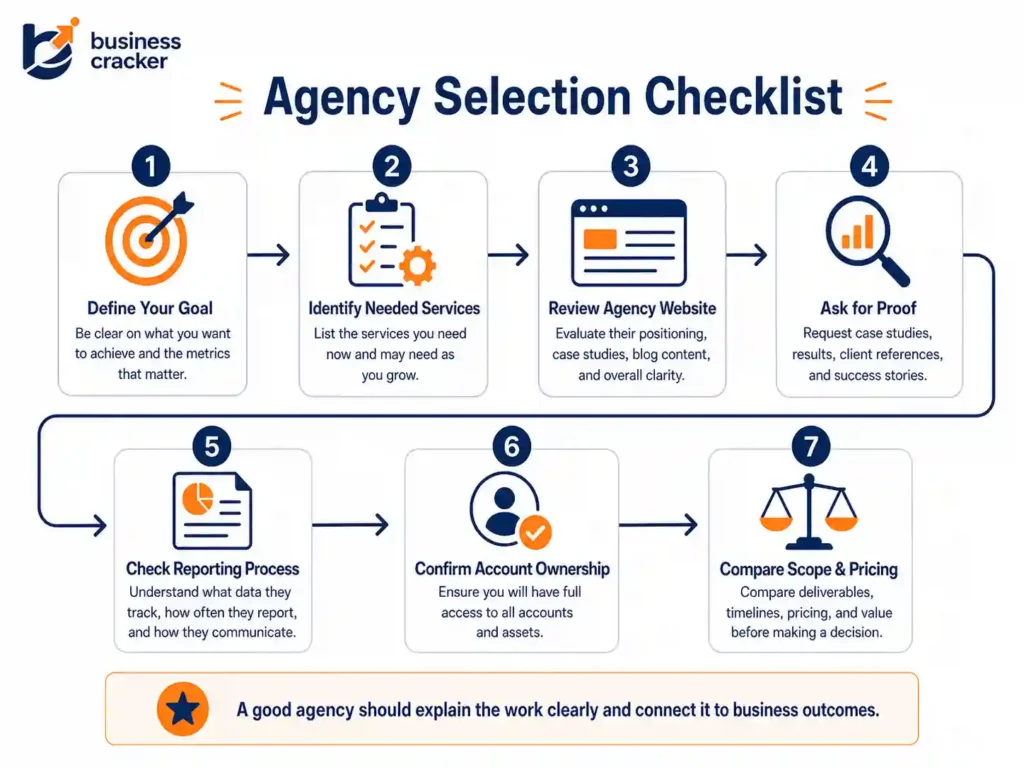
Questions to Ask Before Hiring a Digital Marketing Agency
Use these questions in your discovery call.
Business Fit
- Have you worked with businesses like ours?
- What would you prioritize first and why?
- What should we not spend on right now?
- What does success look like in the first 90 days?
SEO
- How will you audit our website?
- Which pages should we improve first?
- How will you choose keywords?
- How will you handle technical SEO?
- How will you report organic progress?
Paid Marketing
- Which channels should we test first?
- How will you set up conversion tracking?
- How will you measure lead quality?
- How will you reduce wasted spend?
- Who owns the ad accounts?
Web Design
- Will you review conversion issues?
- How will you improve the mobile experience?
- Will landing pages be built for SEO and paid campaigns?
- How will design changes be measured?
Reporting
- What will the monthly report include?
- How often will we meet?
- Will reports include business outcomes?
- How will you explain poor performance?
- What data access will we have?
What a Good Agency Proposal Should Include
A serious proposal should include:
- Business understanding
- Current website or channel observations
- Recommended priorities
- Scope of work
- Timeline
- Deliverables
- Reporting method
- Team responsibilities
- Pricing
- Assumptions
- What the client must provide
- Risks and dependencies
- First 30 to 90-day plan
A weak proposal usually lists services without explaining why they matter.
When Should You Hire a Full-Service Digital Marketing Agency?
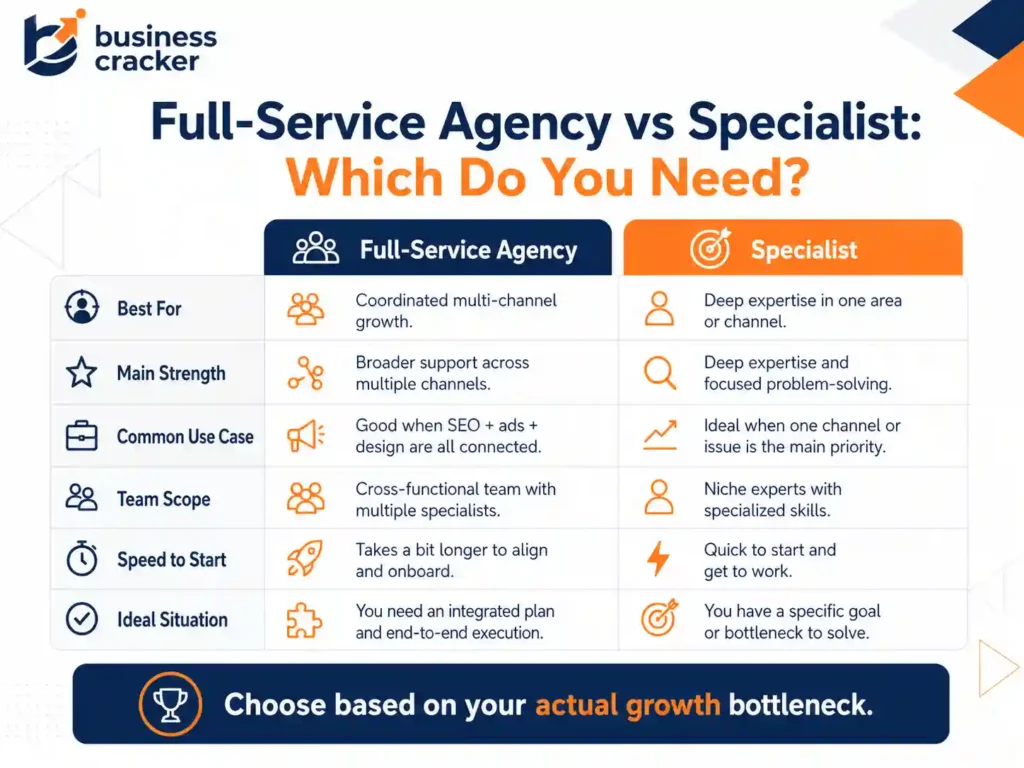
A full-service agency can be useful when your business needs coordinated support across multiple channels.
This may include:
- SEO
- Paid ads
- Website design
- Landing pages
- Content
- Reporting
- Conversion tracking
But full service only works when the agency has real capability across those areas. Some agencies call themselves full-service but outsource most work without strong quality control.
If your need is narrow, a specialist may be better. If your need is connected across channels, a full-service partner can be more efficient.
When Should You Hire a Specialist Instead?
Hire a specialist when:
- Your SEO is the main problem
- Your paid campaigns need expert cleanup
- Your website design is blocking conversions
- Your analytics setup is broken
- You need a technical audit
- You already have an internal marketing team
- You need expert support in one area only
A business with a strong in-house team may not need a full agency. It may need specialist support for SEO, paid media, analytics, or website optimization.
How Business Cracker Approaches Digital Marketing
Business Cracker is built around practical digital marketing work for business websites. The focus is not only on traffic, but on visibility, website structure, service page clarity, campaign readiness, and measurable growth support.
The service areas include:
- SEO
- Link building
- SMO
- Performance marketing
- Web design
- ORM
For businesses that need a structured starting point, the best first step is usually a review of the website, service pages, current traffic sources, conversion path, and priority channels. That helps decide whether the next move should be SEO, ads, web design, or a combined plan.
Final Checklist Before You Choose an Agency
Before signing, confirm:
- Your business goal is clear
- The agency understands your audience
- The scope is specific
- The reporting format is clear
- You own the accounts and data
- The agency can explain its process
- The contract terms are reasonable
- Lead quality is part of a performance review
- The agency has relevant proof
- The team is transparent about who does the work
- You know what will happen in the first 30 days
Do not choose based only on price, pitch deck, or big claims. Choose based on fit, clarity, process, and accountability.
Final Thoughts
Choosing the right digital marketing agency is not about finding the loudest pitch. It is about finding a team that can understand your business, prioritize the right channels, explain the work clearly, and measure outcomes that matter.
A good agency should not hide behind activity reports. It should help you make better marketing decisions.If you want to review your website, service pages, SEO foundation, paid campaign readiness, or overall digital growth plan, contact Business Cracker for a practical discussion.
Frequently Asked Questions
-
What should I look for in a digital marketing agency?
Look for a clear strategy, relevant experience, transparent reporting, proper account access, realistic timelines, and proof of work. The agency should understand your business model before recommending SEO, paid ads, web design, or other digital marketing services.
-
How do I know if a digital marketing agency is trustworthy?
A trustworthy agency explains its process clearly, gives access to data, avoids guaranteed ranking claims, reports on meaningful KPIs, and asks detailed questions about your business. It should be willing to discuss risks, limitations, and priorities.
-
Should I hire a full-service digital marketing agency or a specialist?
Hire a full-service agency if you need coordinated support across SEO, paid ads, content, web design, and reporting. Hire a specialist if one area is clearly the main problem, such as technical SEO, Google Ads, conversion tracking, or website redesign.
-
What are the biggest red flags when hiring an SEO agency?
Common red flags include guaranteed rankings, unclear backlink methods, no technical audit process, keyword stuffing, poor reporting, no Search Console review, and no explanation of how SEO connects to business outcomes.
-
How long does it take to see results from digital marketing?
Paid campaigns can show early data quickly, but profitable performance depends on targeting, offer, tracking, and landing page quality. SEO usually takes longer because it depends on crawl, indexing, content quality, competition, and authority. A good agency should explain realistic timelines before work begins.