April 27, 2026
Guest Posting vs Niche Edits: Which Link Building Strategy Works Better?
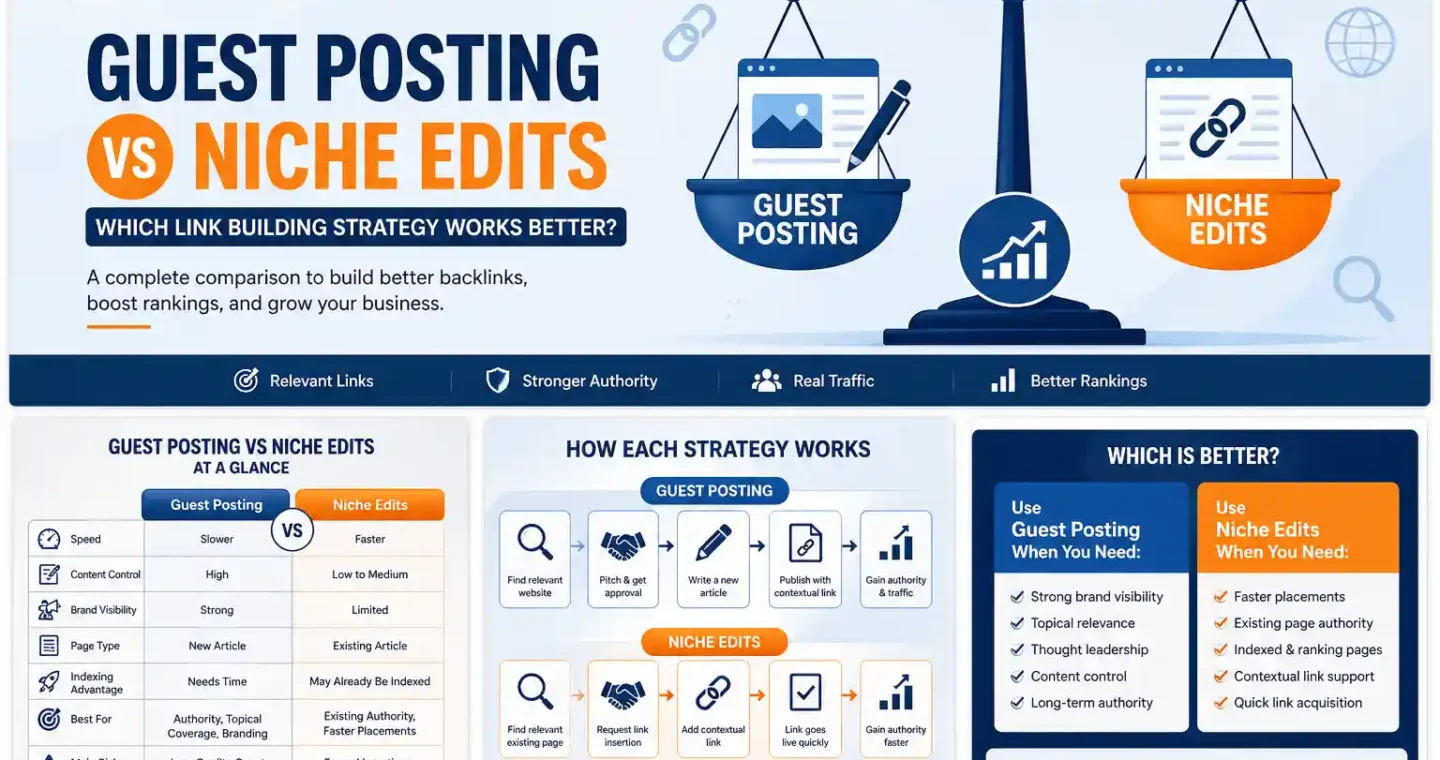
Guest posting and niche edits are two common link-building strategies. Both can work, but neither is automatically safe or effective.
Guest posting means publishing a new article on another website and adding a relevant backlink inside the content. Niche edits, also called link insertions, mean adding a backlink to an existing article that is already live, indexed, and sometimes already ranking.
The question is not which method is better in every case. The better question is which method creates a relevant, useful, and defensible backlink for your target page.
Current SEO discussions show that marketers and outreach teams are less interested in link volume and more concerned about link quality, topical relevance, anchor text risk, traffic, and whether the placement would make sense without SEO.
Quick Answer
Guest posting is usually better for brand authority, content control, and topical relevance. Niche edits are usually better for faster links from existing relevant pages.
For long-term SEO, the best link-building strategy is usually a selective mix of both. The campaign should be supported by strong target pages, natural anchors, manual quality checks, and clear risk control.
The Problem This Article Solves
Many businesses compare guest posting and niche edits only by price, DA, DR, or delivery speed. That is the wrong way to judge links.
A low-quality guest post can be useless even if it appears on a high-metric domain. A niche edit can also be risky if the link is forced into an unrelated article or added to a page that already has too many paid outbound links.
This article helps marketers, SEO specialists, outreach experts, software teams, and business managers understand when guest posting works, when niche edits work, and how to avoid link building mistakes that can waste budget or create risk.
What Is Guest Posting?
Guest posting is the process of writing and publishing a new article on another website, usually with one or more backlinks included in the content.
A guest post may link to:
- A homepage
- A service page
- A blog post
- A case study
- A tool or resource
- A research page
For example, a digital marketing business may publish an article on a marketing website about how businesses can improve search visibility. Inside that article, it may naturally link to its link building services page if the context fits.
Good guest posting is not only about backlink placement. It is a content contribution. The article should match the host website’s audience, add useful information, and include links only where they help the reader.
What Are Niche Edits?
Niche edits are backlinks inserted into existing articles.
Instead of creating a new guest post, you identify a relevant live article and request a link insertion where your page adds value.
A niche edit may appear inside:
- An existing guide
- A resource page
- A tutorial
- A listicle
- A comparison article
- A statistics post
- A relevant industry article
The appeal is speed. The page already exists. It may already be indexed. It may already have backlinks, rankings, and traffic.
The risk is context. If the link does not fit naturally, the edit can look forced.
Guest Posting vs Niche Edits: Key Differences
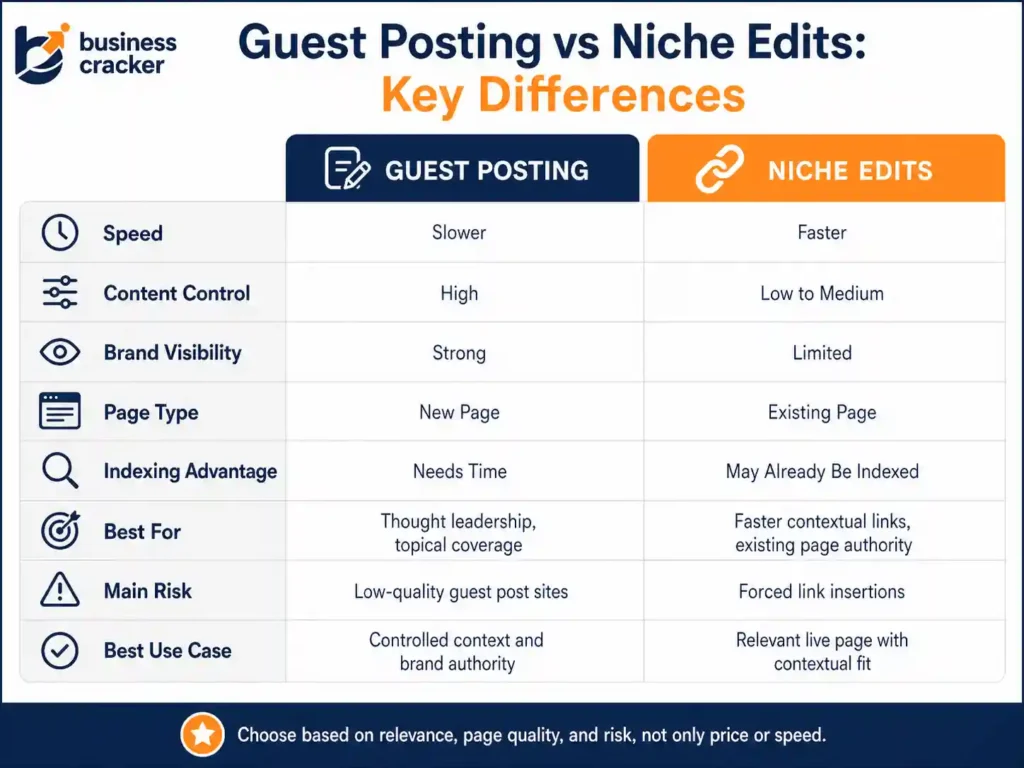
| Factor | Guest Posting | Niche Edits |
| Speed | Slower | Faster |
| Content control | High | Low to medium |
| Brand visibility | Strong | Limited |
| Page type | New page | Existing page |
| Indexing advantage | Needs time to get indexed | May already be indexed |
| Topic control | Strong | Limited by existing content |
| Best for | Thought leadership, topical coverage, brand visibility | Existing page authority, faster contextual links |
| Main risk | Generic paid guest post sites | Forced paid link insertions |
| Cost | Often higher due to content and outreach | Often faster, but strong pages can still be costly |
| Best use case | When you need controlled context and brand authority | When the existing page is relevant, indexed, and useful |
Why This Debate Matters
Backlinks still have a relationship with rankings, but quality matters more than raw volume.
Backlinko’s updated analysis of 11.8 million Google search results, last updated on April 14, 2025, found that backlinks and referring domains correlate with higher Google rankings. It also found that the number one result had an average of 3.8 times more backlinks than positions two to ten. This is a correlation study, not proof that every backlink directly improves rankings.
At the same time, Google’s spam policies define link spam as links created mainly to manipulate rankings. The policy includes buying or selling links for ranking purposes, excessive link exchanges, automated link creation, advertorials with links that pass ranking credit, and low-quality links placed in third-party content. Paid or sponsored links should be qualified with attributes like rel=”nofollow” or rel=”sponsored”.
That is why guest posting vs niche edits should not be judged only by speed or cost. The quality of the placement matters more.
Pros and Cons of Guest Posting
Pros
Guest posting gives you more control over the content. You can choose a topic that supports the target page and write the article around a clear audience need.
It also helps with brand visibility. If the website has a real readership, the article can support authority, referral traffic, and expertise.
Guest posting is also useful for building topical coverage. For example, a business offering SEO services can publish relevant articles around technical SEO, content optimization, local SEO, link building, and website audits.
Cons
Guest posting takes more time. It usually involves prospecting, outreach, pitching, content writing, editing, publishing, and link checking.
Quality also varies heavily. Many guest post websites publish unrelated content across multiple industries. These sites may have decent third-party metrics but weak editorial value.
Guest posting becomes risky when the article exists only for the backlink, uses over-optimized anchor text, or appears on a site that sells placements at scale.
Pros and Cons of Niche Edits
Pros
Niche edits are faster because the article already exists. If the page is indexed, relevant, and receiving traffic, the link may become visible to search engines and users more quickly.
They can also be useful when the target page naturally improves the existing article. For example, adding a practical guide to a resource page can be helpful if the link supports the reader’s next step.
Niche edits require less content production than guest posts.
Cons
The biggest risk is forced placement. Many niche edits are inserted into articles where the link does not belong.
You also have less control over page quality. The existing article may be outdated, thin, over-linked, or part of a paid link network.
Niche edits are weaker for brand visibility because they usually do not include author presence, original commentary, or thought leadership.
Risk Comparison
Guest posting and niche edits both carry risk when they are done mainly to manipulate rankings.
Guest posting becomes risky when:
- The website accepts unrelated guest posts
- The article is generic
- The link uses exact-match anchor text aggressively
- The website has no real traffic
- The publisher sells placements openly
- The content adds no value beyond the backlink
Niche edits become risky when:
- The link is added to an unrelated paragraph
- The page already has many commercial outbound links
- The anchor text is too aggressive
- The page is not indexed
- The website sells link insertions at scale
- The edit does not improve the article
Google does not ban the words “guest post” or “niche edit.” The issue is whether the link is created mainly to manipulate rankings and whether it passes ranking credit without proper qualification.
Quality Checklist for Guest Posts
Before approving a guest post, check the website, content, and link.
Website Quality
Ask:
- Is the website relevant to your industry?
- Does it rank for meaningful keywords?
- Does it have real organic traffic?
- Does it publish original content?
- Does it avoid unrelated categories?
- Does it have editorial standards?
- Does it look built for users, not only link sellers?
Content Quality
Ask:
- Is the article useful?
- Is the topic relevant to the host site?
- Does the article add practical value?
- Is the writing clear and specific?
- Would the article make sense without your backlink?
Link Quality
Ask:
- Is the backlink contextual?
- Does the anchor text fit naturally?
- Is the target page relevant?
- Is the link placed inside the main content?
- Are there too many outbound links on the page?
A guest post should pass all three checks. A high domain metric alone is not enough.
Quality Checklist for Niche Edits
Niche edits should be checked at the page level, not only the domain level.
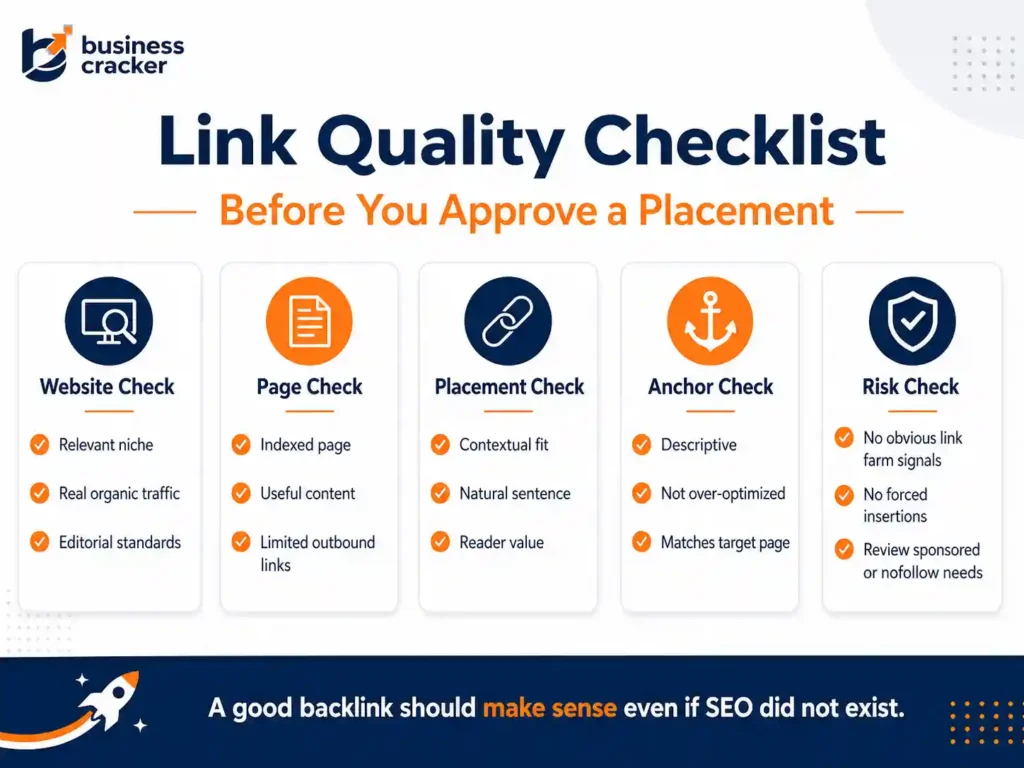
Page Quality
Ask:
- Is the page indexed?
- Does the page receive organic traffic?
- Is the topic relevant to your target URL?
- Is the article still accurate?
- Does the page already have backlinks?
- Are outbound links natural and limited?
- Has the article been overloaded with link insertions?
Placement Quality
Ask:
- Does the sentence read naturally?
- Does the link improve the article?
- Is the anchor text descriptive but not aggressive?
- Is the surrounding paragraph relevant?
- Would a real reader click the link?
Risk Quality
Ask:
- Does the site sell niche edits at scale?
- Does the article link to unrelated commercial pages?
- Has the domain lost visibility recently?
- Does the page look edited only for paid links?
- Would this placement make sense without SEO?
If the answer is no, avoid the placement.
Which Strategy Should You Choose?
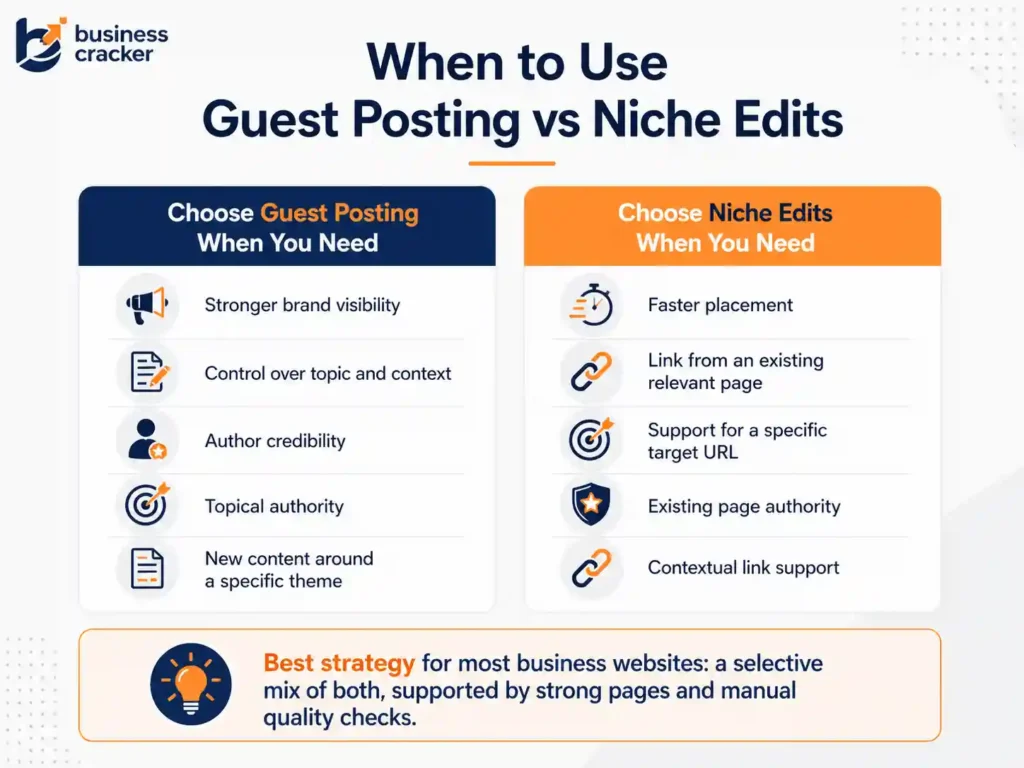
Choose guest posting when you need:
- Stronger brand visibility
- Control over topic and context
- Author credibility
- Topical authority
- A new article around a specific theme
- A placement that supports both SEO and audience reach
Choose niche edits when you need:
- Faster placement
- A link from an existing relevant page
- Support for a specific target URL
- A placement inside an article that already has search value
- A contextual link that improves the existing content
Use both when you have:
- Strong target pages
- Clear anchor text rules
- Manual website review
- A balanced backlink profile
- A mix of brand, URL, partial-match, and natural anchors
- A process for checking link quality after publication
Avoid both when the only reason to approve the link is that it is cheap. For niche edit support, contact the Business Cracker team.
Recommended Link Building Strategy
For most business websites, the best approach is not guest posting or niche edits alone. It is a balanced link-building strategy.
Start with the website first.
Before building links, check:
- Is the target page indexable?
- Does the page satisfy search intent?
- Does it have a clear title and H1?
- Is the content useful?
- Are internal links in place?
- Is the page technically clean?
- Can the page convert visitors?
Then choose the link type.
Use guest posts to build brand authority and controlled topical coverage.
Use niche edits only when the existing page is relevant, indexed, and strong enough to justify the placement.
Use internal links to distribute value from blogs and linkable assets to commercial pages.
Track quality, not only quantity.
A proper link report should include:
- Linking domain
- Linking page
- Target URL
- Anchor text
- Link type
- Relevance
- Page quality
- Indexing status
- Placement notes
- Risk notes
A report that says “10 links built” is not enough. It should explain why those links were worth building.
Common Mistakes to Avoid
Choosing Sites Only by DA or DR
Third-party authority metrics can help filter sites, but they are not final proof of quality. A high-metric website can still have weak traffic, unrelated content, and poor outbound link patterns.
Using Exact-Match Anchors Too Often
Repeated commercial anchors create an unnatural pattern. Use branded, URL, partial-match, and natural anchors.
Ignoring Page Relevance
A link from a relevant, smaller website can be stronger than a link from a large but unrelated website.
Building Links to Weak Pages
Backlinks cannot fully fix a poor target page. Improve content, technical setup, internal links, and conversion path first.
Approving Forced Niche Edits
If the link looks inserted only for SEO, it is usually not a strong placement.
FAQs
Are niche edits safe for SEO?
Niche edits can be safe when the existing page is relevant, indexed, editorially reviewed, and the link genuinely improves the content. They become risky when links are inserted unnaturally, placed on unrelated pages, or sold at scale without quality control.
Are guest posts still good for backlinks?
Guest posts can still be useful when they are published on relevant websites with real audiences and editorial standards. Low-quality paid guest post networks are risky because they often publish generic content with commercial anchor text.
Which is cheaper: guest posts or niche edits?
Niche edits are often faster and may be cheaper because no full article is required. However, strong placements on relevant pages can still be expensive. Cost should be judged against relevance, traffic, page quality, link placement, and risk.
Should I use guest posting or niche edits for a new website?
For a new website, guest posting is often better because it builds visibility, topical relevance, and brand credibility. Niche edits can be added later when you have a clearer process for evaluating page quality and anchor text risk.
Can paid guest posts violate Google’s policies?
Yes. Paid links intended to pass ranking credit can violate Google’s link spam policy unless they are properly qualified with attributes such as rel=”nofollow” or rel=”sponsored”. This applies to paid posts, advertorials, and links with optimized anchor text when payment is involved.
Final Verdict
Guest posting is usually stronger for brand visibility, content control, and topical authority. Niche edits are usually stronger for faster placement on existing relevant pages.
Neither tactic is automatically better. The winning choice depends on the website, target URL, page quality, anchor text, and risk level.
If you are investing in backlinks, start with a backlink quality audit and a target-page review. Build links only to pages that are technically clean, useful, indexable, and supported by internal links.